Periodic Table and Periodicity in Properties — Flashcards
NIOS · Class 12 · Chemistry
30 flashcards for Periodic Table and Periodicity in Properties (NIOS Class 12 Chemistry) to test yourself on key terms and facts.
Interactive on Super Tutor
Studying Periodic Table and Periodicity in Properties? Get the full interactive chapter.
Quizzes, flashcards, AI doubt-solver and a step-by-step study plan — built for flashcards and more.
Free trial, no card needed.
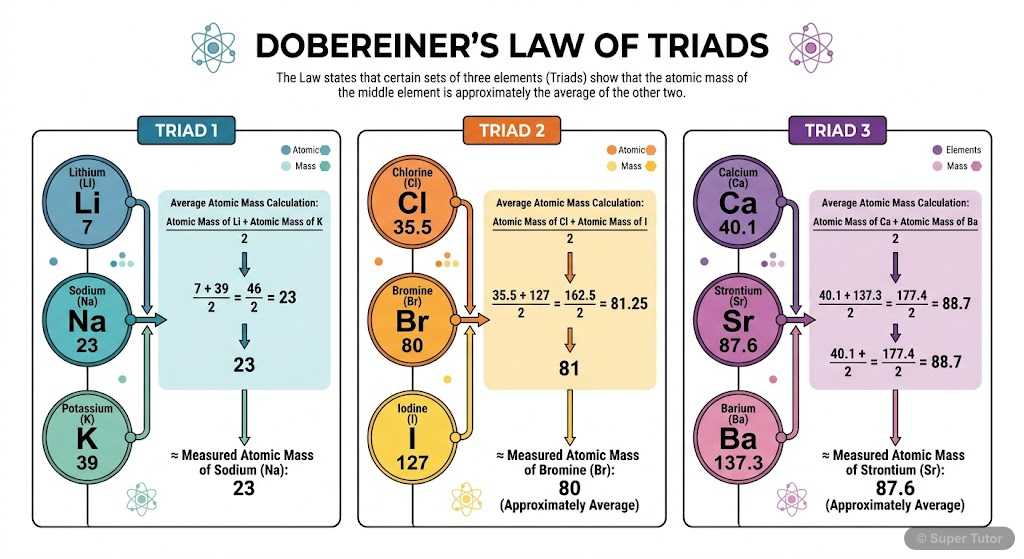
One of 16 illustrations for Periodic Table and Periodicity in Properties in Super Tutor — alongside flashcards, concept maps and practice questions.
What is Dobereiner's Law of Triads? Provide an example.
Answer
Dobereiner's Law of Triads (1817) states that when three closely related elements are grouped together, the atomic weight of the middle element is approximately the arithmetical mean of the other two.
State Newlands' Law of Octaves and explain why it failed.
Answer
Newlands' Law of Octaves (1863): When elements are arranged in order of increasing atomic weight, every eighth element has similar properties, like musical notes repeating in octaves. WHY IT FAILED: T…
What was Mendeleev's greatest contribution to the periodic table?
Answer
Mendeleev's greatest contribution (1869) was: (1) Arranging elements by INCREASING ATOMIC WEIGHT and demonstrating periodic recurrence of properties. (2) LEAVING GAPS for undiscovered elements (Sc, Ga…
Define the Modern Periodic Law and state who discovered atomic number.
Answer
MODERN PERIODIC LAW (discovered 1913 by Moseley): The physical and chemical properties of elements are periodic functions of their ATOMIC NUMBERS (not atomic weights). Moseley used X-ray spectroscopy …
What are the structural features of the modern periodic table? List periods and groups.
Answer
STRUCTURAL FEATURES of the Modern Long-form Periodic Table: • PERIODS: 7 horizontal rows (Period 1-7). Period 1 has 2 elements, Periods 2-3 have 8 elements each (short periods), Periods 4-5 have 18 el…
Explain the classification of elements into s, p, d, and f blocks with examples.
Answer
Elements are classified into BLOCKS based on the ORBITAL where the differentiating electron (last electron) enters: • s-BLOCK: Differentiating electron enters s-orbital. Groups 1-2. Examples: Li, Na,…
Write the IUPAC systematic name for element with atomic number 112 according to the nomenclature system.
Answer
IUPAC NOMENCLATURE for elements with At. no. > 103: Numerical roots for digits 0-9: 0=nil, 1=un, 2=bi, 3=tri, 4=quad, 5=pent, 6=hex, 7=sept, 8=oct, 9=enn For At. no. 112: Break into digits: 1-1-2 1 =…
How does atomic size vary across a period and down a group? Explain the reasons.
Answer
ATOMIC SIZE VARIATION: ACROSS A PERIOD (Left to Right): Atomic size DECREASES Reason: As we move left to right, the number of protons in the nucleus increases, creating stronger nuclear charge. Elect…
+22 more flashcards
Practise AllFrequently Asked Questions
What are the important topics in Periodic Table and Periodicity in Properties for NIOS Class 12 Chemistry?
How many flashcards are available for Periodic Table and Periodicity in Properties?
How should I revise Periodic Table and Periodicity in Properties for the NIOS Class 12 board exam?
Sources & Official References
Content is aligned to the official syllabus. Refer to the board website for the latest curriculum.
More resources for Periodic Table and Periodicity in Properties
For serious students
Get the full Periodic Table and Periodicity in Properties chapter — start free.
Quizzes, flashcards, an AI doubt solver and a study plan for NIOS Class 12 Chemistry. Free to start, no card needed.