Periodic Table and Periodicity in Properties — Chapter Summary
NIOS · Class 12 · Chemistry
Summary of Periodic Table and Periodicity in Properties for NIOS Class 12 Chemistry. Part of the NIOS Class 12 Chemistry syllabus.
Interactive on Super Tutor
Studying Periodic Table and Periodicity in Properties? Get the full interactive chapter.
Quizzes, flashcards, AI doubt-solver and a step-by-step study plan — built for chapter summary and more.
Free trial, no card needed.
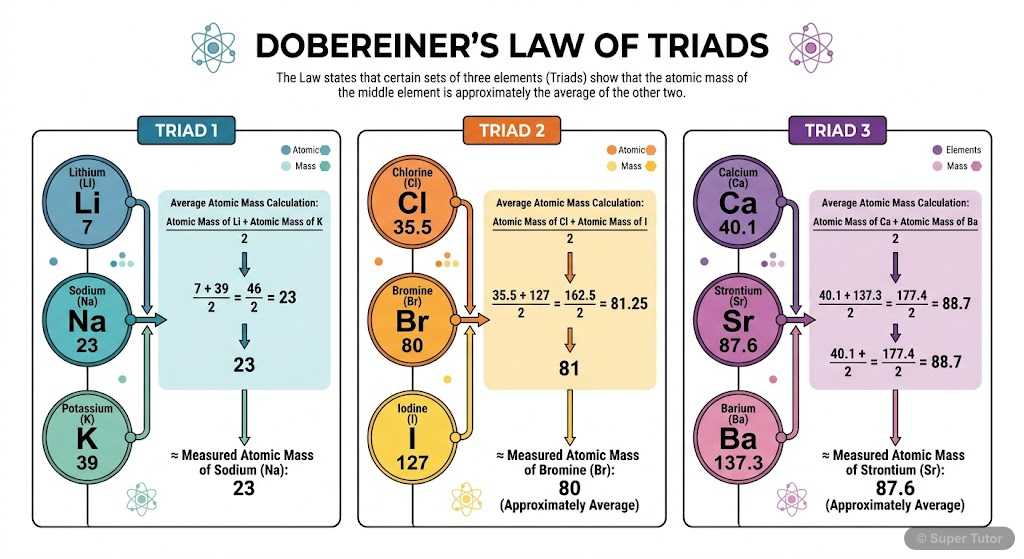
One of 16 illustrations for Periodic Table and Periodicity in Properties in Super Tutor — alongside flashcards, concept maps and practice questions.
Overview
The periodic table is one of the most important tools in chemistry, organizing all known elements in a systematic way. Just as organizing items in a shop makes them easy to find, organizing elements helps us understand their properties and predict how they will behave. This chapter explores how the
Key Concepts
Dobereiner discovered that certain elements could
Dobereiner discovered that certain elements could be grouped in sets of three (triads) where the atomic weight of the middle element was approximately
John Newlands arranged elements in order
John Newlands arranged elements in order of increasing atomic weight and observed that every eighth element had similar properties, like the musical o
Dmitri Mendeleev arranged elements by increasing
Dmitri Mendeleev arranged elements by increasing atomic weight and created a table where elements with similar properties fell into vertical columns (
In 1913
In 1913, Moseley discovered the concept of atomic number through X-ray spectroscopy. He showed that when elements are arranged by atomic number (the n
The modern periodic table perfectly matches
The modern periodic table perfectly matches the filling of electron orbitals. As you move across a period from left to right, electrons are added to t
Learning Objectives
- Understand the need for classification of elements and appreciate early attempts at classification
- Know the development of the periodic table from Mendeleev to the modern periodic table
- Understand the modern periodic law based on atomic number
- Learn the structure of the long form of periodic table with 18 groups and 7 periods
- Classify elements into s-, p-, d-, and f-blocks based on electron configuration
Frequently Asked Questions
What are the important topics in Periodic Table and Periodicity in Properties for NIOS Class 12 Chemistry?
How should I revise Periodic Table and Periodicity in Properties for the NIOS Class 12 board exam?
Sources & Official References
Content is aligned to the official syllabus. Refer to the board website for the latest curriculum.
More resources for Periodic Table and Periodicity in Properties
For serious students
Get the full Periodic Table and Periodicity in Properties chapter — start free.
Quizzes, flashcards, an AI doubt solver and a study plan for NIOS Class 12 Chemistry. Free to start, no card needed.