Chemical Bonding — Flashcards
NIOS · Class 12 · Chemistry
35 flashcards for Chemical Bonding (NIOS Class 12 Chemistry) to test yourself on key terms and facts. Sample: "What are valence electrons and why are they"
Interactive on Super Tutor
Studying Chemical Bonding? Get the full interactive chapter.
Quizzes, flashcards, AI doubt-solver and a step-by-step study plan — built for flashcards and more.
Free trial, no card needed.
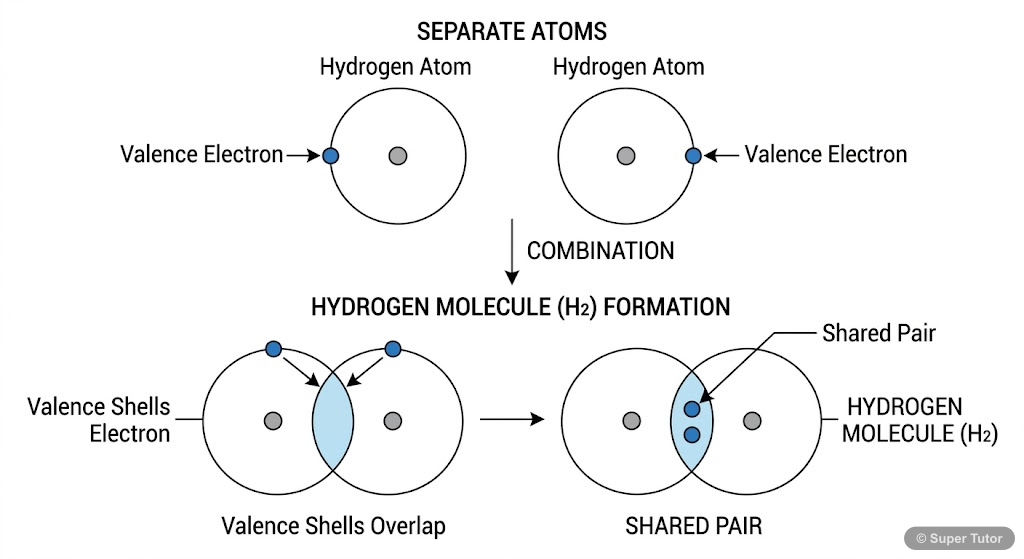
Learn better with visuals Super Tutor pairs illustrations like this with notes and quizzes for Chemical Bonding.
What are valence electrons and why are they important in chemical bonding?
Answer
Valence electrons are electrons in the outermost shell (valence shell) of an atom. They are crucial because: (1) They determine the combining capacity or valency of an atom, (2) They participate direc…
Define a chemical bond and explain how it forms in terms of energy changes.
Answer
A chemical bond is an attractive force that holds atoms together in a molecule. Definition: When two atoms approach each other, the energy of the combined system becomes less than the sum of energies …
Explain Kossel's theory of ionic bond formation using the NaCl example.
Answer
Kossel's Theory: Atoms achieve stable noble gas configuration by losing or gaining electrons. For NaCl formation: Na (2,8,1) loses 1 electron → Na⁺ (2,8 - like Ne). Cl (2,8,7) gains 1 electron → Cl⁻ (…
What is the Born-Haber cycle and why is it important for understanding ionic compound formation?
Answer
Born-Haber Cycle: A thermochemical cycle that breaks down ionic compound formation into individual steps. For NaCl(s): (1) Na(s) → Na(g), ΔH = 108.7 kJ/mol (sublimation), (2) Na(g) → Na⁺(g) + e⁻, ΔH =…
What factors favor the formation of ionic compounds according to Born-Haber analysis?
Answer
Three key factors favor ionic compound formation: (1) Low ionization energy of the metal - easier to remove electrons from metal atoms. (2) High electron affinity of the non-metal - non-metal strongly…
List and explain the characteristic properties of ionic compounds.
Answer
Characteristics of Ionic Compounds: (1) Crystalline solids - ions arranged in regular 3D structure at room temperature. (2) Hard and brittle - strong electrostatic forces, but break when stressed due …
Explain Lewis's theory of covalent bonding and how it differs from Kossel's theory.
Answer
Lewis's Theory: Atoms achieve stable noble gas configuration by SHARING electron pairs (not transferring). Each atom contributes one electron to the shared pair. Example: H· + ·H → H:H (two electrons …
What is a Lewis structure (electron-dot structure)? Draw Lewis structures for O₂ and N₂.
Answer
Lewis Structure: Representation using dots around element symbol to show valence electrons. Rules: (1) Each element symbol represents nucleus + inner electrons. (2) Dots represent valence electrons. (…
+27 more flashcards
Practise AllFrequently Asked Questions
What are the important topics in Chemical Bonding for NIOS Class 12 Chemistry?
How many flashcards are available for Chemical Bonding?
How should I revise Chemical Bonding for the NIOS Class 12 board exam?
Sources & Official References
Content is aligned to the official syllabus. Refer to the board website for the latest curriculum.
More resources for Chemical Bonding
Practice Quiz
Test yourself with a quick quiz
Important Questions
Exam-style questions with answers
Revision Notes
Key points for last-minute revision
Formula Sheet
The chapter's formulas in one place
Chapter Summary
Understand the chapter at a glance
Concept Maps
See how topics connect
Syllabus
What topics to cover
For serious students
Get the full Chemical Bonding chapter — start free.
Quizzes, flashcards, an AI doubt solver and a study plan for NIOS Class 12 Chemistry. Free to start, no card needed.