Chemical Bonding — Chapter Summary
NIOS · Class 12 · Chemistry
Summary of Chemical Bonding for NIOS Class 12 Chemistry. Part of the NIOS Class 12 Chemistry syllabus. Chemical bonding is the fundamental concept that.
Interactive on Super Tutor
Studying Chemical Bonding? Get the full interactive chapter.
Quizzes, flashcards, AI doubt-solver and a step-by-step study plan — built for chapter summary and more.
Free trial, no card needed.
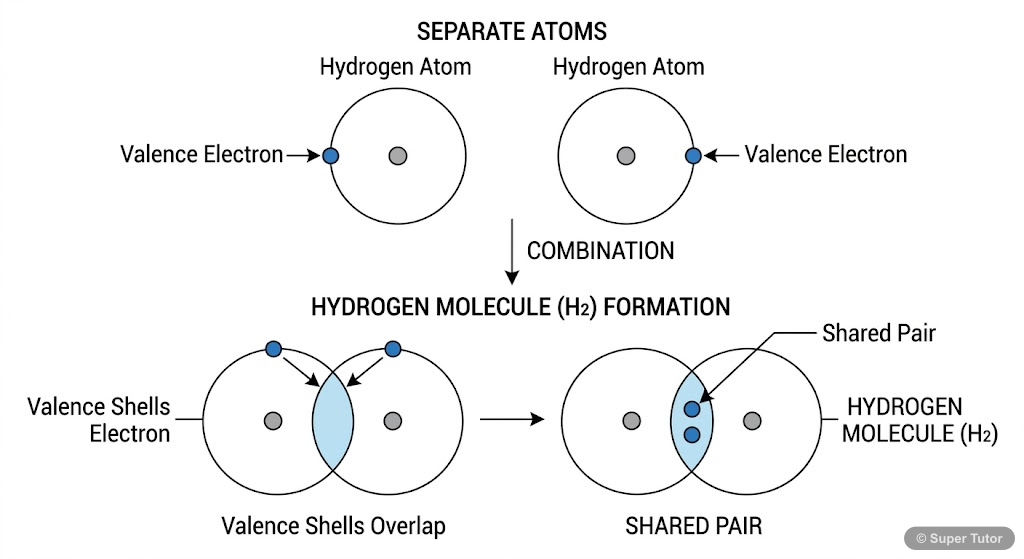
Learn better with visuals Super Tutor pairs illustrations like this with notes and quizzes for Chemical Bonding.
Overview
Chemical bonding is the fundamental concept that explains how atoms combine to form molecules and compounds. When atoms come together, they achieve lower energy states by losing, gaining, or sharing electrons. This chapter explores why atoms bond, the different types of bonds (ionic, covalent, coord
Key Concepts
Valence electrons are the electrons
Valence electrons are the electrons in the outermost shell of an atom. These electrons determine an atom's combining capacity (valency) and are respon
An ionic bond forms when one
An ionic bond forms when one atom transfers electrons to another atom, creating oppositely charged ions held together by electrostatic attraction. Thi
A covalent bond forms when two
A covalent bond forms when two atoms share a pair of electrons. Unlike ionic bonding, both atoms contribute one electron each to the shared pair. Lewi
A coordinate covalent bond forms when
A coordinate covalent bond forms when both electrons of a shared pair are contributed by one atom (the donor) to another atom (the acceptor). The acce
Bond polarity arises when two bonded
Bond polarity arises when two bonded atoms have different electronegativities, causing unequal sharing of electrons. The more electronegative atom pul
Learning Objectives
- Explain the formation of chemical bonds using potential energy diagrams and the octet rule
- Distinguish between ionic, covalent, and coordinate covalent bonds with appropriate examples
- Understand Lewis dot structures and their application in representing molecular bonding
- Analyze bond polarity, electronegativity differences, and dipole moments
- Apply VSEPR theory to predict molecular shapes and geometries
Frequently Asked Questions
What are the important topics in Chemical Bonding for NIOS Class 12 Chemistry?
How should I revise Chemical Bonding for the NIOS Class 12 board exam?
Sources & Official References
Content is aligned to the official syllabus. Refer to the board website for the latest curriculum.
More resources for Chemical Bonding
For serious students
Get the full Chemical Bonding chapter — start free.
Quizzes, flashcards, an AI doubt solver and a study plan for NIOS Class 12 Chemistry. Free to start, no card needed.