Chemical Bonding — Concept Maps
NIOS · Class 12 · Chemistry
3 concept maps of Chemical Bonding for NIOS Class 12 Chemistry, each also written out as a text outline. Part of the NIOS Class 12 Chemistry syllabus.
Interactive on Super Tutor
Studying Chemical Bonding? Get the full interactive chapter.
Quizzes, flashcards, AI doubt-solver and a step-by-step study plan — built for concept maps and more.
Free trial, no card needed.
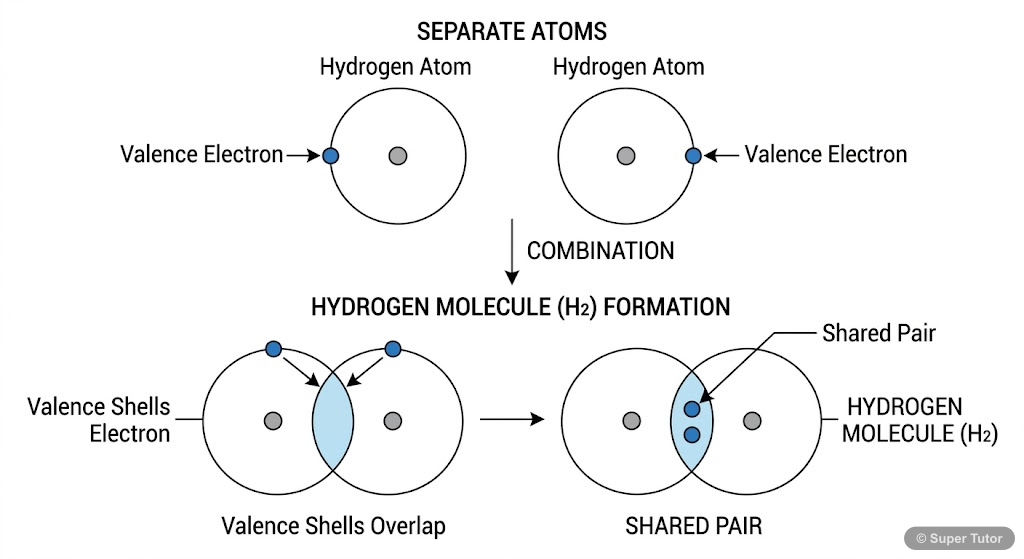
Learn better with visuals Super Tutor pairs illustrations like this with notes and quizzes for Chemical Bonding.
Chemical Bonding Concepts Overview
The map in words
- Chemical Bonding
- Ionic Bonding
- Kossel Theory
- Electron Transfer
- Noble Gas Configuration
- Born Haber Cycle
- Sublimation
- Ionization Energy
- Electron Affinity
- Lattice Energy
- Properties
- High Melting Point
- Conduct When Molten
- Soluble in Water
- Kossel Theory
- Covalent Bonding
- Lewis Theory
- Electron Sharing
- Octet Rule
- Types
- Single Bond
- Double Bond
- Triple Bond
- Coordinate Bond
- Bond Parameters
- Bond Order
- Bond Length
- Bond Angle
- Bond Enthalpy
- Molecular Geometry
- VSEPR Theory
- Hybridization
- Lewis Theory
- Hydrogen Bonding
- Between N,O,F and H
- Intermolecular
- Intramolecular
- Bonding Theories
- Valence Bond Theory
- Orbital Overlap
- Sigma and Pi Bonds
- Molecular Orbital Theory
- LCAO Method
- Bonding Orbitals
- Antibonding Orbitals
- Valence Bond Theory
- Special Concepts
- Electronegativity
- Dipole Moment
- Resonance
- Polarization
- Ionic Bonding
Mind map showing the relationship between valence electrons, the octet rule, and atomic stability
The map in words
- Valence Electrons
- Definition
- Electrons in outermost shell
- Determine bonding capacity
- Octet Rule
- 8 electrons in valence shell
- 2 electrons for He
- Achieve noble gas configuration
- Stability
- Noble gases are unreactive
- Complete valence shells
- Maximum stability
- Definition
Mind map classifying different types of chemical bonds and their characteristics
The map in words
- Chemical Bonds
- Ionic Bond
- Electron transfer
- Electrostatic attraction
- Between metal and nonmetal
- Covalent Bond
- Electron sharing
- Between nonmetals
- Localized bonding
- Coordinate Bond
- Donor-acceptor bond
- Both e⁻ from one atom
- Special covalent bond
- Hydrogen Bond
- H with N, O, or F
- Intermolecular force
- Weak but significant
- Ionic Bond
Explore these maps interactively
Explore DiagramsFrequently Asked Questions
What are the important topics in Chemical Bonding for NIOS Class 12 Chemistry?
What do the concept maps for Chemical Bonding show?
How should I revise Chemical Bonding for the NIOS Class 12 board exam?
Sources & Official References
Content is aligned to the official syllabus. Refer to the board website for the latest curriculum.
More resources for Chemical Bonding
Practice Quiz
Test yourself with a quick quiz
Important Questions
Exam-style questions with answers
Revision Notes
Key points for last-minute revision
Formula Sheet
The chapter's formulas in one place
Chapter Summary
Understand the chapter at a glance
Flashcards
Quick-fire cards for active recall
Syllabus
What topics to cover
For serious students
Get the full Chemical Bonding chapter — start free.
Quizzes, flashcards, an AI doubt solver and a study plan for NIOS Class 12 Chemistry. Free to start, no card needed.