Acids, Bases and Salts — Concept Maps
Punjab Board · Class 10 · Science
3 concept maps of Acids, Bases and Salts for Punjab Board Class 10 Science, each also written out as a text outline.
Interactive on Super Tutor
Studying Acids, Bases and Salts? Get the full interactive chapter.
Quizzes, flashcards, AI doubt-solver and a step-by-step study plan — built for concept maps and more.
Free trial, no card needed.
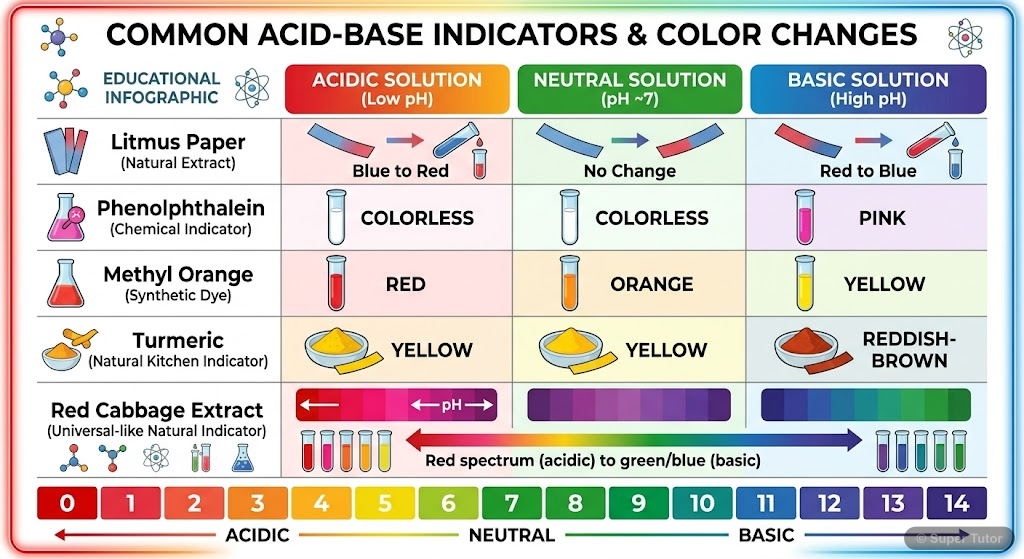
One of 14 illustrations for Acids, Bases and Salts in Super Tutor — alongside flashcards, concept maps and practice questions.
Acids, Bases and Salts - Concept Overview
The map in words
- Acids Bases Salts
- Acids
- Sour taste
- Turn blue litmus red
- Produce H+ ions
- React with metals
- React with carbonates
- Bases
- Bitter taste
- Turn red litmus blue
- Produce OH- ions
- React with acids
- Basic oxides react with acids
- Salts
- Formed by acid-base reaction
- Neutral pH = 7
- Acidic pH less than 7
- Basic pH greater than 7
- Water of crystallization
- pH Scale
- 0-7 Acidic
- 7 Neutral
- 7-14 Basic
- Measured with indicators
- Universal indicator paper
- Indicators
- Visual indicators
- Litmus paper
- Phenolphthalein
- Methyl orange
- Olfactory indicators
- Common Salt Uses
- Chlor-alkali process
- Sodium hydroxide
- Bleaching powder
- Baking soda
- Washing soda
- Acids
Acids, Bases and Salts – Chapter Overview Mind Map
The map in words
- Acids Bases and Salts
- Indicators
- Natural
- Litmus
- Turmeric
- Red Cabbage
- Synthetic
- Phenolphthalein
- Methyl Orange
- Olfactory
- Onion
- Clove Oil
- Vanilla
- Natural
- Chemical Properties
- Acid plus Metal
- Salt plus H2 gas
- Acid plus Carbonate
- Salt plus H2O plus CO2
- Acid plus Base
- Neutralisation
- Salt plus Water
- Metal Oxide plus Acid
- Basic Oxides
- Non-metal Oxide plus Base
- Acidic Oxides
- Acid plus Metal
- Ions in Solution
- Acids produce H3O plus
- Bases produce OH minus
- Water needed for ionisation
- Dilution reduces ion concentration
- pH Scale
- 0 to 6 Acidic
- 7 Neutral
- 8 to 14 Basic
- Daily Life pH
- Tooth Decay below 5.5
- Acid Rain below 5.6
- Stomach HCl
- Blood pH 7.4
- Salts
- Families of Salts
- pH of Salts
- Water of Crystallisation
- CuSO4 5H2O Blue
- Na2CO3 10H2O Washing Soda
- CaSO4 2H2O Gypsum
- Chemicals from NaCl
- Chlor Alkali Process
- NaOH
- Cl2
- H2
- Bleaching Powder CaOCl2
- Baking Soda NaHCO3
- Washing Soda Na2CO3 10H2O
- Plaster of Paris
- Chlor Alkali Process
- Indicators
Flow diagram showing how indicators react to acidic, basic, and neutral solutions
The map in words
- Indicator Solution
- Acidic?
- Yes: Red Litmus Paper Changes Blue
- No: Basic?
- Yes: Blue Litmus Paper Changes Red
- No: Neutral Solution No Color Change
- Acidic?
Explore these maps interactively
Explore DiagramsFrequently Asked Questions
What are the important topics in Acids, Bases and Salts for Punjab Board Class 10 Science?
What do the concept maps for Acids, Bases and Salts show?
How should I revise Acids, Bases and Salts for the Punjab Board Class 10 board exam?
Sources & Official References
Content is aligned to the official syllabus. Refer to the board website for the latest curriculum.
More resources for Acids, Bases and Salts
Practice Quiz
Test yourself with a quick quiz
Important Questions
Exam-style questions with answers
Revision Notes
Key points for last-minute revision
Formula Sheet
The chapter's formulas in one place
Chapter Summary
Understand the chapter at a glance
Flashcards
Quick-fire cards for active recall
Syllabus
What topics to cover
For serious students
Get the full Acids, Bases and Salts chapter — start free.
Quizzes, flashcards, an AI doubt solver and a study plan for Punjab Board Class 10 Science. Free to start, no card needed.