Acids, Bases and Salts — Chapter Summary
Punjab Board · Class 10 · Science
Summary of Acids, Bases and Salts for Punjab Board Class 10 Science. Part of the Punjab Board Class 10 Science syllabus.
Interactive on Super Tutor
Studying Acids, Bases and Salts? Get the full interactive chapter.
Quizzes, flashcards, AI doubt-solver and a step-by-step study plan — built for chapter summary and more.
Free trial, no card needed.
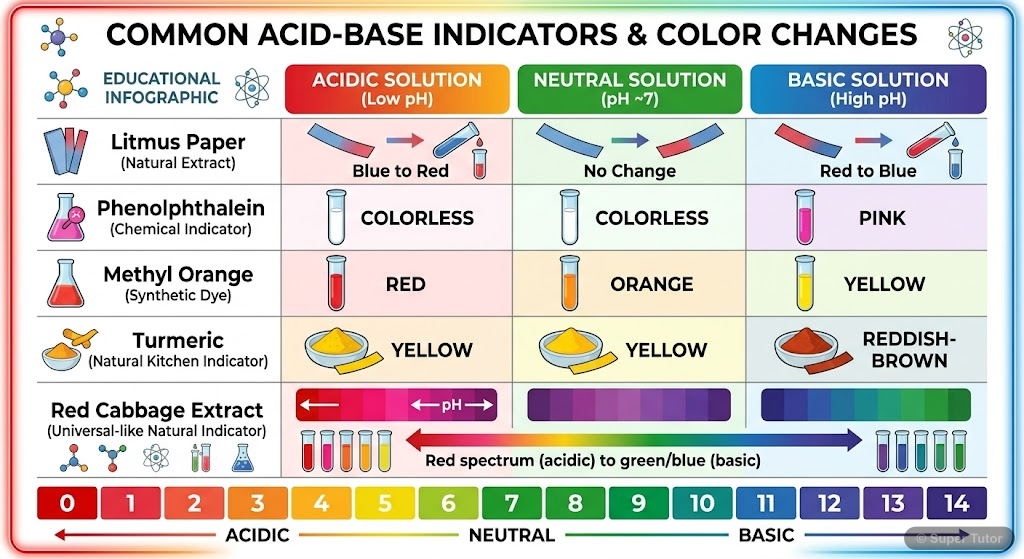
One of 14 illustrations for Acids, Bases and Salts in Super Tutor — alongside flashcards, concept maps and practice questions.
Overview
Acids, bases and salts are three fundamental categories of chemical compounds that play crucial roles in everyday life and numerous industrial processes. This chapter explores the chemical properties of acids and bases, their reactions with various substances, the concept of pH scale, and the format
Key Concepts
Acids are chemical compounds that produce
Acids are chemical compounds that produce hydrogen ions (H⁺) or hydronium ions (H₃O⁺) when dissolved in water. Common acids include hydrochloric acid
Bases are chemical compounds that produce
Bases are chemical compounds that produce hydroxide ions (OH⁻) when dissolved in water. Examples include sodium hydroxide (NaOH), calcium hydroxide [C
Indicators are substances that change colour
Indicators are substances that change colour in the presence of acids or bases. Natural indicators include litmus (a purple dye from lichen that turns
The pH scale is a numerical
The pH scale is a numerical scale ranging from 0 to 14 that measures the concentration of hydrogen ions (H⁺ or H₃O⁺) in a solution. pH = 7 indicates a
A neutralisation reaction occurs when
A neutralisation reaction occurs when an acid reacts with a base to produce a salt and water. The general equation is: Acid + Base → Salt + Water. At
Learning Objectives
- Understand the chemical properties of acids and bases through practical experiments
- Learn how acids and bases react with metals, carbonates, and each other
- Identify the common ions present in acidic and basic solutions
- Understand and use the pH scale to measure the strength of acids and bases
- Learn about neutralisation reactions and their importance
Frequently Asked Questions
What are the important topics in Acids, Bases and Salts for Punjab Board Class 10 Science?
How should I revise Acids, Bases and Salts for the Punjab Board Class 10 board exam?
Sources & Official References
Content is aligned to the official syllabus. Refer to the board website for the latest curriculum.
More resources for Acids, Bases and Salts
For serious students
Get the full Acids, Bases and Salts chapter — start free.
Quizzes, flashcards, an AI doubt solver and a study plan for Punjab Board Class 10 Science. Free to start, no card needed.