Acids, Bases and Salts — Flashcards
Punjab Board · Class 10 · Science
31 flashcards for Acids, Bases and Salts (Punjab Board Class 10 Science) to test yourself on key terms and facts.
Interactive on Super Tutor
Studying Acids, Bases and Salts? Get the full interactive chapter.
Quizzes, flashcards, AI doubt-solver and a step-by-step study plan — built for flashcards and more.
Free trial, no card needed.
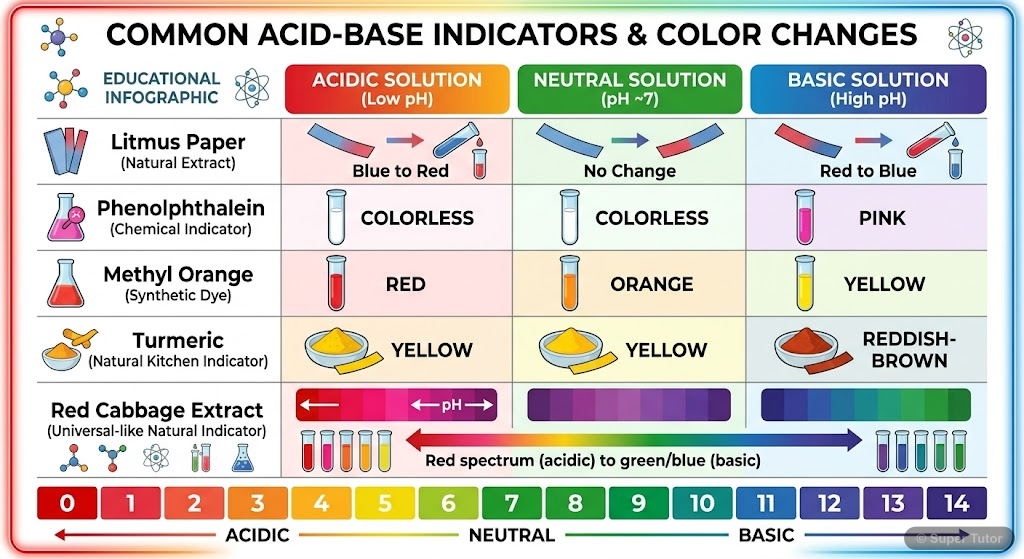
One of 14 illustrations for Acids, Bases and Salts in Super Tutor — alongside flashcards, concept maps and practice questions.
What would you suggest as a remedy for acidity—lemon juice, vinegar, or baking soda solution? Why?
Answer
You should suggest BAKING SODA SOLUTION. Reason: Acidity is caused by excess acid in the stomach. Baking soda (sodium hydrogencarbonate, NaHCO₃) is a base that neutralizes the excess acid through a ne…
You have three test tubes: one with distilled water, one with acidic solution, and one with basic solution. You only have red litmus paper. How will you identify each one?
Answer
Step 1: Test with red litmus paper on all three. Step 2: The one where red litmus turns BLUE = basic solution (base turns red litmus blue). Step 3: The ones where red litmus remains RED = either acidi…
Why does curd and other sour substances not be kept in brass and copper vessels?
Answer
Acids in curd (lactic acid) react with copper and brass (copper alloy) to form toxic copper compounds that contaminate the food and can cause poisoning. The reaction is: Cu + 2CH₃COOH → Cu(CH₃COO)₂ + …
When zinc granules are added to dilute sulphuric acid, what gas is produced and how can you test for it?
Answer
Gas produced: HYDROGEN GAS (H₂). Reaction: Zn(s) + H₂SO₄(aq) → ZnSO₄(aq) + H₂(g). Testing for hydrogen: 1) Collect gas in a test tube, 2) Bring a burning candle near the mouth of the test tube, 3) If …
A metal compound A reacts with dilute hydrochloric acid producing effervescence, and the evolved gas extinguishes a burning candle. What can you conclude about compound A?
Answer
Compound A is a METAL CARBONATE. Conclusion: The effervescence indicates CO₂ gas evolution. The gas extinguishing a candle confirms it's CO₂ (not H₂, which would pop). Example: If compound formed is C…
Explain the experimental setup and observations when passing carbon dioxide through lime water.
Answer
Setup: Bubble CO₂ gas through calcium hydroxide solution (lime water). Observations: Stage 1: Initial CO₂ + Ca(OH)₂ → CaCO₃ (white precipitate): CO₂(g) + Ca(OH)₂(aq) → CaCO₃(s) + H₂O(l). Solution turn…
What is the difference between HCl gas and HCl solution in terms of acidic properties?
Answer
HCl GAS: Does NOT show acidic properties. Dry HCl gas does NOT change the color of dry litmus paper because H⁺ ions are not produced without water. HCl SOLUTION (in water): SHOWS acidic properties. HC…
Why does dry HCl gas not conduct electricity, but HCl solution does?
Answer
DRY HCl GAS: Does not conduct electricity because no free ions are present. HCl molecules are covalent and do not ionize without water. NO CHARGE CARRIERS = NO ELECTRICAL CONDUCTIVITY. HCl SOLUTION: C…
+23 more flashcards
Practise AllFrequently Asked Questions
What are the important topics in Acids, Bases and Salts for Punjab Board Class 10 Science?
How many flashcards are available for Acids, Bases and Salts?
How should I revise Acids, Bases and Salts for the Punjab Board Class 10 board exam?
Sources & Official References
Content is aligned to the official syllabus. Refer to the board website for the latest curriculum.
More resources for Acids, Bases and Salts
Practice Quiz
Test yourself with a quick quiz
Important Questions
Exam-style questions with answers
Revision Notes
Key points for last-minute revision
Formula Sheet
The chapter's formulas in one place
Chapter Summary
Understand the chapter at a glance
Concept Maps
See how topics connect
Syllabus
What topics to cover
For serious students
Get the full Acids, Bases and Salts chapter — start free.
Quizzes, flashcards, an AI doubt solver and a study plan for Punjab Board Class 10 Science. Free to start, no card needed.