Chemical Reactions and Equations — Concept Maps
Punjab Board · Class 10 · Science
2 concept maps of Chemical Reactions and Equations for Punjab Board Class 10 Science, each also written out as a text outline.
Interactive on Super Tutor
Studying Chemical Reactions and Equations? Get the full interactive chapter.
Quizzes, flashcards, AI doubt-solver and a step-by-step study plan — built for concept maps and more.
Free trial, no card needed.
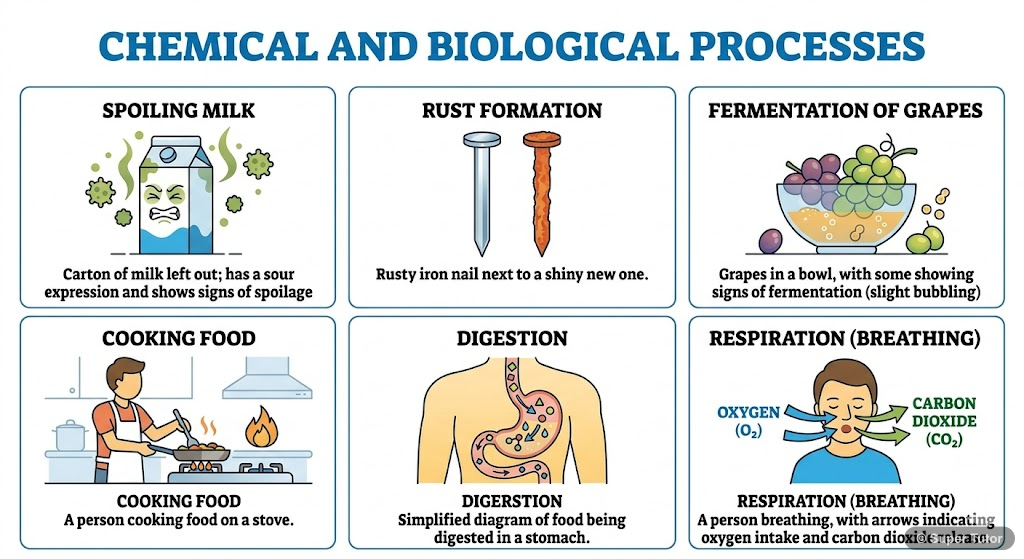
One of 23 illustrations for Chemical Reactions and Equations in Super Tutor — alongside flashcards, concept maps and practice questions.
A mind map showing the four main observable signs that indicate a chemical reaction has taken place, with examples of each type of change.
The map in words
- Signs of Chemical Reaction
- Change in State
- Solid to gas
- Liquid to solid
- State transformation
- Change in Colour
- Original substance color
- New substance color
- Visible difference
- Evolution of Gas
- Bubble formation
- Escaping vapors
- Gas displacement
- Change in Temperature
- Heat released
- Temperature increase
- Exothermic reaction
- Change in State
A flowchart showing the process of balancing a chemical equation step by step, from identifying atoms to achieving balance.
The map in words
- Start: Write chemical equation Mg + O₂ → MgO
- Count atoms on each side LHS: 1 Mg, 2 O RHS: 1 Mg, 1 O
- Are atoms balanced?
- No: Adjust coefficients 2Mg + O₂ → 2MgO
- Recount atoms LHS: 2 Mg, 2 O RHS: 2 Mg, 2 O
- Are atoms balanced?
- Yes: Balanced equation! 2Mg + O₂ → 2MgO
- Are atoms balanced?
- Recount atoms LHS: 2 Mg, 2 O RHS: 2 Mg, 2 O
- No: Adjust coefficients 2Mg + O₂ → 2MgO
- Are atoms balanced?
- Count atoms on each side LHS: 1 Mg, 2 O RHS: 1 Mg, 1 O
Explore these maps interactively
Explore DiagramsFrequently Asked Questions
What are the important topics in Chemical Reactions and Equations for Punjab Board Class 10 Science?
What do the concept maps for Chemical Reactions and Equations show?
How should I revise Chemical Reactions and Equations for the Punjab Board Class 10 board exam?
Sources & Official References
Content is aligned to the official syllabus. Refer to the board website for the latest curriculum.
More resources for Chemical Reactions and Equations
Practice Quiz
Test yourself with a quick quiz
Important Questions
Exam-style questions with answers
Revision Notes
Key points for last-minute revision
Formula Sheet
The chapter's formulas in one place
Chapter Summary
Understand the chapter at a glance
Flashcards
Quick-fire cards for active recall
Syllabus
What topics to cover
For serious students
Get the full Chemical Reactions and Equations chapter — start free.
Quizzes, flashcards, an AI doubt solver and a study plan for Punjab Board Class 10 Science. Free to start, no card needed.