Chemical Reactions and Equations — Flashcards
Punjab Board · Class 10 · Science
25 flashcards for Chemical Reactions and Equations (Punjab Board Class 10 Science) to test yourself on key terms and facts.
Interactive on Super Tutor
Studying Chemical Reactions and Equations? Get the full interactive chapter.
Quizzes, flashcards, AI doubt-solver and a step-by-step study plan — built for flashcards and more.
Free trial, no card needed.
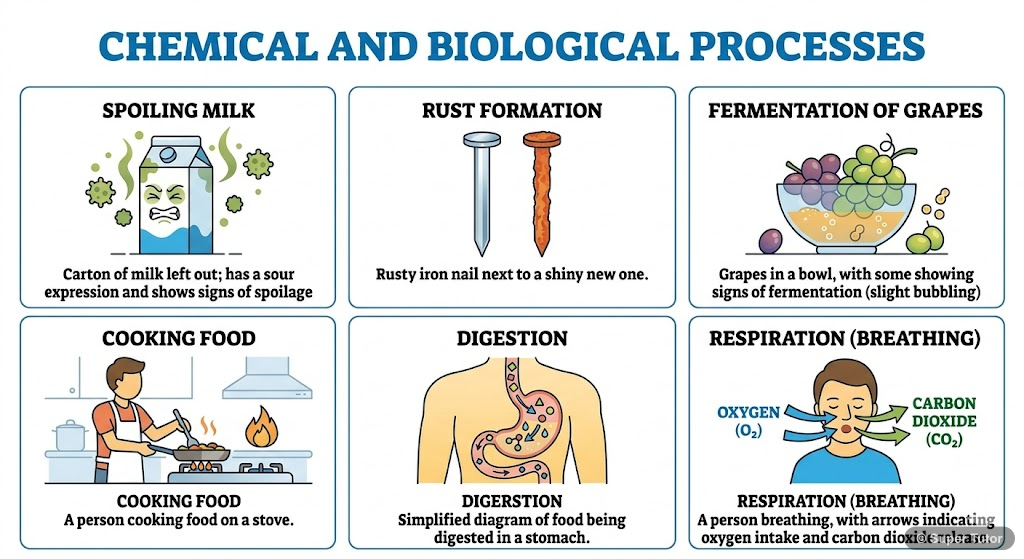
One of 23 illustrations for Chemical Reactions and Equations in Super Tutor — alongside flashcards, concept maps and practice questions.
What is a chemical reaction? Name two observations that help identify if a chemical reaction has occurred.
Answer
A chemical reaction is a process where substances change their chemical composition to form new substances. Two key observations that indicate a chemical reaction has occurred are: (1) Change in color…
Write the word equation and chemical equation for the burning of magnesium ribbon in air.
Answer
Word equation: Magnesium + Oxygen → Magnesium oxide Chemical equation (skeletal): Mg + O₂ → MgO Balanced chemical equation: 2Mg + O₂ → 2MgO Observation: Magnesium burns with a dazzling white flame,…
What does the law of conservation of mass state, and why is it important in balancing chemical equations?
Answer
The law of conservation of mass states that mass can neither be created nor destroyed in a chemical reaction. Therefore, the total mass of reactants must equal the total mass of products. In balancing…
Balance the equation: Fe + H₂O → Fe₃O₄ + H₂ (HINT: Start with the compound having the most atoms)
Answer
Balanced equation: 3Fe + 4H₂O → Fe₃O₄ + 4H₂ Step-by-step balancing: 1. Fe₃O₄ has the most atoms, so start there 2. Balance oxygen: 4 oxygen atoms on right → need 4H₂O on left 3. Balance hydrogen: 4H₂…
What do the symbols (s), (l), (g), and (aq) represent in a chemical equation?
Answer
(s) = Solid state - like Fe₃O₄(s) in 3Fe(s) + 4H₂O(g) → Fe₃O₄(s) + 4H₂(g) (l) = Liquid state - like H₂O(l) when water is in liquid form (g) = Gaseous state - like H₂(g) for hydrogen gas (aq) = Aqueous…
What is a combination reaction? Give two examples from daily life.
Answer
A combination reaction occurs when two or more substances (elements or compounds) combine to form a single new product. Formula: A + B → C Example 1: Burning of coal - C(s) + O₂(g) → CO₂(g) Example 2…
Explain why the blue color of copper sulfate solution fades when iron nails are dipped in it. Write the balanced equation.
Answer
The blue color fades because copper ions (Cu²⁺) from the solution are displaced by iron metal, which is more reactive. As Cu²⁺ ions are consumed, the solution becomes less blue. Balanced equation: Fe…
What is the difference between thermal decomposition and decomposition by light or electricity?
Answer
Decomposition reactions require energy input to break down a compound into simpler products. The energy source differs: 1. Thermal decomposition (heat): - CaCO₃(s) --Heat-→ CaO(s) + CO₂(g) (limest…
+17 more flashcards
Practise AllFrequently Asked Questions
What are the important topics in Chemical Reactions and Equations for Punjab Board Class 10 Science?
How many flashcards are available for Chemical Reactions and Equations?
How should I revise Chemical Reactions and Equations for the Punjab Board Class 10 board exam?
Sources & Official References
Content is aligned to the official syllabus. Refer to the board website for the latest curriculum.
More resources for Chemical Reactions and Equations
Practice Quiz
Test yourself with a quick quiz
Important Questions
Exam-style questions with answers
Revision Notes
Key points for last-minute revision
Formula Sheet
The chapter's formulas in one place
Chapter Summary
Understand the chapter at a glance
Concept Maps
See how topics connect
Syllabus
What topics to cover
For serious students
Get the full Chemical Reactions and Equations chapter — start free.
Quizzes, flashcards, an AI doubt solver and a study plan for Punjab Board Class 10 Science. Free to start, no card needed.