Chemical Reactions and Equations — Syllabus
Punjab Board · Class 10 · Science
What Chemical Reactions and Equations covers in Punjab Board Class 10 Science: 4 topics, for the 2026-27 session.
Interactive on Super Tutor
Studying Chemical Reactions and Equations? Get the full interactive chapter.
Quizzes, flashcards, AI doubt-solver and a step-by-step study plan — built for syllabus and more.
Free trial, no card needed.
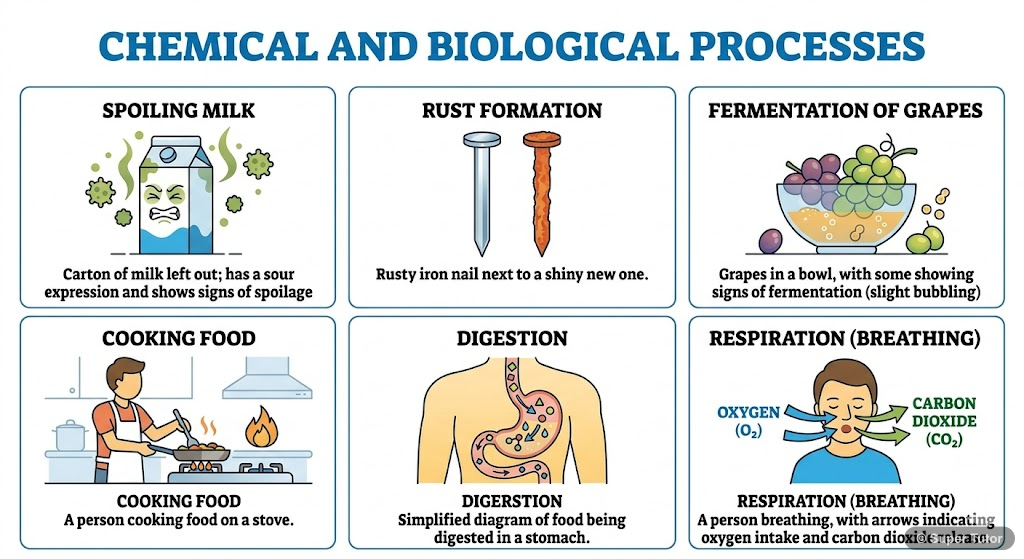
One of 23 illustrations for Chemical Reactions and Equations in Super Tutor — alongside flashcards, concept maps and practice questions.
Topics in Chemical Reactions and Equations
1. Chemical Equations
- A chemical reaction involves breaking and making of bonds between atoms to form new substances.
- Signs of a chemical reaction: change in state, change in colour, evolution of gas, change in temperature.
- A word equation describes a reaction using names of reactants and products. Example: Magnesium + Oxygen → Magnesium oxide.
2. Steps to Balance a Chemical Equation (Hit-and-Trial Method)
- Step 1: Write the skeletal (unbalanced) chemical equation.
- Step 2: Draw boxes around each formula to remind yourself not to change them.
- Step 3: Count and list the number of atoms of each element on both sides.
3. Types of Chemical Reactions
- There are five main types of chemical reactions: Combination, Decomposition, Displacement, Double Displacement, and Oxidation-Reduction (Redox).
- COMBINATION: Two or more reactants combine to form a single product. A + B → AB.
- Example of combination: CaO(s) + H₂O(l) → Ca(OH)₂(aq) + Heat (Quick lime + Water → Slaked lime).
4. Effects of Oxidation in Everyday Life – Corrosion and Rancidity
- Corrosion is the process by which metals are attacked by substances in their environment (moisture, acids, etc.) and are slowly eaten away.
- Rusting of iron is the most common example of corrosion: Iron + Water + Oxygen → Rust (hydrated iron oxide Fe₂O₃.xH₂O).
- Silver develops a black coating (silver sulphide) and copper develops a green coating (copper carbonate/basic copper carbonate) – both are examples of corrosion.
Key Concepts
Work through every topic in Chemical Reactions and Equations with notes and quizzes
Start This ChapterFrequently Asked Questions
What are the important topics in Chemical Reactions and Equations for Punjab Board Class 10 Science?
How should I revise Chemical Reactions and Equations for the Punjab Board Class 10 board exam?
Sources & Official References
Content is aligned to the official syllabus. Refer to the board website for the latest curriculum.
More resources for Chemical Reactions and Equations
Practice Quiz
Test yourself with a quick quiz
Important Questions
Exam-style questions with answers
Revision Notes
Key points for last-minute revision
Formula Sheet
The chapter's formulas in one place
Chapter Summary
Understand the chapter at a glance
Concept Maps
See how topics connect
Flashcards
Quick-fire cards for active recall
For serious students
Get the full Chemical Reactions and Equations chapter — start free.
Quizzes, flashcards, an AI doubt solver and a study plan for Punjab Board Class 10 Science. Free to start, no card needed.