Chemical Reactions and Equations — Chapter Summary
Punjab Board · Class 10 · Science
Summary of Chemical Reactions and Equations for Punjab Board Class 10 Science. Part of the Punjab Board Class 10 Science syllabus.
Interactive on Super Tutor
Studying Chemical Reactions and Equations? Get the full interactive chapter.
Quizzes, flashcards, AI doubt-solver and a step-by-step study plan — built for chapter summary and more.
Free trial, no card needed.
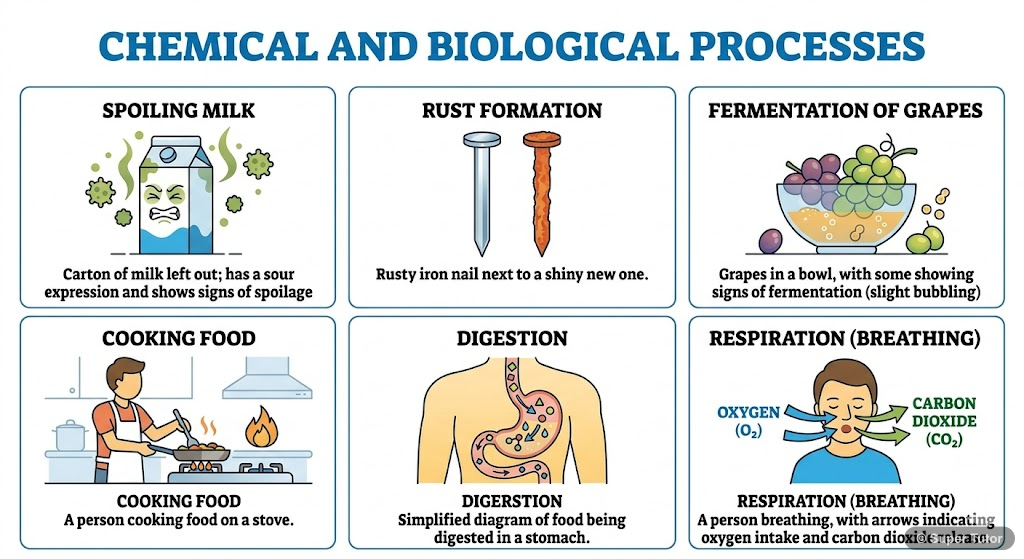
One of 23 illustrations for Chemical Reactions and Equations in Super Tutor — alongside flashcards, concept maps and practice questions.
Overview
Chemical reactions are the foundation of chemistry and occur constantly in our everyday lives. From the rusting of iron to the digestion of food, from burning fuel to photosynthesis in plants, chemical reactions transform matter from one form to another. This chapter explores how to identify, repres
Key Concepts
A chemical reaction occurs when substances
A chemical reaction occurs when substances (reactants) undergo a chemical change to form new substances (products) with different properties. This inv
A word equation describes a chemical
A word equation describes a chemical reaction using the names of substances. For example: 'Magnesium + Oxygen → Magnesium oxide'. A chemical equation
A balanced chemical equation has
A balanced chemical equation has the same number of atoms of each element on both sides of the equation, obeying the law of conservation of mass. For
A combination reaction occurs when two
A combination reaction occurs when two or more substances (elements or compounds) combine to form a single product. General form: A + B → AB or A + B
A decomposition reaction is the opposite
A decomposition reaction is the opposite of combination - one reactant breaks down into two or more simpler products. General form: AB → A + B or ABC
Learning Objectives
- Identify when a chemical reaction has occurred by observing changes such as colour change, gas evolution, temperature change, and state change
- Write word equations and convert them into balanced chemical equations using chemical formulae
- Understand and apply the law of conservation of mass to balance chemical equations
- Classify chemical reactions into combination, decomposition, displacement, and double displacement types
- Understand exothermic and endothermic reactions and identify examples from daily life
Frequently Asked Questions
What are the important topics in Chemical Reactions and Equations for Punjab Board Class 10 Science?
How should I revise Chemical Reactions and Equations for the Punjab Board Class 10 board exam?
Sources & Official References
Content is aligned to the official syllabus. Refer to the board website for the latest curriculum.
More resources for Chemical Reactions and Equations
For serious students
Get the full Chemical Reactions and Equations chapter — start free.
Quizzes, flashcards, an AI doubt solver and a study plan for Punjab Board Class 10 Science. Free to start, no card needed.