Chapter 3 of 5
Revision Notes
Metals and Non-metals — Revision Notes
Punjab Board · Class 10 · Science
Metals and Non-metals revision notes for Punjab Board Class 10 Science: 4 topics in quick points. Part of the Punjab Board Class 10 Science syllabus.
45 questions30 flashcards2 formulas & key relations5 concepts
Interactive on Super Tutor
Studying Metals and Non-metals? Get the full interactive chapter.
Quizzes, flashcards, AI doubt-solver and a step-by-step study plan — built for revision notes and more.
Free trial, no card needed.
Super Tutor
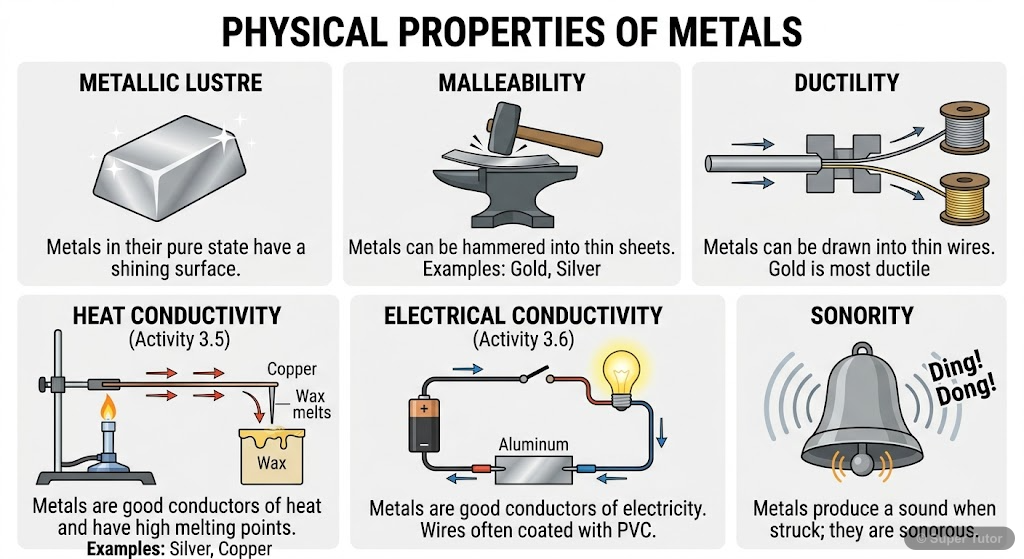
One of 17 illustrations for Metals and Non-metals in Super Tutor — alongside flashcards, concept maps and practice questions.
Key Topics to Revise
1
Physical Properties of Metals and Non-metals
- Metals are generally solid at room temperature. Exception: Mercury (Hg) is a liquid metal at room temperature.
- Metals have a shiny appearance called metallic lustre. Non-metals generally lack lustre. Exception: Iodine is a lustrous non-metal.
- Metals are malleable (can be beaten into thin sheets). Gold and silver are the most malleable metals.
2
Chemical Properties of Metals – Reactions with Oxygen, Water, and Acids
- Metal + Oxygen → Metal Oxide (basic in nature). Example: 2Cu + O₂ → 2CuO (black copper oxide).
- Aluminium forms aluminium oxide: 4Al + 3O₂ → 2Al₂O₃.
- Amphoteric oxides react with BOTH acids and bases. Examples: Aluminium oxide (Al₂O₃) and Zinc oxide (ZnO).
3
Reactivity Series and Displacement Reactions
- The reactivity series arranges metals in DECREASING order of reactivity: K > Na > Ca > Mg > Al > Zn > Fe > Pb > [H] > Cu > Hg > Ag > Au.
- Hydrogen is placed in the reactivity series to compare metal reactivity — metals above H displace it from dilute acids.
- Metals below H in the series (Cu, Hg, Ag, Au) do NOT react with dilute acids to produce H₂.
4
Ionic Compounds – Formation and Properties
- Metals tend to LOSE electrons to achieve a stable electronic configuration (like noble gases) — they form positive ions (cations).
- Non-metals tend to GAIN electrons — they form negative ions (anions).
- When a metal transfers electrons to a non-metal, ionic bonds are formed. The resulting compound is called an ionic compound or electrovalent compound.
Get complete notes with diagrams and examples
Full NotesKey Concepts
Metals have a shinyMalleability is the ability to beMetals are excellent conductors of heatMetals that produce a clearDifferent metals react with oxygen
Frequently Asked Questions
What are the important topics in Metals and Non-metals for Punjab Board Class 10 Science?
Key topics in Metals and Non-metals include Physical Properties of Metals and Non-metals, Chemical Properties of Metals – Reactions with Oxygen, Water, and Acids, Reactivity Series and Displacement Reactions, Ionic Compounds – Formation and Properties. Study these first, then practise questions on each for the Punjab Board Class 10 board exam.
How should I revise Metals and Non-metals for the Punjab Board Class 10 board exam?
Learn the core ideas first, then work through the 45 practice questions on Metals and Non-metals. Revise definitions regularly and use flashcards for quick recall before the exam.
Sources & Official References
Content is aligned to the official syllabus. Refer to the board website for the latest curriculum.
More resources for Metals and Non-metals
For serious students
Get the full Metals and Non-metals chapter — start free.
Quizzes, flashcards, an AI doubt solver and a study plan for Punjab Board Class 10 Science. Free to start, no card needed.