Metals and Non-metals — Chapter Summary
Punjab Board · Class 10 · Science
Summary of Metals and Non-metals for Punjab Board Class 10 Science. Part of the Punjab Board Class 10 Science syllabus.
Interactive on Super Tutor
Studying Metals and Non-metals? Get the full interactive chapter.
Quizzes, flashcards, AI doubt-solver and a step-by-step study plan — built for chapter summary and more.
Free trial, no card needed.
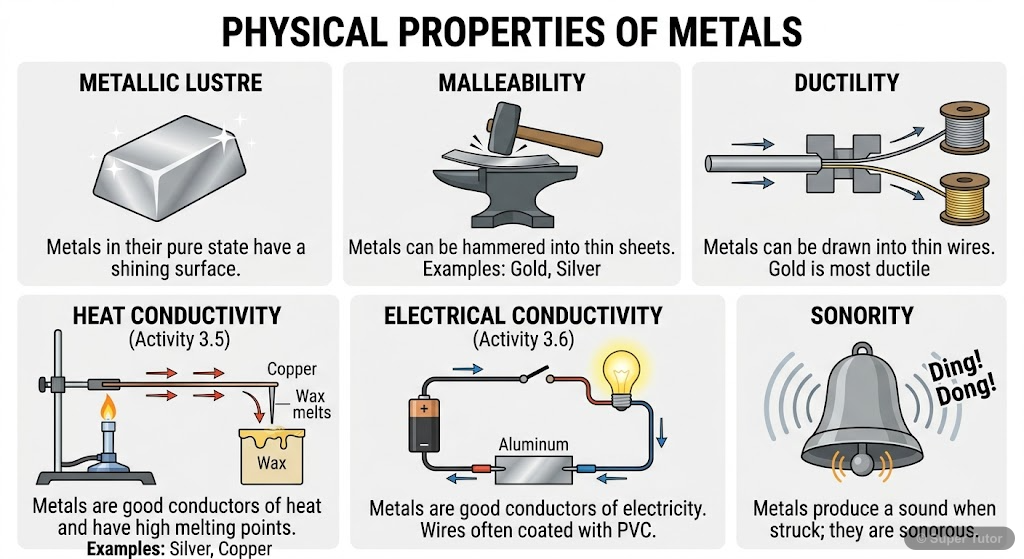
One of 17 illustrations for Metals and Non-metals in Super Tutor — alongside flashcards, concept maps and practice questions.
Overview
Metals and non-metals are two major categories of elements that form the basis of chemistry. This chapter explores the physical and chemical properties that distinguish metals from non-metals, their reactivity patterns, occurrence in nature, extraction methods, and practical applications. Understand
Key Concepts
Metals have a shiny
Metals have a shiny, reflective surface in their pure state. When cleaned with sandpaper, this shine becomes more apparent. This property is called me
Malleability is the ability to be
Malleability is the ability to be beaten into thin sheets without breaking. Ductility is the ability to be drawn into thin wires. Metals like gold and
Metals are excellent conductors of heat
Metals are excellent conductors of heat and electricity due to the presence of free electrons that can move easily through their structure. Silver and
Metals that produce a clear
Metals that produce a clear, ringing sound when struck are called sonorous. This property is due to their ability to vibrate and transmit sound waves
Different metals react with oxygen
Different metals react with oxygen, water, and acids at different rates. Some metals like sodium and potassium react violently with water and must be
Learning Objectives
- Understand and identify physical properties of metals and non-metals through practical observations
- Classify elements as metals or non-metals based on their chemical properties
- Explain the reactivity series and predict metal displacement reactions
- Understand ionic compound formation and their properties
- Learn metal extraction methods based on reactivity levels
Frequently Asked Questions
What are the important topics in Metals and Non-metals for Punjab Board Class 10 Science?
How should I revise Metals and Non-metals for the Punjab Board Class 10 board exam?
Sources & Official References
Content is aligned to the official syllabus. Refer to the board website for the latest curriculum.
More resources for Metals and Non-metals
For serious students
Get the full Metals and Non-metals chapter — start free.
Quizzes, flashcards, an AI doubt solver and a study plan for Punjab Board Class 10 Science. Free to start, no card needed.