Metals and Non-metals — Flashcards
Punjab Board · Class 10 · Science
30 flashcards for Metals and Non-metals (Punjab Board Class 10 Science) to test yourself on key terms and facts.
Interactive on Super Tutor
Studying Metals and Non-metals? Get the full interactive chapter.
Quizzes, flashcards, AI doubt-solver and a step-by-step study plan — built for flashcards and more.
Free trial, no card needed.
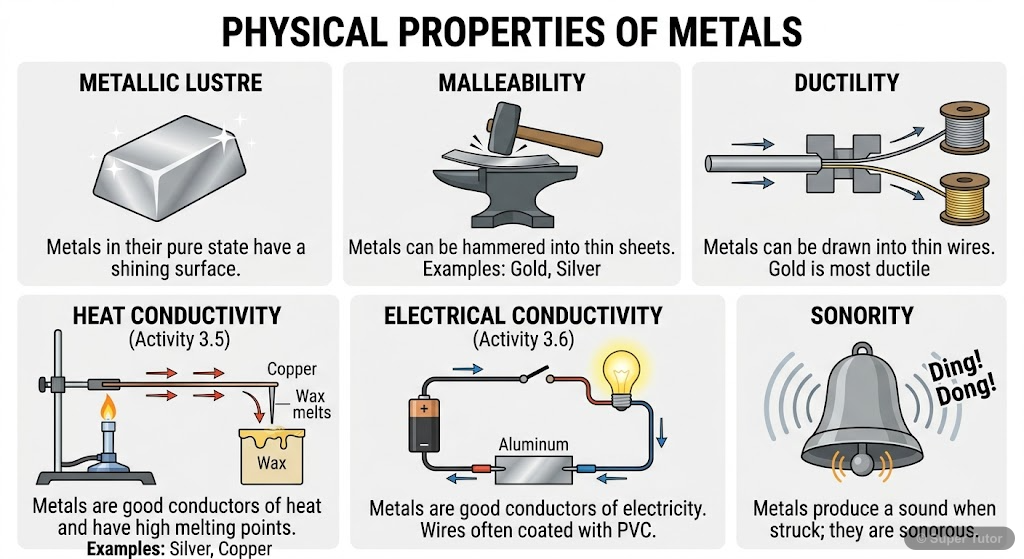
One of 17 illustrations for Metals and Non-metals in Super Tutor — alongside flashcards, concept maps and practice questions.
What is metallic lustre and how would you test for it?
Answer
Metallic lustre is the shiny, reflective appearance of pure metals. Test: Clean a metal sample with sandpaper and observe its surface. Pure metals like copper, iron, and aluminum show a characteristic…
A student strikes a hammer on samples of iron, copper, lead, and aluminum. Iron deforms slightly, copper spreads thin, and lead flattens significantly. Which property is being tested and what order wo
Answer
This tests MALLEABILITY - the ability to be beaten into thin sheets. Order (decreasing): Lead > Copper > Aluminum > Iron. Malleability varies among metals because different metals have different cryst…
Why can gold be drawn into a wire 2 km long from just 1 gram, while copper cannot achieve the same length?
Answer
This demonstrates DUCTILITY - gold's exceptional ductility means its atoms can be stretched and rearranged without breaking. Gold has unique atomic arrangement and bonding that allows extreme stretchi…
In Activity 3.5, a pin is attached to a heated copper wire with wax. What happens and why? What does this tell us?
Answer
When heated, the wax melts and the pin falls off because metals conduct heat efficiently. Heat travels along the copper wire from the heated end to the free end. This demonstrates that metals are GOOD…
Set up an electric circuit with a metal sample between terminals. The bulb glows brightly. What property does this demonstrate and why do we coat electrical wires with PVC?
Answer
This demonstrates ELECTRICAL CONDUCTIVITY - metals conduct electricity because their valence electrons move freely. PVC (polyvinylchloride) or rubber coating is used because these are NON-CONDUCTORS (…
Why are school bells made of metal while door handles are not typically all-metal? Explain the property involved.
Answer
School bells are made of metal because metals are SONOROUS - they produce ringing sounds when struck. This is because metal atoms vibrate and transfer vibrations through the structure, creating resona…
Magnesium ribbon burns in air with a dazzling white flame producing white ashes. What is the chemical equation and what property of metals is being demonstrated?
Answer
2Mg + O₂ → 2MgO (Magnesium oxide - white). This demonstrates that metals BURN IN OXYGEN, forming metal oxides. Magnesium burns vigorously because it's highly reactive. The white flame indicates high h…
Aluminum oxide (Al₂O₃) reacts with both HCl and NaOH. What is this property called and which other common metal oxide shows this behavior?
Answer
This property is called AMPHOTERIC behavior. Amphoteric oxides react with both acids AND bases: Al₂O₃ + 6HCl → 2AlCl₃ + 3H₂O Al₂O₃ + 2NaOH → 2NaAlO₂ + H₂O Zinc oxide (ZnO) also shows amphoteric behav…
+22 more flashcards
Practise AllFrequently Asked Questions
What are the important topics in Metals and Non-metals for Punjab Board Class 10 Science?
How many flashcards are available for Metals and Non-metals?
How should I revise Metals and Non-metals for the Punjab Board Class 10 board exam?
Sources & Official References
Content is aligned to the official syllabus. Refer to the board website for the latest curriculum.
More resources for Metals and Non-metals
Practice Quiz
Test yourself with a quick quiz
Important Questions
Exam-style questions with answers
Revision Notes
Key points for last-minute revision
Formula Sheet
The chapter's formulas in one place
Chapter Summary
Understand the chapter at a glance
Concept Maps
See how topics connect
Syllabus
What topics to cover
For serious students
Get the full Metals and Non-metals chapter — start free.
Quizzes, flashcards, an AI doubt solver and a study plan for Punjab Board Class 10 Science. Free to start, no card needed.