Structure of Atom — Chapter Summary
Punjab Board · Class 11 · Chemistry
Summary of Structure of Atom for Punjab Board Class 11 Chemistry. Key concepts: Atoms consist of three, Proposed in 1898 and Based on alpha particle.
Interactive on Super Tutor
Studying Structure of Atom? Get the full interactive chapter.
Quizzes, flashcards, AI doubt-solver and a step-by-step study plan — built for chapter summary and more.
Free trial, no card needed.
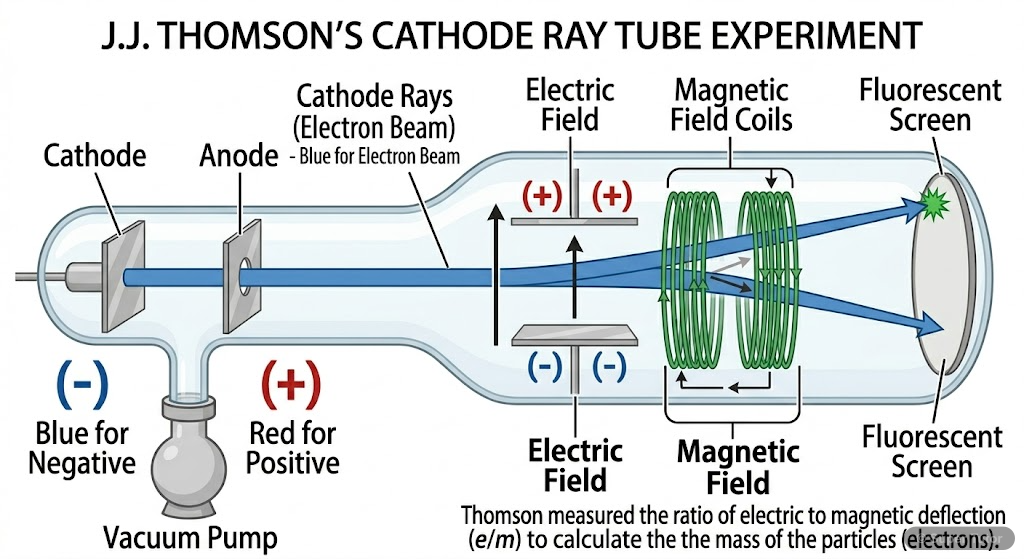
Learn better with visuals Super Tutor pairs illustrations like this with notes and quizzes for Structure of Atom.
Overview
The structure of atom is fundamental to understanding chemistry. From ancient philosophers to modern quantum mechanics, our understanding of atoms has evolved dramatically. This chapter traces the discovery of sub-atomic particles (electrons, protons, and neutrons), explores various atomic models fr
Key Concepts
Atoms consist of three fundamental particles
Atoms consist of three fundamental particles: electrons (negative charge, mass = 9.109 × 10⁻³¹ kg, charge = -1.602 × 10⁻¹⁹ C), protons (positive charg
Proposed in 1898
Proposed in 1898, Thomson suggested atoms are uniform spheres of positive charge with electrons embedded within, like plums in pudding. He calculated
Based on alpha particle scattering experiments
Based on alpha particle scattering experiments (1909), Rutherford concluded that atoms have a tiny, dense, positively charged nucleus at the center wi
Atomic number (Z) = number
Atomic number (Z) = number of protons = number of electrons in neutral atom. Mass number (A) = number of protons + number of neutrons. Represented as
Isotopes are atoms of same element
Isotopes are atoms of same element (same Z) with different numbers of neutrons (different A). Examples: ¹²₆C, ¹³₆C, ¹⁴₆C. Isobars are atoms with same
Learning Objectives
- Know about the discovery of electron, proton, and neutron and their characteristics
- Describe Thomson, Rutherford, and Bohr atomic models
- Understand important features of the quantum mechanical model of atom
- Understand nature of electromagnetic radiation and Planck's quantum theory
- Explain the photoelectric effect and describe features of atomic spectra
Frequently Asked Questions
What are the important topics in Structure of Atom for Punjab Board Class 11 Chemistry?
How should I revise Structure of Atom for Class 11 exams?
Sources & Official References
Content is aligned to the official syllabus. Refer to the board website for the latest curriculum.
More resources for Structure of Atom
For serious students
Get the full Structure of Atom chapter — start free.
Quizzes, flashcards, an AI doubt solver and a study plan for Punjab Board Class 11 Chemistry. Free to start, no card needed.