Structure of Atom — Concept Maps
Punjab Board · Class 11 · Chemistry
3 concept maps of Structure of Atom for Punjab Board Class 11 Chemistry, each also written out as a text outline.
Interactive on Super Tutor
Studying Structure of Atom? Get the full interactive chapter.
Quizzes, flashcards, AI doubt-solver and a step-by-step study plan — built for concept maps and more.
Free trial, no card needed.
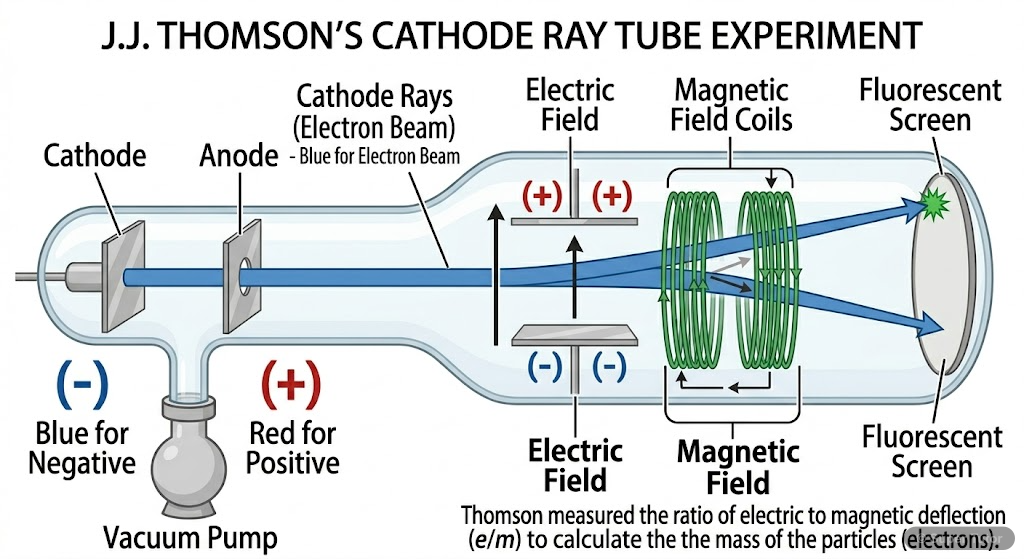
Learn better with visuals Super Tutor pairs illustrations like this with notes and quizzes for Structure of Atom.
Structure of Atom – Chapter Overview Mind Map
The map in words
- Structure of Atom
- Sub-atomic Particles
- Electron
- Cathode Ray Expt
- Thomson e/me ratio
- Millikan Oil Drop
- Charge -1.6x10⁻¹⁹ C
- Mass 9.1x10⁻³¹ kg
- Proton
- Canal Rays
- Charge +1.6x10⁻¹⁹ C
- Mass 1.67x10⁻²⁷ kg
- Neutron
- Chadwick 1932
- Neutral particle
- Mass 1.67x10⁻²⁷ kg
- Electron
- Atomic Models
- Thomson Model
- Plum pudding
- Failed Rutherford expt
- Rutherford Model
- Alpha scattering
- Nuclear model
- Failed stability
- Bohr Model
- Quantized orbits
- Explains H spectrum
- Failed multi-electron
- Thomson Model
- Quantum Concepts
- EM Radiation
- Wave nature
- c = v times lambda
- Spectrum types
- Planck Quantum Theory
- E = hv
- Black body radiation
- Photoelectric Effect
- KE = h times v minus hv0
- Dual nature of light
- de Broglie
- lambda = h divided by mv
- Wave-particle duality
- Heisenberg Principle
- Delta-x times Delta-p
- No definite orbits
- EM Radiation
- Quantum Mechanical Model
- Schrodinger Equation
- Wave function psi
- Probability density
- Quantum Numbers
- n Principal
- l Azimuthal
- ml Magnetic
- ms Spin
- Orbital Shapes
- s spherical
- p dumbbell
- d cloverleaf
- Nodes
- Radial n-l-1
- Angular l
- Schrodinger Equation
- Electronic Configuration
- Aufbau Principle
- Filling order
- Pauli Exclusion
- Max 2 per orbital
- Hunds Rule
- Singly fill first
- Exceptions
- Cr half-filled d5
- Cu fully filled d10
- Aufbau Principle
- Sub-atomic Particles
Structure of Atom - Comprehensive Concept Map
The map in words
- Structure of Atom
- Historical Models
- Thomson Plum Pudding
- Rutherford Nuclear
- Bohr Orbits
- Schrodinger Quantum
- Subatomic Particles
- Electron
- Charge -1.602e-19 C
- Mass 9.11e-31 kg
- Proton
- Charge +1.602e-19 C
- Mass 1.673e-27 kg
- Neutron
- Charge 0
- Mass 1.675e-27 kg
- Electron
- Atomic Structure
- Atomic Number Z
- Mass Number A
- Isotopes
- Isobars
- Quantum Theory
- Planck Quantization
- Photoelectric Effect
- Wave-Particle Duality
- Uncertainty Principle
- Bohr Model
- Stationary States
- Energy Levels
- Spectral Lines
- Hydrogen Spectrum
- Quantum Mechanics
- Schrodinger Equation
- Wave Functions
- Probability Density
- Quantum Numbers
- Orbitals
- Principal n
- Azimuthal l
- Magnetic ml
- Spin ms
- Orbital Properties
- s Orbitals
- Spherical
- 1 per subshell
- p Orbitals
- Dumbbell
- 3 per subshell
- d Orbitals
- Complex
- 5 per subshell
- s Orbitals
- Electron Configuration
- Aufbau Principle
- Pauli Exclusion
- Hund's Rule
- Core vs Valence
- Atomic Stability
- Half-filled Stability
- Filled Stability
- Exchange Energy
- Shielding Effect
- Historical Models
Structure of Atom — Complete Chapter Overview
The map in words
- Structure of Atom
- Sub-atomic Particles
- Electron
- Cathode Rays
- Charge -1.6e-19 C
- Mass 9.109e-31 kg
- Proton
- Canal Rays
- Charge +1.6e-19 C
- Mass 1.673e-27 kg
- Neutron
- Chadwick 1932
- Neutral Charge
- Mass 1.675e-27 kg
- Electron
- Atomic Models
- Thomson Model
- Plum Pudding
- Failed Rutherford Test
- Rutherford Model
- Alpha Scattering
- Nuclear Model
- Fails Stability Test
- Bohr Model
- Fixed Orbits
- Quantized Energy
- Explains H Spectrum
- Fails Multi-electron
- Quantum Mechanical
- Schrodinger Equation
- Wave Function
- Probability Density
- Thomson Model
- EM Radiation and Quanta
- Wave Nature
- c equals nu times lambda
- Wavenumber
- Planck Quantum Theory
- E equals h nu
- Quantization of Energy
- Photoelectric Effect
- Threshold Frequency
- Work Function
- KE equals h nu minus W0
- Wave Nature
- Quantum Numbers
- Principal n
- Shell Size Energy
- Azimuthal l
- Shape Subshell
- Magnetic ml
- Orientation
- Spin ms
- Plus half or Minus half
- Principal n
- Electronic Configuration
- Aufbau Principle
- Lowest Energy First
- Pauli Exclusion
- Max 2 per Orbital
- Hunds Rule
- Singly Fill First
- Exceptions
- Cr 3d5 4s1
- Cu 3d10 4s1
- Aufbau Principle
- Sub-atomic Particles
Explore these maps interactively
Explore DiagramsFrequently Asked Questions
What are the important topics in Structure of Atom for Punjab Board Class 11 Chemistry?
What do the concept maps for Structure of Atom show?
How should I revise Structure of Atom for Class 11 exams?
Sources & Official References
Content is aligned to the official syllabus. Refer to the board website for the latest curriculum.
More resources for Structure of Atom
Practice Quiz
Test yourself with a quick quiz
Important Questions
Exam-style questions with answers
Revision Notes
Key points for last-minute revision
Formula Sheet
The chapter's formulas in one place
Chapter Summary
Understand the chapter at a glance
Flashcards
Quick-fire cards for active recall
Syllabus
What topics to cover
For serious students
Get the full Structure of Atom chapter — start free.
Quizzes, flashcards, an AI doubt solver and a study plan for Punjab Board Class 11 Chemistry. Free to start, no card needed.