Classification of Elements and Periodicity in Properties — Chapter Summary
Punjab Board · Class 11 · Chemistry
Summary of Classification of Elements and Periodicity in Properties for Punjab Board Class 11 Chemistry. The Periodic Table is one of the most important.
Interactive on Super Tutor
Studying Classification of Elements and Periodicity in Properties? Get the full interactive chapter.
Quizzes, flashcards, AI doubt-solver and a step-by-step study plan — built for chapter summary and more.
Free trial, no card needed.
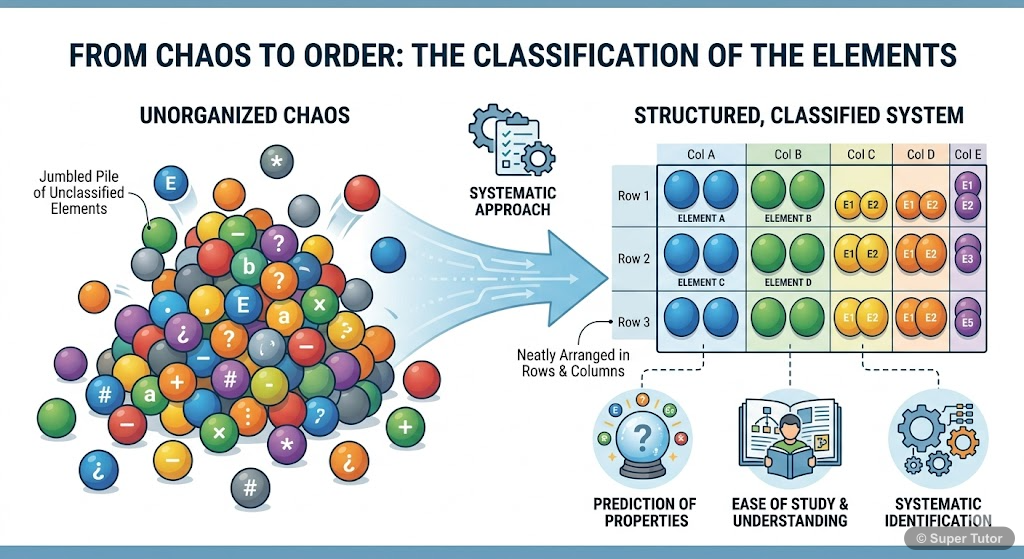
Learn better with visuals Super Tutor pairs illustrations like this with notes and quizzes for Classification of Elements and Periodicity in Properties.
Overview
The Periodic Table is one of the most important concepts in chemistry, serving as the foundation for understanding how elements are organized and how their properties change. This chapter explores how scientists gradually developed the modern Periodic Table through observations and experiments, star
Key Concepts
The Periodic Law states that 'the
The Periodic Law states that 'the physical and chemical properties of the elements are periodic functions of their atomic numbers.' This means that wh
The modern Periodic Table consists
The modern Periodic Table consists of 7 horizontal rows called periods and 18 vertical columns called groups. The period number corresponds to the hig
The periodic nature of elements directly
The periodic nature of elements directly results from periodic variations in their electronic configurations. Elements in the same period have the sam
Elements are classified based on
Elements are classified based on which orbital is being filled with electrons: s-block (Groups 1-2, filling s orbitals), p-block (Groups 13-18, fillin
Atomic radius generally decreases across
Atomic radius generally decreases across a period from left to right because electrons are added to the same valence shell while nuclear charge increa
Learning Objectives
- Appreciate how grouping elements by properties led to the development of the Periodic Table
- Understand the Modern Periodic Law and how it differs from Mendeleev's original formulation
- Recognize the significance of atomic number as the basis for periodic classification
- Learn IUPAC nomenclature for elements with atomic numbers greater than 100
- Classify elements into s, p, d, and f blocks based on their electronic configurations
Frequently Asked Questions
What are the important topics in Classification of Elements and Periodicity in Properties for Punjab Board Class 11 Chemistry?
How should I revise Classification of Elements and Periodicity in Properties for Class 11 exams?
Sources & Official References
Content is aligned to the official syllabus. Refer to the board website for the latest curriculum.
More resources for Classification of Elements and Periodicity in Properties
For serious students
Get the full Classification of Elements and Periodicity in Properties chapter — start free.
Quizzes, flashcards, an AI doubt solver and a study plan for Punjab Board Class 11 Chemistry. Free to start, no card needed.