Classification of Elements and Periodicity in Properties — Flashcards
Punjab Board · Class 11 · Chemistry
30 flashcards for Classification of Elements and Periodicity in Properties (Punjab Board Class 11 Chemistry) to test yourself on key terms and facts.
Interactive on Super Tutor
Studying Classification of Elements and Periodicity in Properties? Get the full interactive chapter.
Quizzes, flashcards, AI doubt-solver and a step-by-step study plan — built for flashcards and more.
Free trial, no card needed.
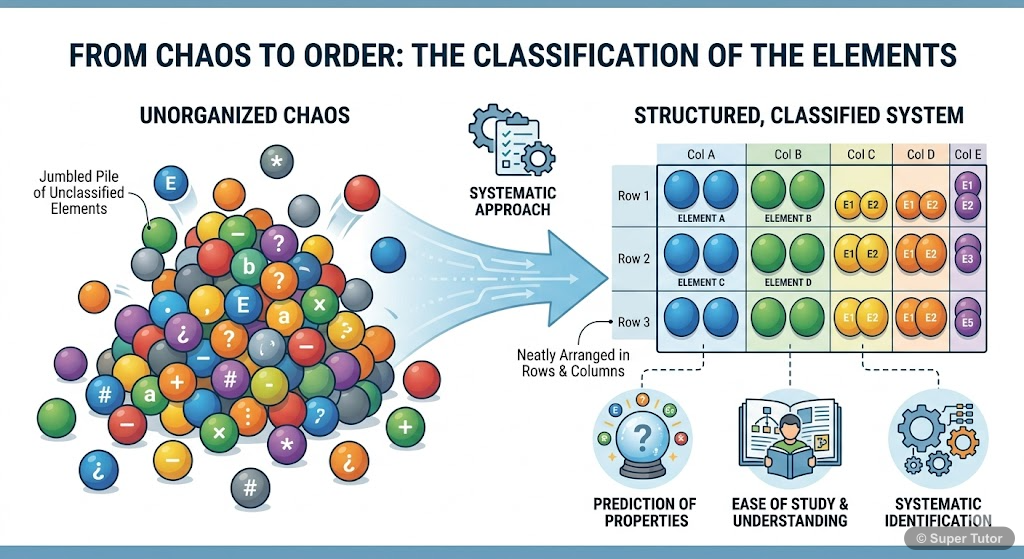
Learn better with visuals Super Tutor pairs illustrations like this with notes and quizzes for Classification of Elements and Periodicity in Properties.
What is the Modern Periodic Law and how does it differ from Mendeleev's original law?
Answer
Modern Periodic Law: The physical and chemical properties of elements are periodic functions of their atomic numbers (Z), not atomic mass. Henry Moseley discovered this in 1913 by observing X-ray spec…
Explain Dobereiner's Law of Triads with an example.
Answer
Dobereiner's Law of Triads (1829): Elements arranged in groups of three showed a pattern where the middle element had properties intermediate to the other two, and its atomic weight was approximately …
What is the significance of Mendeleev leaving gaps in his Periodic Table?
Answer
Mendeleev's bold decision to leave gaps in his 1905 Periodic Table demonstrated scientific insight and confidence. He predicted the existence of undiscovered elements (Eka-Aluminium/Gallium and Eka-Si…
IUPAC Nomenclature Problem: What is the IUPAC systematic name and symbol for element with atomic number 120?
Answer
Step 1: Break 120 into digits: 1, 2, 0 Step 2: From Table 3.4, find root names: - 1 = 'un' (u) - 2 = 'bi' (b) - 0 = 'nil' (n) Step 3: Combine in order: un + bi + nil = unbinilium Step 4: Symbol uses f…
Why do elements in the same group of the Periodic Table have similar chemical properties?
Answer
Elements in the same vertical group have similar valence shell electronic configurations. Since chemical properties depend primarily on the number and arrangement of valence electrons, elements with i…
What is the relationship between period number and the principal quantum number (n) of valence electrons?
Answer
The period number in the Periodic Table corresponds directly to the highest principal quantum number (n) of electrons in an element. Period 1 (n=1): Contains 2 elements (H, He) - 1s orbital filling. P…
Explain the s-block elements and give their characteristic properties.
Answer
s-Block Elements: Groups 1 and 2 with valence configuration ns¹ and ns² respectively. Group 1 (Alkali Metals): Li, Na, K, Rb, Cs, Fr - highly reactive metals, lose one electron easily, form M+ ions. G…
What are p-block elements? Describe the range of their properties.
Answer
p-Block Elements: Groups 13-18 with valence configuration ns²np¹ to ns²np⁶. Include non-metals, metalloids, and poor metals. Range of Properties: (1) Non-metallic character increases left to right. (2…
+22 more flashcards
Practise AllFrequently Asked Questions
What are the important topics in Classification of Elements and Periodicity in Properties for Punjab Board Class 11 Chemistry?
How many flashcards are available for Classification of Elements and Periodicity in Properties?
How should I revise Classification of Elements and Periodicity in Properties for Class 11 exams?
Sources & Official References
Content is aligned to the official syllabus. Refer to the board website for the latest curriculum.
More resources for Classification of Elements and Periodicity in Properties
For serious students
Get the full Classification of Elements and Periodicity in Properties chapter — start free.
Quizzes, flashcards, an AI doubt solver and a study plan for Punjab Board Class 11 Chemistry. Free to start, no card needed.