Classification of Elements and Periodicity in Properties — Concept Maps
Punjab Board · Class 11 · Chemistry
3 concept maps of Classification of Elements and Periodicity in Properties for Punjab Board Class 11 Chemistry, each also written out as a text outline.
Interactive on Super Tutor
Studying Classification of Elements and Periodicity in Properties? Get the full interactive chapter.
Quizzes, flashcards, AI doubt-solver and a step-by-step study plan — built for concept maps and more.
Free trial, no card needed.
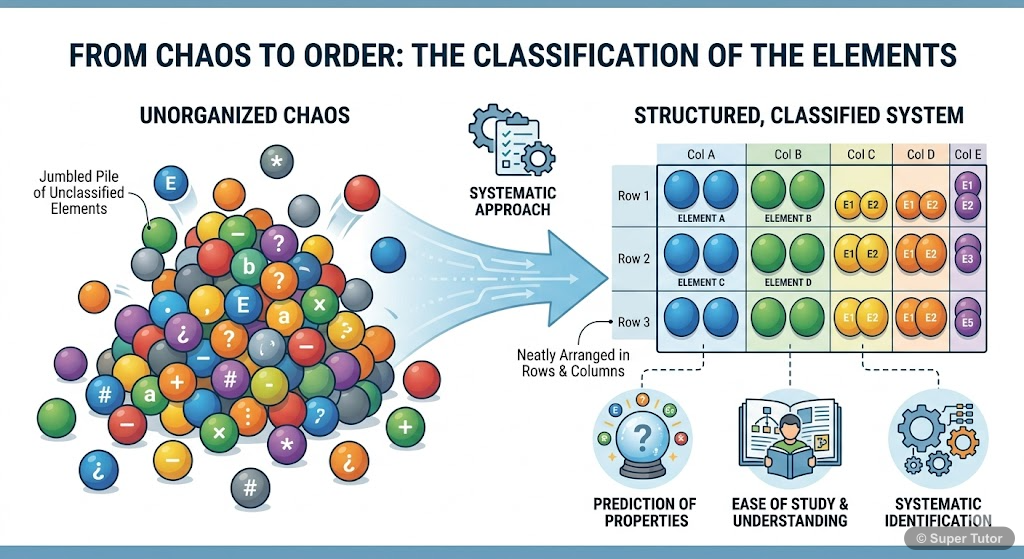
Learn better with visuals Super Tutor pairs illustrations like this with notes and quizzes for Classification of Elements and Periodicity in Properties.
Periodic Table Organization and Classification
The map in words
- Periodic Table
- Structure
- 7 Periods
- Increasing n value
- Elements per period
- Period 1: 2
- Periods 2-3: 8
- Periods 4-5: 18
- Periods 6-7: 32
- 18 Groups
- Valence electrons
- Similar properties
- Group 1: Alkali metals
- Group 2: Alkaline earth
- Group 17: Halogens
- Group 18: Noble gases
- 7 Periods
- Element Classification
- s-block
- Groups 1-2
- Reactive metals
- ns configuration
- p-block
- Groups 13-18
- Metals and nonmetals
- ns2np1-6
- d-block
- Groups 3-12
- Transition metals
- (n-1)d configuration
- f-block
- Lanthanoids
- Actinoids
- (n-2)f configuration
- s-block
- Periodic Trends
- Atomic Radius
- Decreases right
- Increases down
- Ionization Enthalpy
- Increases right
- Decreases down
- Electronegativity
- Increases right
- Decreases down
- Electron Gain
- More negative right
- Less negative down
- Metallic Character
- Decreases right
- Increases down
- Atomic Radius
- Structure
Historical Development of the Periodic Table
The map in words
- 1829
- Dobereiner proposes Law of Triads
- 1862
- de Chancourtois arranges elements on cylinder
- 1865
- Newlands proposes Law of Octaves
- 1869
- Mendeleev and Lothar Meyer publish Periodic Law based on atomic weights
- 1887
- Newlands awarded Davy Medal by Royal Society
- 1913
- Moseley discovers atomic number basis using X-ray spectra
- 1940
- Seaborg discovers Plutonium and transuranium elements
- 1984
- IUPAC recommends groups numbered 1 to 18
Chapter Overview: Classification of Elements and Periodicity in Properties
The map in words
- Periodic Table
- Historical Development
- Dobereiners Triads 1829
- Newlands Octaves 1865
- Mendeleev Periodic Law 1869
- Moseley Modern Law 1913
- Modern Periodic Table
- 7 Periods
- 18 Groups IUPAC
- Period number equals n value
- Elements per period 2 8 8 18 18 32 32
- Blocks of Elements
- s-Block Groups 1 and 2
- p-Block Groups 13 to 18
- d-Block Groups 3 to 12
- f-Block Lanthanoids and Actinoids
- IUPAC Nomenclature Z above 100
- Roots 0 to 9
- Suffix ium
- Example Element 120 Unbinilium
- Periodic Trends
- Atomic Radius
- Decreases across period
- Increases down group
- Ionization Enthalpy
- Increases across period
- Decreases down group
- Anomalies B and O
- Electron Gain Enthalpy
- More negative across period
- Less negative down group
- Cl more negative than F
- Electronegativity
- Increases across period
- Decreases down group
- F has maximum 4.0
- Atomic Radius
- Chemical Properties
- Valence and Oxidation States
- Oxide Nature
- Basic left side
- Acidic right side
- Amphoteric centre
- Diagonal Relationship
- Li resembles Mg
- Be resembles Al
- Anomalous 2nd Period
- Small size
- High charge radius ratio
- Only 4 valence orbitals
- Historical Development
Explore these maps interactively
Explore DiagramsFrequently Asked Questions
What are the important topics in Classification of Elements and Periodicity in Properties for Punjab Board Class 11 Chemistry?
What do the concept maps for Classification of Elements and Periodicity in Properties show?
How should I revise Classification of Elements and Periodicity in Properties for Class 11 exams?
Sources & Official References
Content is aligned to the official syllabus. Refer to the board website for the latest curriculum.
More resources for Classification of Elements and Periodicity in Properties
For serious students
Get the full Classification of Elements and Periodicity in Properties chapter — start free.
Quizzes, flashcards, an AI doubt solver and a study plan for Punjab Board Class 11 Chemistry. Free to start, no card needed.