Moving Charges and Magnetism — Chapter Summary
Punjab Board · Class 12 · Physics
Summary of Moving Charges and Magnetism for Punjab Board Class 12 Physics. Part of the Punjab Board Class 12 Physics syllabus.
Interactive on Super Tutor
Studying Moving Charges and Magnetism? Get the full interactive chapter.
Quizzes, flashcards, AI doubt-solver and a step-by-step study plan — built for chapter summary and more.
Free trial, no card needed.
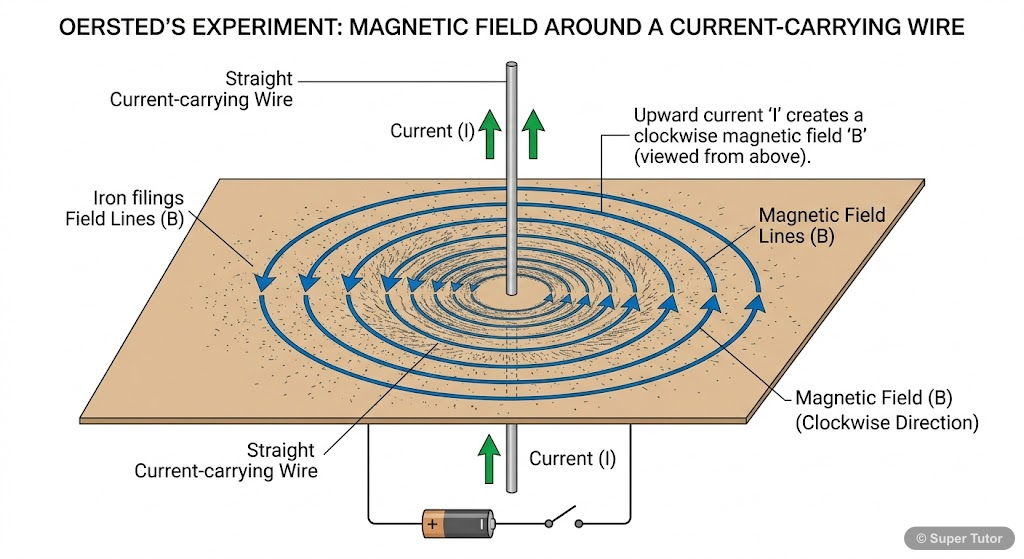
Learn better with visuals Super Tutor pairs illustrations like this with notes and quizzes for Moving Charges and Magnetism.
Overview
The chapter 'Moving Charges and Magnetism' explores the fundamental relationship between electric currents and magnetic fields, a discovery made by Hans Christian Oersted in 1820. This chapter is crucial for understanding how electricity and magnetism are interconnected phenomena. Moving charges (cu
Key Concepts
The total force on a charge
The total force on a charge q moving with velocity v in combined electric and magnetic fields. The magnetic component is F = q(v × B), which is always
Describes the magnetic field dB produced
Describes the magnetic field dB produced by a current element Idl at a point P located at distance r: dB = (μ₀/4π) × (Idl × r)/r³. The magnitude is dB
States that the line integral
States that the line integral of magnetic field B around a closed loop equals μ₀ times the current enclosed by that loop: ∮B·dl = μ₀I_enclosed. Simpli
A long straight wire carrying current
A long straight wire carrying current I produces a magnetic field at distance r perpendicular to it: B = (μ₀I)/(2πr). Field lines form concentric circ
A circular loop of radius R
A circular loop of radius R carrying current I produces field at axial distance x: B = (μ₀IR²)/(2(x² + R²)^(3/2)). At center (x=0): B = (μ₀I)/(2R). Fi
Learning Objectives
- Understand the Lorentz force and how magnetic fields affect moving charges
- Apply the Biot-Savart law to calculate magnetic fields from current elements
- Use Ampere's Circuital Law to find magnetic fields in symmetric situations
- Analyze the motion of charged particles in magnetic fields (circular and helical paths)
- Calculate magnetic fields due to specific current configurations (straight wires, loops, solenoids)
Frequently Asked Questions
What are the important topics in Moving Charges and Magnetism for Punjab Board Class 12 Physics?
How should I revise Moving Charges and Magnetism for the Punjab Board Class 12 board exam?
Sources & Official References
Content is aligned to the official syllabus. Refer to the board website for the latest curriculum.
More resources for Moving Charges and Magnetism
For serious students
Get the full Moving Charges and Magnetism chapter — start free.
Quizzes, flashcards, an AI doubt solver and a study plan for Punjab Board Class 12 Physics. Free to start, no card needed.