Moving Charges and Magnetism — Flashcards
Punjab Board · Class 12 · Physics
24 flashcards for Moving Charges and Magnetism (Punjab Board Class 12 Physics) to test yourself on key terms and facts.
Interactive on Super Tutor
Studying Moving Charges and Magnetism? Get the full interactive chapter.
Quizzes, flashcards, AI doubt-solver and a step-by-step study plan — built for flashcards and more.
Free trial, no card needed.
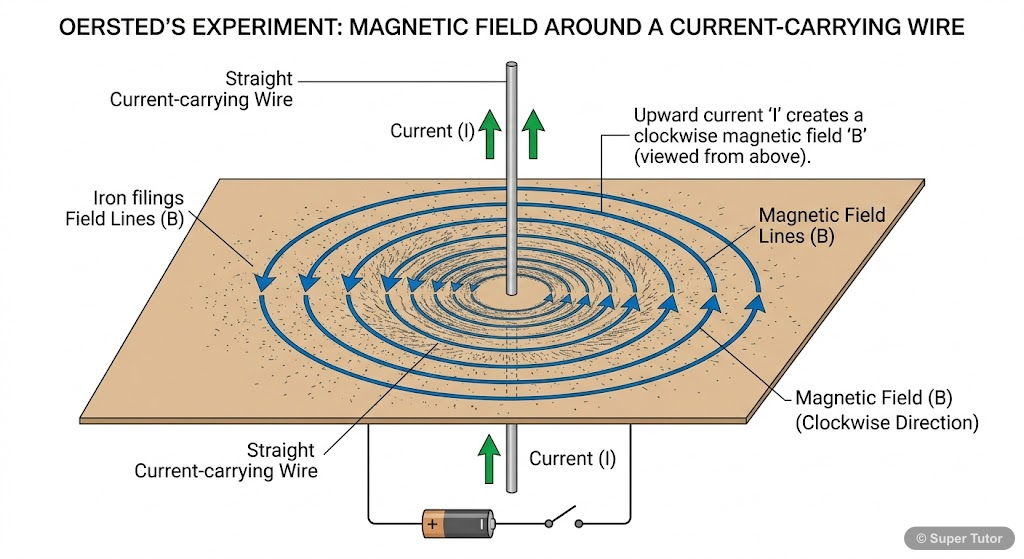
Learn better with visuals Super Tutor pairs illustrations like this with notes and quizzes for Moving Charges and Magnetism.
Define the Lorentz Force. Write its mathematical expression.
Answer
The Lorentz Force is the total electromagnetic force experienced by a charged particle moving in the presence of both electric and magnetic fields. Mathematical Expression: F = q(E + v × B) Where: -…
An electron (charge = 1.6 × 10⁻¹⁹ C) moves with velocity 3 × 10⁷ m/s perpendicular to a magnetic field of 6 × 10⁻⁴ T. Calculate the magnetic force on the electron.
Answer
Given: - q = 1.6 × 10⁻¹⁹ C - v = 3 × 10⁷ m/s - B = 6 × 10⁻⁴ T - θ = 90° (perpendicular, so sin θ = 1) Formula: F = qvB sin θ Step 1: Substitute values F = (1.6 × 10⁻¹⁹) × (3 × 10⁷) × (6 × 10⁻⁴) × 1 …
Why does a moving charged particle experience a magnetic force perpendicular to its velocity, while a stationary charge experiences no magnetic force?
Answer
The magnetic force arises from the motion of charge through a magnetic field. The force is given by F = q(v × B). Key Physics Principle: 1. For stationary charges (v = 0): F = 0 because the velocity …
State Ampere's Circuital Law. What is its simplified form for high-symmetry cases?
Answer
Ampere's Circuital Law: The line integral of the magnetic field around any closed loop is equal to μ₀ times the current enclosed by that loop. Mathematical Form: ∮ B·dl = μ₀I_enclosed Simplified For…
A long straight wire carries a current of 10 A. Calculate the magnetic field at a perpendicular distance of 2 cm from the wire.
Answer
Given: - I = 10 A - r = 2 cm = 0.02 m - μ₀ = 4π × 10⁻⁷ T·m/A Formula (for infinite straight wire): B = (μ₀I)/(2πr) Step 1: Substitute values B = (4π × 10⁻⁷ × 10)/(2π × 0.02) Step 2: Cancel π terms …
Explain why magnetic field lines form closed loops, unlike electric field lines which originate from charges.
Answer
The fundamental difference stems from the nature of sources: Electric Field Lines: - Originate from positive charges (sources) - Terminate at negative charges (sinks) - Because electric monopoles (is…
State the Biot-Savart Law. What does each term represent?
Answer
Biot-Savart Law: The magnetic field dB produced by a small current element at a distance r is: dB = (μ₀/4π) × (I dl sin θ)/r² Vector Form: dB = (μ₀/4π) × (I dl × r)/r³ Where: - dB = Magnetic field …
A semicircular wire of radius 5 cm carries current 10 A. Find the magnetic field at the center of the semicircle. What would it be for a complete circle?
Answer
For Semicircular Wire: Given: - R = 5 cm = 0.05 m - I = 10 A - μ₀ = 4π × 10⁻⁷ T·m/A Step 1: For semicircle, use formula (half of complete loop) B_semi = (1/2) × (μ₀I)/(2R) B_semi = (μ₀I)/(4R) Step …
+16 more flashcards
Practise AllFrequently Asked Questions
What are the important topics in Moving Charges and Magnetism for Punjab Board Class 12 Physics?
How many flashcards are available for Moving Charges and Magnetism?
How should I revise Moving Charges and Magnetism for the Punjab Board Class 12 board exam?
Sources & Official References
Content is aligned to the official syllabus. Refer to the board website for the latest curriculum.
More resources for Moving Charges and Magnetism
Practice Quiz
Test yourself with a quick quiz
Important Questions
Exam-style questions with answers
Revision Notes
Key points for last-minute revision
Formula Sheet
The chapter's formulas in one place
Chapter Summary
Understand the chapter at a glance
Concept Maps
See how topics connect
Syllabus
What topics to cover
For serious students
Get the full Moving Charges and Magnetism chapter — start free.
Quizzes, flashcards, an AI doubt solver and a study plan for Punjab Board Class 12 Physics. Free to start, no card needed.