Optics
Tamil Nadu Board · Class 10 · Science
Most important questions from Optics for Tamil Nadu Board Class 10 Science board exam 2026. MCQs, short answer, and long answer questions with marks.
Interactive on Super Tutor
Studying Optics? Get the full interactive chapter.
Quizzes, flashcards, AI doubt-solver and a step-by-step study plan — built for important questions and more.
1,000+ Class 10 students started this chapter today
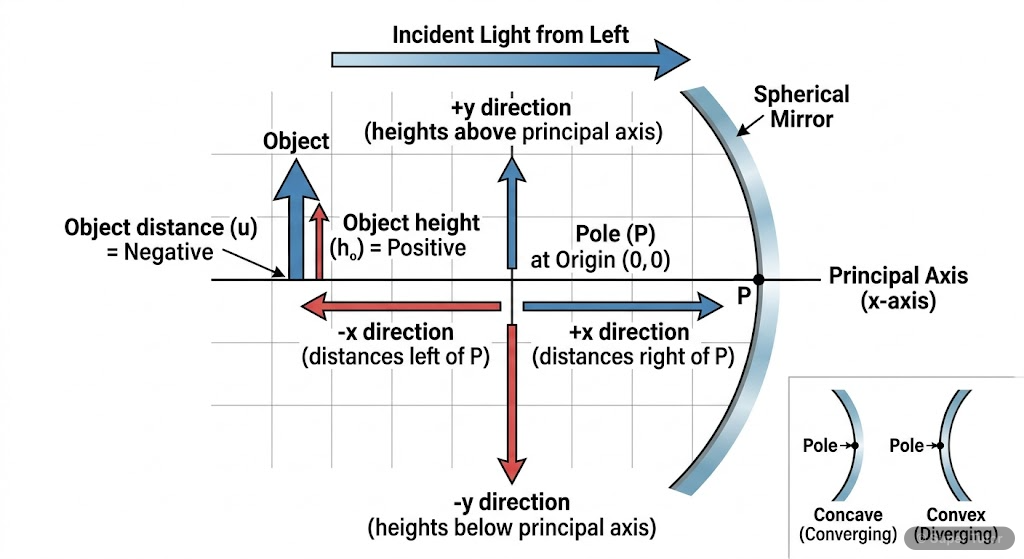
Learn better with visuals Super Tutor has hundreds of illustrations like this across every chapter — all free to try.
Get startedSample Questions
An object is placed at the centre of curvature (C) of a convex lens. What is the nature of the image formed?
Show answer
Real, inverted, and same size as the object
Step 1: For a convex lens, the centre of curvature C is the same as 2F (twice the focal length from the optical centre). Step 2: When an object is placed at 2F (centre of curvature), the image is formed at 2F on the other side of the lens. Step 3: This means the image distance equals the object distance, so the image is the same size as the object (magnification = 1). Step 4: Since the image is formed on the other side of the lens, it is a real image. Step 5: All real images formed by a convex lens are inverted. Therefore, the image is real, inverted, and of the same size.
The lens formula relating object distance (u), image distance (v), and focal length (f) is:
Show answer
1/f = 1/v - 1/u
Step 1: The lens formula is a standard formula used to find the position of images formed by lenses. Step 2: The correct formula is 1/f = 1/v − 1/u, where u is the object distance, v is the image distance, and f is the focal length. Step 3: The sign convention is important — distances are measured from the optical centre; distances in the direction of incident light are positive and opposite are negative. Step 4: The option 1/f = 1/u + 1/v is wrong — it ignores the sign convention between image and object distances. Step 5: This formula applies to both convex and concave lenses when proper sig
A concave lens of focal length 0.5 m is used. What is the power of this lens?
Show answer
-2 D
Step 1: Power of a lens P = 1/f, where f must be in metres. Step 2: A concave lens has a negative focal length by convention, so f = -0.5 m. Step 3: P = 1/f = 1/(-0.5) = -2 D. Step 4: The negative sign confirms it is a concave (diverging) lens — concave lens always has negative power. Step 5: The option +2 D would be the power of a convex lens with f = +0.5 m, which is incorrect for a concave lens. The unit of power is dioptre (D).
The scattering of light by colloidal particles in a colloidal solution is called:
Show answer
Tyndall scattering
Step 1: There are four main types of scattering — Rayleigh, Mie, Tyndall, and Raman. Step 2: Rayleigh scattering is caused by gas molecules in the atmosphere (explains blue sky). Step 3: Mie scattering occurs when the scatterer is similar in size to the wavelength of light (explains white clouds). Step 4: Tyndall scattering specifically refers to the scattering of light by colloidal particles in a colloidal solution — for example, when a beam of light passes through milk or muddy water, its path becomes visible. Step 5: Raman scattering involves a change in the frequency/wavelength of scattere
+41 more questions available
Practice AllFrequently Asked Questions
What are the important topics in Optics for Tamil Nadu Board Class 10 Science?
How to score full marks in Optics — Tamil Nadu Board Class 10 Science?
How many important questions are there in Optics?
Sources & Official References
Content is aligned to the official syllabus. Refer to the board website for the latest curriculum.
More resources for Optics
Practice Quiz
Test yourself with a quick quiz
Revision Notes
Key points for last-minute revision
Formula Sheet
All formulas in one place
Chapter Summary
Understand the chapter at a glance
Concept Maps
See how topics connect visually
Study Plan
Step-by-step plan to ace this chapter
Flashcards
Quick-fire cards for active recall
Syllabus
What topics to cover
NCERT Solutions
Every textbook question solved step by step
For serious students
Get the full Optics chapter — for free.
Quizzes, flashcards, AI doubt-solver and a step-by-step study plan for Tamil Nadu Board Class 10 Science.