Coordination Chemistry — Revision Notes
Tamil Nadu Board · Class 12 · Chemistry
Coordination Chemistry revision notes for Tamil Nadu Board Class 12 Chemistry: 4 topics in quick points. Includes Coordination Compounds vs Double Salts.
Interactive on Super Tutor
Studying Coordination Chemistry? Get the full interactive chapter.
Quizzes, flashcards, AI doubt-solver and a step-by-step study plan — built for revision notes and more.
Free trial, no card needed.
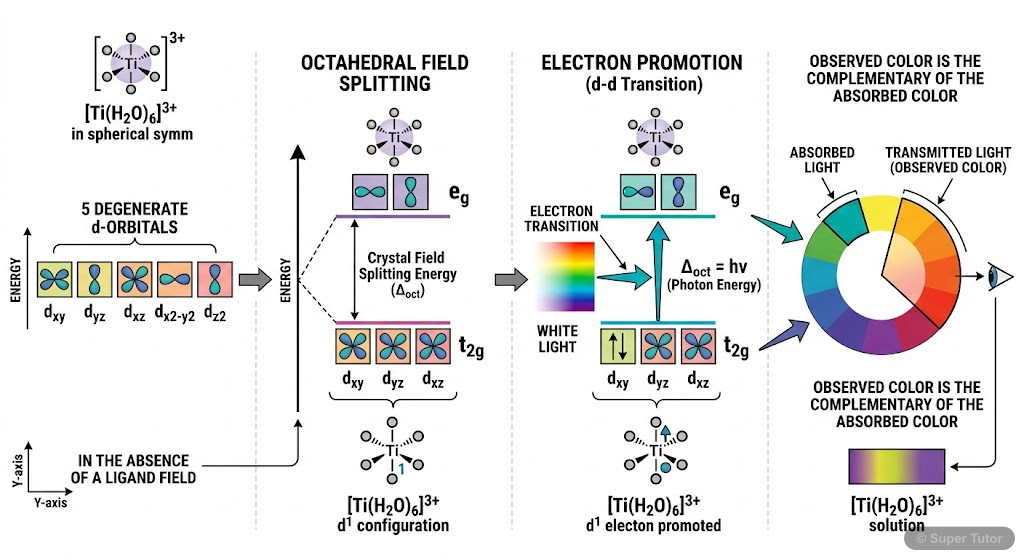
One of 4 illustrations for Coordination Chemistry in Super Tutor — alongside flashcards, concept maps and practice questions.
Key Topics to Revise
1. Coordination Compounds vs Double Salts
- Double salts dissociate completely into simple ions in solution (e.g., Mohr's salt: FeSO₄·(NH₄)₂SO₄·6H₂O)
- Coordination compounds do NOT dissociate into simple ions in solution - the complex ion retains its identity
- Example: K₃[Fe(SCN)₆] gives ferric-thiocyanate complex, NOT simple Fe³⁺ and SCN⁻
2. Werner's Theory of Coordination Compounds
- Proposed in 1893 before electron discovery - based purely on reaction chemistry
- Primary valence = oxidation state of central metal (always satisfied by negative ions)
- Secondary valence = coordination number (satisfied by ligands, can be negative, neutral, or positive ions)
3. Important Terms in Coordination Chemistry
- Coordination entity: Central atom + array of ligands (enclosed in square brackets)
- Central atom/ion: Occupies center, accepts electron pairs (Lewis acid), forms coordinate covalent bonds
- Ligands: Atoms/groups bonded to central metal; donor atom is the atom directly bonded to metal
4. IUPAC Nomenclature of Coordination Compounds
- Cation named first, then anion (regardless of complexity)
- Within complex ion: ligands named in alphabetical order, then central metal
- Anionic ligand names end in 'o' (e.g., cyano, chlorido, fluoro)
Get complete notes with diagrams and examples
Full NotesKey Concepts
Frequently Asked Questions
What are the important topics in Coordination Chemistry for Tamil Nadu Board Class 12 Chemistry?
How should I revise Coordination Chemistry for the Tamil Nadu Board Class 12 board exam?
Sources & Official References
Content is aligned to the official syllabus. Refer to the board website for the latest curriculum.
More resources for Coordination Chemistry
For serious students
Get the full Coordination Chemistry chapter — start free.
Quizzes, flashcards, an AI doubt solver and a study plan for Tamil Nadu Board Class 12 Chemistry. Free to start, no card needed.