Coordination Chemistry — Chapter Summary
Tamil Nadu Board · Class 12 · Chemistry
Summary of Coordination Chemistry for Tamil Nadu Board Class 12 Chemistry. Part of the Tamil Nadu Board Class 12 Chemistry syllabus.
Interactive on Super Tutor
Studying Coordination Chemistry? Get the full interactive chapter.
Quizzes, flashcards, AI doubt-solver and a step-by-step study plan — built for chapter summary and more.
Free trial, no card needed.
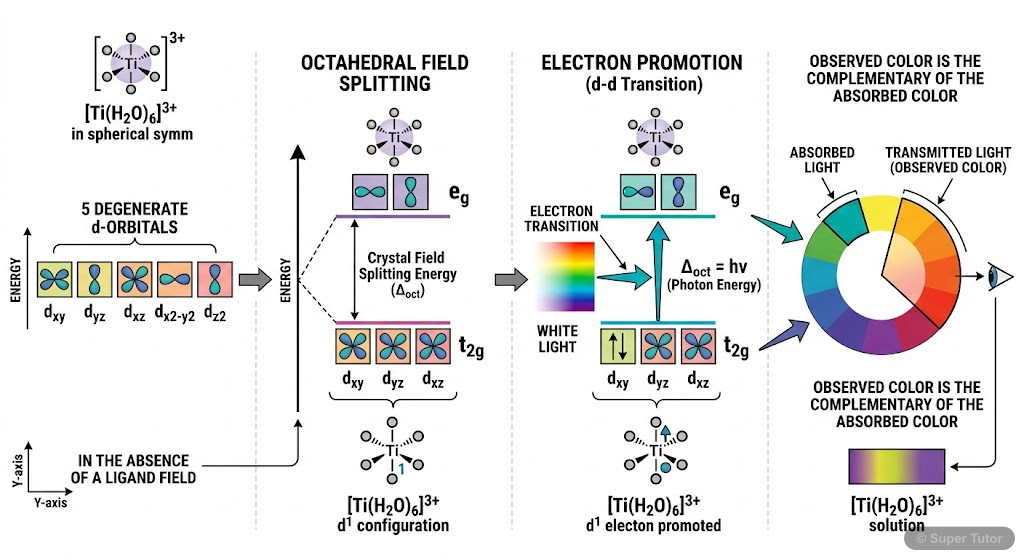
One of 4 illustrations for Coordination Chemistry in Super Tutor — alongside flashcards, concept maps and practice questions.
Overview
Coordination chemistry deals with the study of coordination compounds, which are formed when transition metals bond with ligands through coordinate covalent bonds. These compounds are fascinating because they exhibit unique properties like distinct colors, magnetic behavior, and catalytic activity.
Key Concepts
Double salts like Mohr's salt (FeSO₄·(NH₄)₂SO₄·6H₂O)
Double salts like Mohr's salt (FeSO₄·(NH₄)₂SO₄·6H₂O) completely dissociate in solution into their constituent ions (Fe²⁺, NH₄⁺, SO₄²⁻), losing their i
Werner proposed that elements have two
Werner proposed that elements have two types of valence: primary valence (oxidation state) satisfied by negative ions, and secondary valence (coordina
The coordination sphere is the complex
The coordination sphere is the complex ion enclosed in square brackets: [M(ligands)]^(charge). It contains the central metal atom/ion and all directly
Naming follows specific rules
Naming follows specific rules: (1) Cation is named first, then anion; (2) Ligands are named in alphabetical order before the metal; (3) Anionic ligand
Structural isomers have the same molecular
Structural isomers have the same molecular formula but different arrangements of atoms. Linkage isomerism occurs when ambidentate ligands (like NO₂⁻ o
Learning Objectives
- Define and distinguish between coordination compounds and double salts
- Understand Werner's coordination theory and its postulates
- Learn IUPAC nomenclature rules for naming coordination compounds
- Identify and classify different types of isomerism in coordination compounds
- Apply Valence Bond Theory (VBT) to predict complex geometry and magnetic properties
Frequently Asked Questions
What are the important topics in Coordination Chemistry for Tamil Nadu Board Class 12 Chemistry?
How should I revise Coordination Chemistry for the Tamil Nadu Board Class 12 board exam?
Sources & Official References
Content is aligned to the official syllabus. Refer to the board website for the latest curriculum.
More resources for Coordination Chemistry
For serious students
Get the full Coordination Chemistry chapter — start free.
Quizzes, flashcards, an AI doubt solver and a study plan for Tamil Nadu Board Class 12 Chemistry. Free to start, no card needed.