Coordination Chemistry — Flashcards
Tamil Nadu Board · Class 12 · Chemistry
34 flashcards for Coordination Chemistry (Tamil Nadu Board Class 12 Chemistry) to test yourself on key terms and facts.
Interactive on Super Tutor
Studying Coordination Chemistry? Get the full interactive chapter.
Quizzes, flashcards, AI doubt-solver and a step-by-step study plan — built for flashcards and more.
Free trial, no card needed.
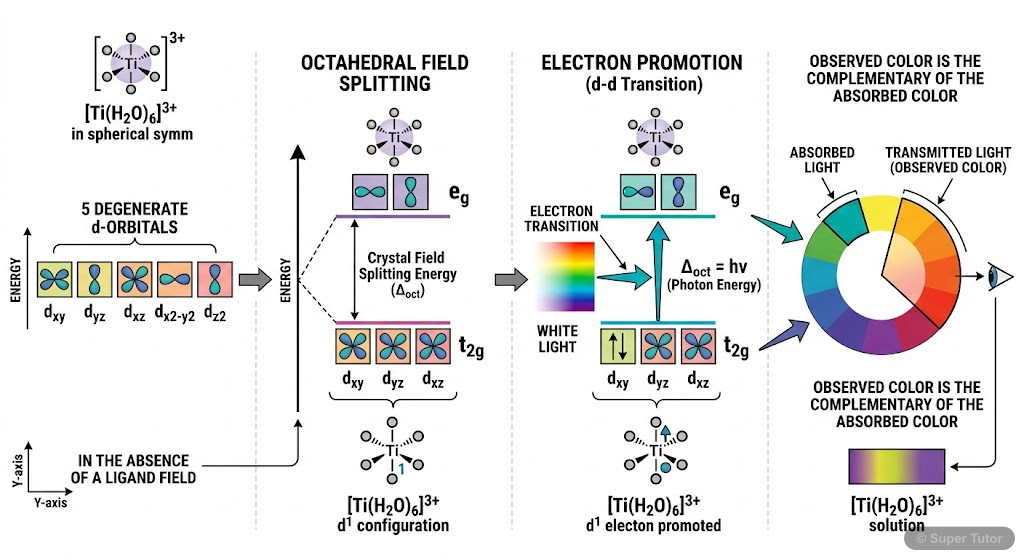
One of 4 illustrations for Coordination Chemistry in Super Tutor — alongside flashcards, concept maps and practice questions.
What is the difference between a double salt and a coordination compound?
Answer
Double Salt: Loses identity in solution, dissociates into constituent simple ions. Example: Mohr's salt [FeSO₄·(NH₄)₂SO₄·6H₂O] gives Fe²⁺, NH₄⁺, SO₄²⁻ ions separately. Coordination Compound: Does not…
Define primary valence and secondary valence according to Werner's theory. What are their modern equivalents?
Answer
Primary Valence: The charge that a metal atom/ion would have if all ligands were removed. Modern equivalent = Oxidation State of the metal. Example: In [Co(NH₃)₆]Cl₃, Co has primary valence of +3. Se…
Explain the concept of coordination sphere and ionisation sphere in coordination compounds.
Answer
Coordination Sphere (Inner Sphere): Contains the central metal atom/ion and all ligands directly bonded to it. Enclosed in square brackets. Groups here are firmly attached and remain together in solut…
In the complex CrCl₂·4H₂O, when treated with AgNO₃, only 1 mole of AgCl is precipitated. Determine the structural formula and assign secondary valence.
Answer
Given: Only 1 Cl⁻ is ionisable (free) in outer sphere, so 2 Cl⁻ must be in inner coordination sphere. Since coordination number of Cr is 6: - 2 Cl⁻ in inner sphere (coordinate with Cr) - 4 H₂O in inn…
Define coordination entity and list its essential components.
Answer
Coordination Entity: An ion or neutral molecule composed of a central atom (usually a metal) and an array of other atoms or groups of atoms (ligands) bonded to it. Essential Components: 1. Central at…
What is coordination number? Give examples of common coordination numbers and their geometries.
Answer
Coordination Number: The number of ligand donor atoms bonded to a central metal ion in a complex. Common Coordination Numbers and Geometries: - CN = 2 → Linear. Example: [Cu(CN)₂]⁻, [Ag(NH₃)₂]⁺ - CN …
Calculate the oxidation state of central metal in [Fe(CN)₆]⁴⁻.
Answer
Formula: Net Charge = (Oxidation State of Metal) + [(Number of Ligands) × (Charge on Ligand)] Given: [Fe(CN)₆]⁴⁻ Net charge = -4 Number of CN⁻ ligands = 6 Charge on each CN⁻ = -1 Calculation: -4 = x…
Calculate the oxidation state of Co in [Co(NH₃)₅Cl]²⁺.
Answer
Formula: Net Charge = (Oxidation State of Metal) + [(Charge on Ligands)] Given: [Co(NH₃)₅Cl]²⁺ Net charge = +2 NH₃ ligands = 5 (neutral, charge = 0) Cl⁻ ligands = 1 (charge = -1) Calculation: +2 = x…
+26 more flashcards
Practise AllFrequently Asked Questions
What are the important topics in Coordination Chemistry for Tamil Nadu Board Class 12 Chemistry?
How many flashcards are available for Coordination Chemistry?
How should I revise Coordination Chemistry for the Tamil Nadu Board Class 12 board exam?
Sources & Official References
Content is aligned to the official syllabus. Refer to the board website for the latest curriculum.
More resources for Coordination Chemistry
For serious students
Get the full Coordination Chemistry chapter — start free.
Quizzes, flashcards, an AI doubt solver and a study plan for Tamil Nadu Board Class 12 Chemistry. Free to start, no card needed.