Electro Chemistry
Tamil Nadu Board · Class 12 · Chemistry
Most important questions from Electro Chemistry for Tamil Nadu Board Class 12 Chemistry board exam 2026. MCQs, short answer, and long answer questions with marks.
Interactive on Super Tutor
Studying Electro Chemistry? Get the full interactive chapter.
Quizzes, flashcards, AI doubt-solver and a step-by-step study plan — built for important questions and more.
1,000+ Class 12 students started this chapter today
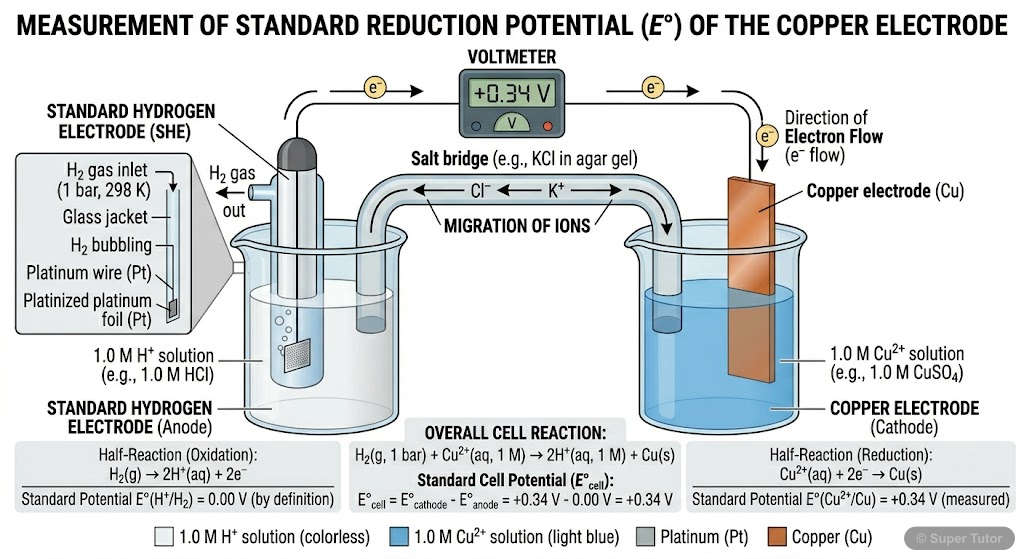
Learn better with visuals Super Tutor has hundreds of illustrations like this across every chapter — all free to try.
Get startedSample Questions
The standard reduction potential of Zn²⁺/Zn is −0.76 V and that of Cu²⁺/Cu is +0.34 V. What is the standard EMF of the Daniel cell?
Show answer
1.10 V
Step 1: In the Daniel cell, Zn is the anode (oxidation) and Cu is the cathode (reduction). Step 2: Standard oxidation potential of Zn = −(−0.76) = +0.76 V (reverse the sign of reduction potential). Step 3: Standard reduction potential of Cu²⁺/Cu = +0.34 V. Step 4: E°cell = E°ox(anode) + E°red(cathode) = 0.76 + 0.34 = 1.10 V. Option B (0.42) is obtained by subtracting, which is wrong here. Option C gives a negative value which would indicate a non-spontaneous reaction. Option D only uses Zn's value and ignores Cu.
The Nernst equation at 25°C for a cell reaction is: Ecell = E°cell − (0.0591/n) log Q. What does 'n' represent in this equation?
Show answer
Number of moles of electrons transferred in the balanced cell reaction
Step 1: The Nernst equation is derived from ΔG = −nFEcell and ΔG = ΔG° + RT ln Q. Step 2: Here 'n' is the number of moles of electrons exchanged between the oxidising and reducing agents in the overall balanced cell reaction. Step 3: For the Daniel cell (Zn + Cu²⁺ → Zn²⁺ + Cu), n = 2 because 2 electrons are transferred. Step 4: This 'n' appears because Faraday's law uses nF as total charge (n moles of electrons × F coulombs/mol). Other options describe different quantities entirely and would change the physical meaning of the equation.
According to Faraday's First Law of electrolysis, if a current of 2 A is passed for 20 minutes through AgNO₃ solution, what mass of silver is deposited? (Molar mass of Ag = 108 g/mol, 1F = 96500 C)
Show answer
2.68 g
Step 1: Calculate charge Q = I × t = 2 A × (20 × 60) s = 2 × 1200 = 2400 C. Step 2: Find electrochemical equivalent Z = Molar mass / (n × F) = 108 / (1 × 96500) g/C. (n=1 because Ag⁺ + e⁻ → Ag requires 1 electron). Step 3: Use m = Z × I × t = Z × Q = (108/96500) × 2400. Step 4: m = (108 × 2400) / 96500 = 259200 / 96500 ≈ 2.68 g. Option B would be double (wrong time/current), Option C is half the correct answer, Option D is the molar mass itself (deposited only when 1 mole = 96500 C is passed).
In an electrolytic cell used for the electrolysis of molten NaCl, which reaction occurs at the cathode?
Show answer
Na⁺(l) + e⁻ → Na(l)
Step 1: In an electrolytic cell, the cathode is connected to the negative terminal of the power supply. Step 2: The cathode attracts cations (positive ions) from the melt. Step 3: Na⁺ ions are attracted to the cathode and gain electrons — this is reduction. Step 4: Na⁺(l) + e⁻ → Na(l), E° = −2.71 V. Option B is the anode reaction (oxidation of Cl⁻). Option C is also an oxidation reaction, which occurs at the anode. Option D is reduction of Cl₂, which does not happen under these conditions. Cathode = reduction = gain of electrons.
+41 more questions available
Practice AllFrequently Asked Questions
What are the important topics in Electro Chemistry for Tamil Nadu Board Class 12 Chemistry?
How to score full marks in Electro Chemistry — Tamil Nadu Board Class 12 Chemistry?
How many important questions are there in Electro Chemistry?
Sources & Official References
Content is aligned to the official syllabus. Refer to the board website for the latest curriculum.
More resources for Electro Chemistry
Practice Quiz
Test yourself with a quick quiz
Revision Notes
Key points for last-minute revision
Formula Sheet
All formulas in one place
Chapter Summary
Understand the chapter at a glance
Concept Maps
See how topics connect visually
Study Plan
Step-by-step plan to ace this chapter
Flashcards
Quick-fire cards for active recall
Syllabus
What topics to cover
NCERT Solutions
Every textbook question solved step by step
For serious students
Get the full Electro Chemistry chapter — for free.
Quizzes, flashcards, AI doubt-solver and a step-by-step study plan for Tamil Nadu Board Class 12 Chemistry.