Electro Chemistry — Chapter Summary
Tamil Nadu Board · Class 12 · Chemistry
Summary of Electro Chemistry for Tamil Nadu Board Class 12 Chemistry. Part of the Tamil Nadu Board Class 12 Chemistry syllabus.
Interactive on Super Tutor
Studying Electro Chemistry? Get the full interactive chapter.
Quizzes, flashcards, AI doubt-solver and a step-by-step study plan — built for chapter summary and more.
Free trial, no card needed.
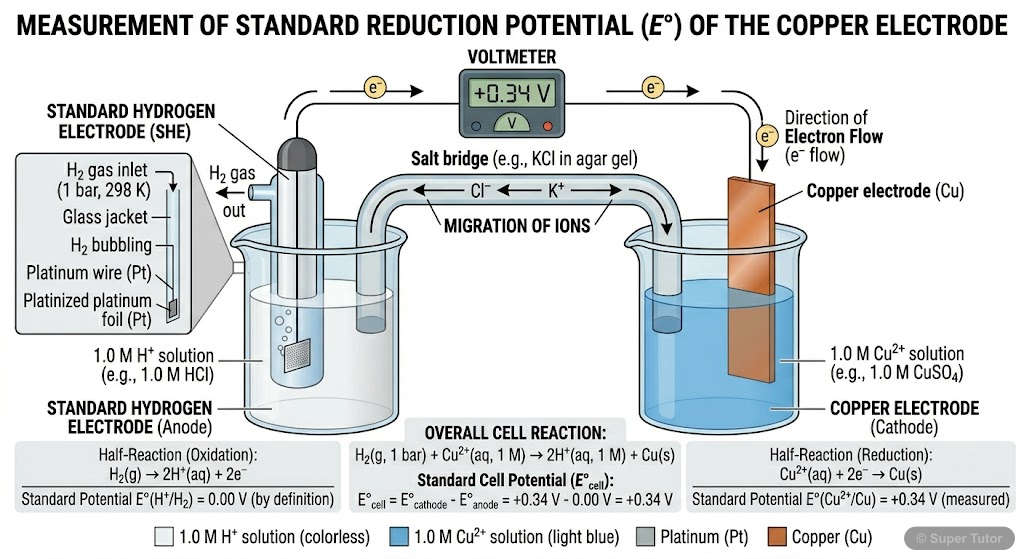
Learn better with visuals Super Tutor pairs illustrations like this with notes and quizzes for Electro Chemistry.
Overview
Electrochemistry is the fascinating branch of chemistry that studies the conversion between chemical energy and electrical energy. This chapter explores how spontaneous chemical reactions can generate electric current (as in batteries and fuel cells) and how electrical energy can drive non-spontaneo
Key Concepts
Conductivity is the ability of
Conductivity is the ability of an electrolytic solution to conduct electric current through the movement of ions. It is the reciprocal of resistivity
Molar conductivity (Λₘ) is the conductance
Molar conductivity (Λₘ) is the conductance of a solution containing one mole of electrolyte in a volume V (in m³), measured between electrodes 1 meter
At infinite dilution
At infinite dilution, the molar conductivity approaches a limiting value Λ₀ₘ where interionic attractions become negligible. Kohlrausch's law states t
A galvanic cell is a device
A galvanic cell is a device where a spontaneous redox reaction generates electrical current. The Daniel cell exemplifies this: Zn(s) | Zn²⁺(aq) || Cu²
The standard electrode potential (E°)
The standard electrode potential (E°) is the potential of an electrode relative to the standard hydrogen electrode, which is arbitrarily assigned 0V.
Learning Objectives
- Understand and apply concepts of conductivity, resistivity, and molar conductivity in electrolytic solutions
- Define and calculate equivalent conductivity and apply Kohlrausch's law for weak electrolytes
- Distinguish between galvanic cells (electrochemical cells) and electrolytic cells
- Construct and interpret galvanic cells using IUPAC cell notation
- Calculate electrode potentials using the standard hydrogen electrode as reference
Frequently Asked Questions
What are the important topics in Electro Chemistry for Tamil Nadu Board Class 12 Chemistry?
How should I revise Electro Chemistry for the Tamil Nadu Board Class 12 board exam?
Sources & Official References
Content is aligned to the official syllabus. Refer to the board website for the latest curriculum.
More resources for Electro Chemistry
For serious students
Get the full Electro Chemistry chapter — start free.
Quizzes, flashcards, an AI doubt solver and a study plan for Tamil Nadu Board Class 12 Chemistry. Free to start, no card needed.