Electro Chemistry — Syllabus
Tamil Nadu Board · Class 12 · Chemistry
What Electro Chemistry covers in Tamil Nadu Board Class 12 Chemistry: 4 topics, for the 2026-27 session. Topics include 1 Conductivity of Electrolytic.
Interactive on Super Tutor
Studying Electro Chemistry? Get the full interactive chapter.
Quizzes, flashcards, AI doubt-solver and a step-by-step study plan — built for syllabus and more.
Free trial, no card needed.
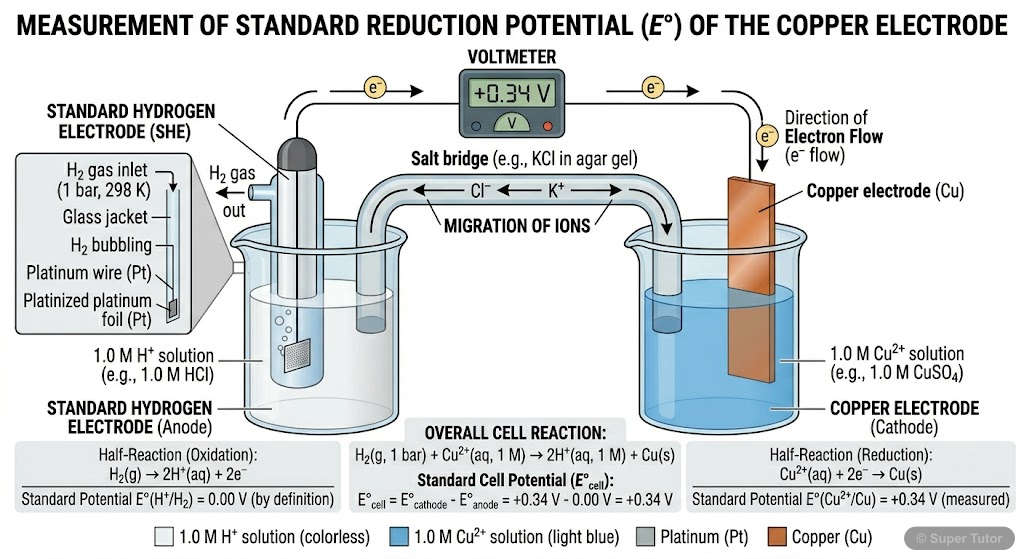
Learn better with visuals Super Tutor pairs illustrations like this with notes and quizzes for Electro Chemistry.
Topics in Electro Chemistry
9.1 Conductivity of Electrolytic Solutions
- Conductivity is the ability of a solution to conduct electric current through the movement of ions
- Resistance (R) is inversely proportional to conductance (C): C = 1/R
- Resistivity (ρ) depends on the nature of the electrolyte and is defined as R = ρ(l/A)
9.2 Kohlraush's Law and Applications
- Kohlrasch's law states that at infinite dilution, Λm° equals the sum of ionic molar conductances of constituent ions
- For electrolyte AxBy: Λm° = x(λm°)A^y+ + y(λm°)B^x-
- Each ion contributes a fixed amount to molar conductance independent of other ions present
9.3 Electrochemical Cells
- Electrochemical cells convert between chemical and electrical energy
- Galvanic cells produce electrical energy from spontaneous redox reactions (E° > 0)
- Electrolytic cells consume electrical energy to drive non-spontaneous reactions (E° < 0)
9.4 Thermodynamics and Nernst Equation
- Maximum electrical work done by cell: Wmax = -nFEcell
- Free energy change related to cell potential: ΔG° = -nFEcell°
- At equilibrium (when Ecell = 0): ΔG° = -nFEcell° = -RT ln(Keq) = 0, so Keq = 1 doesn't mean K=1
Key Concepts
Work through every topic in Electro Chemistry with notes and quizzes
Start This ChapterFrequently Asked Questions
What are the important topics in Electro Chemistry for Tamil Nadu Board Class 12 Chemistry?
How should I revise Electro Chemistry for the Tamil Nadu Board Class 12 board exam?
Sources & Official References
Content is aligned to the official syllabus. Refer to the board website for the latest curriculum.
More resources for Electro Chemistry
Practice Quiz
Test yourself with a quick quiz
Important Questions
Exam-style questions with answers
Revision Notes
Key points for last-minute revision
Formula Sheet
The chapter's formulas in one place
Chapter Summary
Understand the chapter at a glance
Concept Maps
See how topics connect
Flashcards
Quick-fire cards for active recall
For serious students
Get the full Electro Chemistry chapter — start free.
Quizzes, flashcards, an AI doubt solver and a study plan for Tamil Nadu Board Class 12 Chemistry. Free to start, no card needed.