Hydroxy Compounds and Ethers
Tamil Nadu Board · Class 12 · Chemistry
Most important questions from Hydroxy Compounds and Ethers for Tamil Nadu Board Class 12 Chemistry board exam 2026. MCQs, short answer, and long answer questions with marks.
Interactive on Super Tutor
Studying Hydroxy Compounds and Ethers? Get the full interactive chapter.
Quizzes, flashcards, AI doubt-solver and a step-by-step study plan — built for important questions and more.
1,000+ Class 12 students started this chapter today
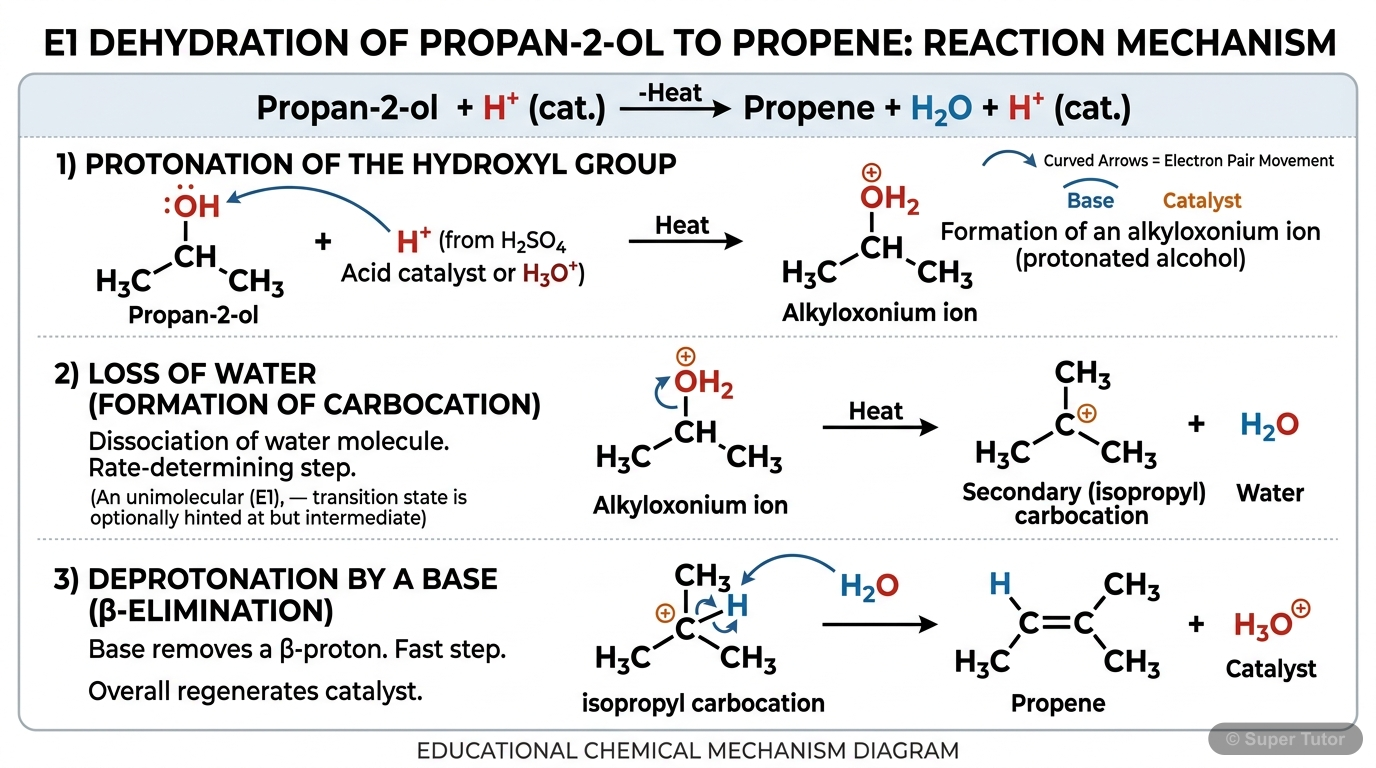
This is just one of 5+ visuals inside Super Tutor's Hydroxy Compounds and Ethers chapter
Explore the full setSample Questions
The dehydration of 3,3-dimethylbutan-2-ol with H₂SO₄ gives predominantly 2,3-dimethylbut-2-ene. Which intermediate explains this?
Show answer
A secondary carbocation that undergoes 1,2-hydride shift to form a more stable tertiary carbocation
Step 1 – 3,3-Dimethylbutan-2-ol: CH₃CH(OH)C(CH₃)₃. Protonation of –OH by H₂SO₄ gives oxonium ion, which loses water to form a secondary carbocation at C-2. Step 2 – The secondary carbocation (less stable) undergoes a 1,2-hydride shift: a hydrogen with its bonding electrons migrates from C-3 to C-2. This converts the secondary carbocation to a MORE stable tertiary carbocation at C-3. Step 3 – The tertiary carbocation at C-3 then loses a proton (Saytzeff's rule) to give the most substituted alkene: 2,3-dimethylbut-2-ene (4 alkyl substituents, 64% yield). Step 4 – Option C is wrong: a tertiary
Which reagent selectively oxidises a primary alcohol to an aldehyde WITHOUT further oxidation to carboxylic acid?
Show answer
Pyridinium chlorochromate (PCC)
Step 1 – The oxidation of primary alcohol normally proceeds: R-CH₂OH → R-CHO → R-COOH. The challenge is to STOP at aldehyde stage. Step 2 – PCC (Pyridinium chlorochromate, C₅H₅NH⁺CrO₃Cl⁻) is a mild oxidising agent that selectively oxidises primary alcohols to aldehydes and secondary alcohols to ketones. It does NOT further oxidise aldehydes to carboxylic acids because the reaction conditions (anhydrous, mild) do not support the hydration of aldehyde needed for further oxidation. Step 3 – Acidified K₂Cr₂O₇ (Option A) and KMnO₄/H₂SO₄ (Option C) are STRONG oxidising agents. They oxidise primary
Phenol reacts with CHCl₃ in the presence of NaOH to give salicylaldehyde (2-hydroxybenzaldehyde). This reaction is known as:
Show answer
Riemer-Tiemann reaction
Step 1 – The Riemer-Tiemann reaction involves treating phenol with chloroform (CHCl₃) in the presence of NaOH. A –CHO group is introduced at the ORTHO position of the phenol ring. Step 2 – Mechanism: CHCl₃ + NaOH → :CCl₂ (dichlorocarbene, a highly reactive electrophile). This electrophile attacks the activated benzene ring at the ortho position (–OH is ortho/para director). Step 3 – The intermediate substituted benzal dichloride is hydrolysed by NaOH to give the ortho-hydroxy benzaldehyde (salicylaldehyde). Step 4 – Do not confuse with: Kolbe-Schmitt (uses CO₂/NaOH, gives salicylic acid), S
In the preparation of phenol from cumene, the intermediate that is hydrolysed with dilute acid to give phenol and acetone is:
Show answer
Cumene hydroperoxide
Step 1 – Cumene (isopropylbenzene) is prepared by Friedel-Crafts alkylation of benzene with propene in presence of H₃PO₄ at 523K. Step 2 – When air is passed through a mixture of cumene and 5% aqueous Na₂CO₃, the benzylic C-H bond is oxidised by O₂. The secondary benzylic carbon readily forms a radical, which reacts with O₂ to form cumene hydroperoxide: C₆H₅C(CH₃)₂–O–O–H. Step 3 – Cumene hydroperoxide on treatment with dilute H₂SO₄ undergoes cleavage (Hock rearrangement) to give phenol (C₆H₅OH) and acetone (CH₃COCH₃). Step 4 – This is the industrial (Dow's cumene) process for phenol product
+41 more questions available
Practice AllFrequently Asked Questions
What are the important topics in Hydroxy Compounds and Ethers for Tamil Nadu Board Class 12 Chemistry?
How to score full marks in Hydroxy Compounds and Ethers — Tamil Nadu Board Class 12 Chemistry?
How many important questions are there in Hydroxy Compounds and Ethers?
Sources & Official References
Content is aligned to the official syllabus. Refer to the board website for the latest curriculum.
More resources for Hydroxy Compounds and Ethers
Practice Quiz
Test yourself with a quick quiz
Revision Notes
Key points for last-minute revision
Formula Sheet
All formulas in one place
Chapter Summary
Understand the chapter at a glance
Concept Maps
See how topics connect visually
Study Plan
Step-by-step plan to ace this chapter
Flashcards
Quick-fire cards for active recall
Syllabus
What topics to cover
NCERT Solutions
Every textbook question solved step by step
For serious students
Get the full Hydroxy Compounds and Ethers chapter — for free.
Quizzes, flashcards, AI doubt-solver and a step-by-step study plan for Tamil Nadu Board Class 12 Chemistry.