Hydroxy Compounds and Ethers — Flashcards
Tamil Nadu Board · Class 12 · Chemistry
37 flashcards for Hydroxy Compounds and Ethers (Tamil Nadu Board Class 12 Chemistry) to test yourself on key terms and facts.
Interactive on Super Tutor
Studying Hydroxy Compounds and Ethers? Get the full interactive chapter.
Quizzes, flashcards, AI doubt-solver and a step-by-step study plan — built for flashcards and more.
Free trial, no card needed.
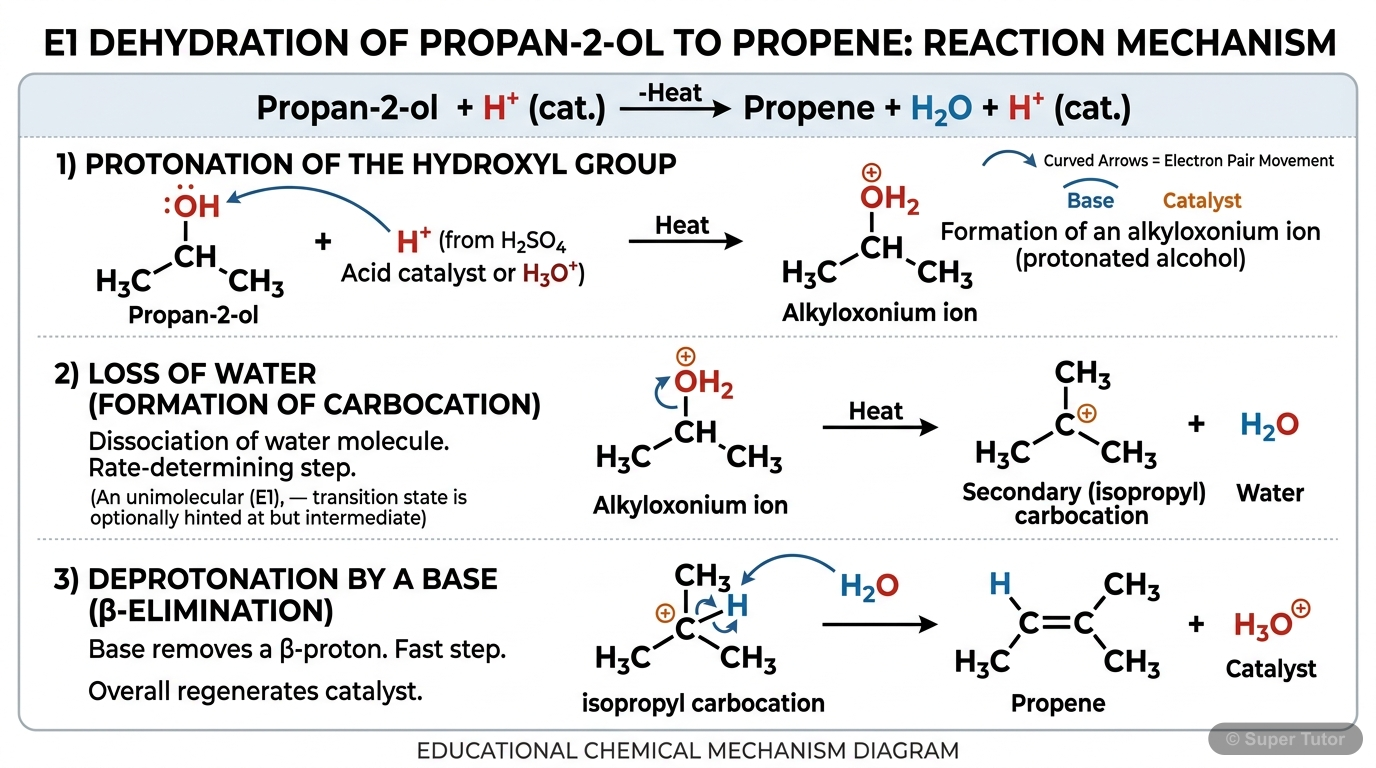
One of 2 illustrations for Hydroxy Compounds and Ethers in Super Tutor — alongside flashcards, concept maps and practice questions.
What is the structure of the hydroxyl functional group (-OH) in alcohols? Describe the bonding and geometry.
Answer
The -OH group in alcohols is attached to an sp³ hybridized carbon. The oxygen is also sp³ hybridized with two lone pairs. One sp³ orbital of oxygen overlaps with sp³ orbital of carbon to form C-O σ bo…
Classify the following alcohols as primary (1°), secondary (2°), or tertiary (3°): (i) CH₃-CH₂-CH(OH)CH₂-C(CH₃)₂ (ii) (C₂H₅)₃COH (iii) CH₃-CH₂-CH₂-OH
Answer
(i) CH₃-CH₂-CH(OH)CH₂-C(CH₃)₂ = Secondary alcohol (2°). The OH group is attached to a carbon with two alkyl groups. (ii) (C₂H₅)₃COH = Tertiary alcohol (3°). The OH group is attached to a carbon with t…
Give the IUPAC name for: CH₃-CH(OH)-CH₂-CH₃
Answer
IUPAC Name: Butan-2-ol Steps: (1) Identify longest chain containing -OH: 4 carbons = butane. (2) Number from the end closest to -OH: OH is at position 2. (3) Apply IUPAC rules: but(root for 4 carbons)…
What happens when ethanol is heated with concentrated H₂SO₄ at 443K? Write the balanced equation and name the mechanism.
Answer
Reaction: CH₃-CH₂-OH → (conc. H₂SO₄, 443K) → CH₂=CH₂ + H₂O Balanced equation: C₂H₅OH(l) → C₂H₄(g) + H₂O(l) This is an elimination reaction (dehydration). Mechanism: E1 for tertiary alcohols (two-step:…
Write the mechanism for formation of 2-methylprop-2-ol from 2-methylpropene with H₂SO₄ and water. Identify the type of addition reaction.
Answer
Reaction: (CH₃)₂C=CH₂ + H₂O → (conc. H₂SO₄) → (CH₃)₃COH Mechanism (Markovnikov addition): Step 1: Protonation of π electrons by H⁺ to form carbocation intermediate: (CH₃)₂C⁺-CH₃ (tertiary, most stable…
A Grignard reagent is treated with formaldehyde followed by acid hydrolysis. What type of alcohol is formed? Give an example reaction.
Answer
A primary alcohol (1°) is formed. Example: CH₃-MgBr + HCHO (formaldehyde) → CH₃-CH₂-O-MgBr (in dry ether). After acid hydrolysis (with dilute HCl): CH₃-CH₂-OH (ethanol, primary alcohol). The reaction …
Calculate the number of moles of H₂ gas liberated when 3.2g of ethanol reacts with sodium metal. (Molar mass of ethanol = 46 g/mol, Molar mass of H₂ = 2 g/mol)
Answer
Reaction: 2C₂H₅OH + 2Na → 2C₂H₅ONa + H₂↑ Step 1: Calculate moles of ethanol: n = mass/molar mass = 3.2/46 = 0.0696 mol Step 2: From stoichiometry, 2 moles of ethanol produce 1 mole of H₂ Step 3: Moles…
What is the Lucas test? Explain how it differentiates between primary, secondary, and tertiary alcohols.
Answer
Lucas test uses Lucas reagent (concentrated HCl + anhydrous ZnCl₂). The reaction follows nucleophilic substitution mechanism forming alkyl chloride (insoluble, causes turbidity). Results: (1) Tertiary…
+29 more flashcards
Practise AllFrequently Asked Questions
What are the important topics in Hydroxy Compounds and Ethers for Tamil Nadu Board Class 12 Chemistry?
How many flashcards are available for Hydroxy Compounds and Ethers?
How should I revise Hydroxy Compounds and Ethers for the Tamil Nadu Board Class 12 board exam?
Sources & Official References
Content is aligned to the official syllabus. Refer to the board website for the latest curriculum.
More resources for Hydroxy Compounds and Ethers
Practice Quiz
Test yourself with a quick quiz
Important Questions
Exam-style questions with answers
Revision Notes
Key points for last-minute revision
Formula Sheet
The chapter's formulas in one place
Chapter Summary
Understand the chapter at a glance
Concept Maps
See how topics connect
Syllabus
What topics to cover
For serious students
Get the full Hydroxy Compounds and Ethers chapter — start free.
Quizzes, flashcards, an AI doubt solver and a study plan for Tamil Nadu Board Class 12 Chemistry. Free to start, no card needed.