Chapter 8 of 15
Revision Notes
Hydroxy Compounds and Ethers — Revision Notes
Tamil Nadu Board · Class 12 · Chemistry
Hydroxy Compounds and Ethers revision notes for Tamil Nadu Board Class 12 Chemistry: 4 topics in quick points.
45 questions37 flashcards3 formulas & key relations5 concepts
Interactive on Super Tutor
Studying Hydroxy Compounds and Ethers? Get the full interactive chapter.
Quizzes, flashcards, AI doubt-solver and a step-by-step study plan — built for revision notes and more.
Free trial, no card needed.
Super Tutor
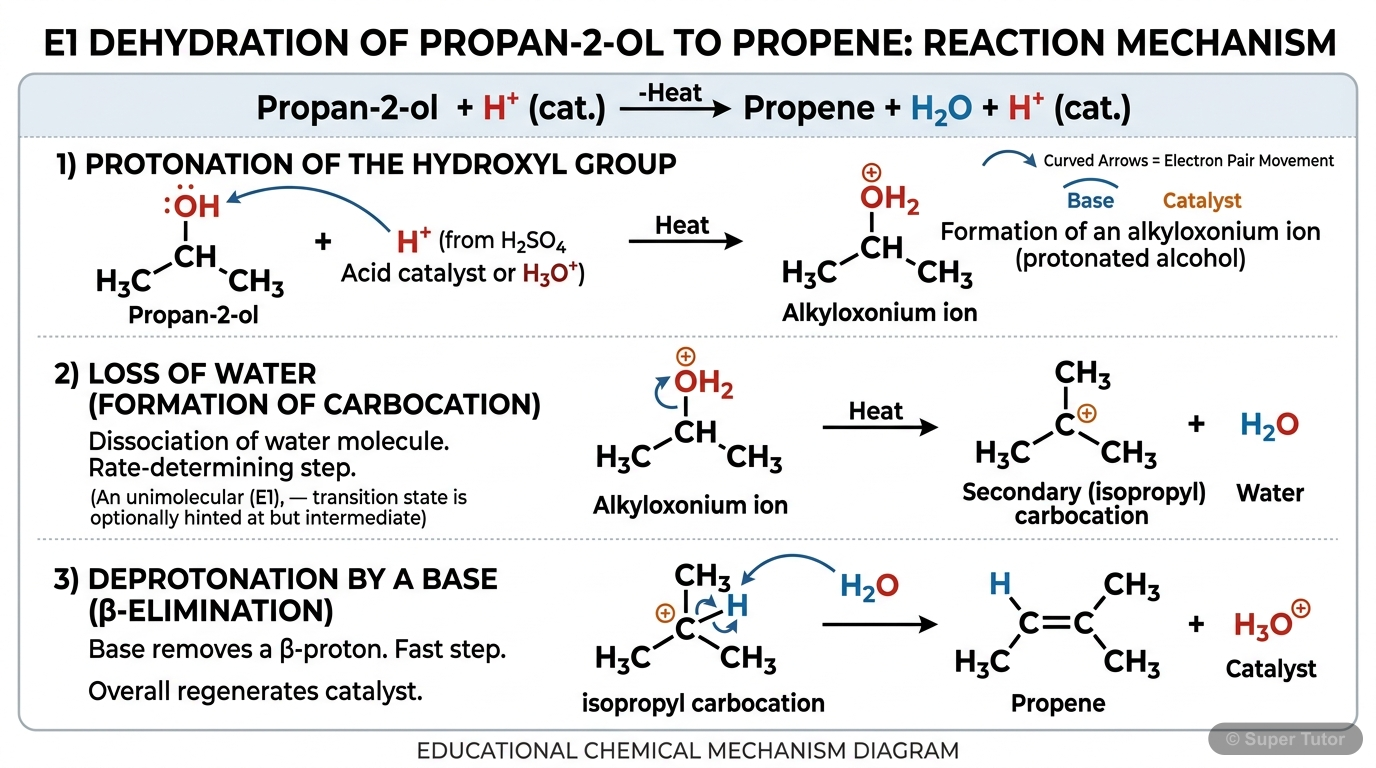
One of 2 illustrations for Hydroxy Compounds and Ethers in Super Tutor — alongside flashcards, concept maps and practice questions.
Key Topics to Revise
1
1. Classification and Nomenclature of Alcohols
- Alcohols are organic compounds with a hydroxyl (-OH) functional group attached to a saturated carbon atom
- Primary alcohols (1°): -OH attached to a carbon connected to only one other carbon (R-CH₂-OH)
- Secondary alcohols (2°): -OH attached to a carbon connected to two other carbons (R₂CH-OH)
2
2. Preparation of Alcohols
- From alkyl halides: R-X + NaOH(aq) → R-OH + NaX (primary alcohols via SN2; secondary/tertiary via SN1)
- From alkenes: CH₃CH=CH₂ + H₂O → CH₃CH(OH)CH₃ (follows Markownikoff's rule with H₂SO₄ catalyst)
- From Grignard reagent: RMgX + R'CHO → R-CH(OH)-R' (primary alcohol), RMgX + R'₂CO → R-CR'₂-OH (secondary/tertiary)
3
3. Physical Properties of Alcohols
- Lower alcohols (C₁-C₃) are colorless liquids; higher alcohols (C₁₂+) are waxes or solids
- Boiling points are higher than corresponding alkanes, aldehydes, and ethers due to intermolecular hydrogen bonding between O-H groups
- Boiling point trend among isomers: primary > secondary > tertiary (more branching = lower b.p.)
4
4. Chemical Properties - Nucleophilic Substitution of Alcohols
- The -OH group is weakly basic but strongly attached to carbon (not a good leaving group in its neutral form)
- In acidic conditions, -OH is protonated to form -OH₂⁺ (oxonium ion), which is an excellent leaving group
- Primary alcohols undergo SN2 (bimolecular nucleophilic substitution) mechanism with HX or PX₃
Get complete notes with diagrams and examples
Full NotesKey Concepts
Alcohols are classified as primary (1°)IUPAC naming followsTheFive major methods existAlcohols are weak nucleophiles because OH⁻
Frequently Asked Questions
What are the important topics in Hydroxy Compounds and Ethers for Tamil Nadu Board Class 12 Chemistry?
Key topics in Hydroxy Compounds and Ethers include Classification and Nomenclature of Alcohols, Preparation of Alcohols, Physical Properties of Alcohols, Chemical Properties - Nucleophilic Substitution of Alcohols. Study these first, then practise questions on each for the Tamil Nadu Board Class 12 board exam.
How should I revise Hydroxy Compounds and Ethers for the Tamil Nadu Board Class 12 board exam?
Learn the core ideas first, then work through the 45 practice questions on Hydroxy Compounds and Ethers. Revise definitions regularly and use flashcards for quick recall before the exam.
Sources & Official References
Content is aligned to the official syllabus. Refer to the board website for the latest curriculum.
More resources for Hydroxy Compounds and Ethers
For serious students
Get the full Hydroxy Compounds and Ethers chapter — start free.
Quizzes, flashcards, an AI doubt solver and a study plan for Tamil Nadu Board Class 12 Chemistry. Free to start, no card needed.