Hydroxy Compounds and Ethers — Chapter Summary
Tamil Nadu Board · Class 12 · Chemistry
Summary of Hydroxy Compounds and Ethers for Tamil Nadu Board Class 12 Chemistry. Key concepts: Alcohols are classified as, IUPAC naming follows and The.
Interactive on Super Tutor
Studying Hydroxy Compounds and Ethers? Get the full interactive chapter.
Quizzes, flashcards, AI doubt-solver and a step-by-step study plan — built for chapter summary and more.
Free trial, no card needed.
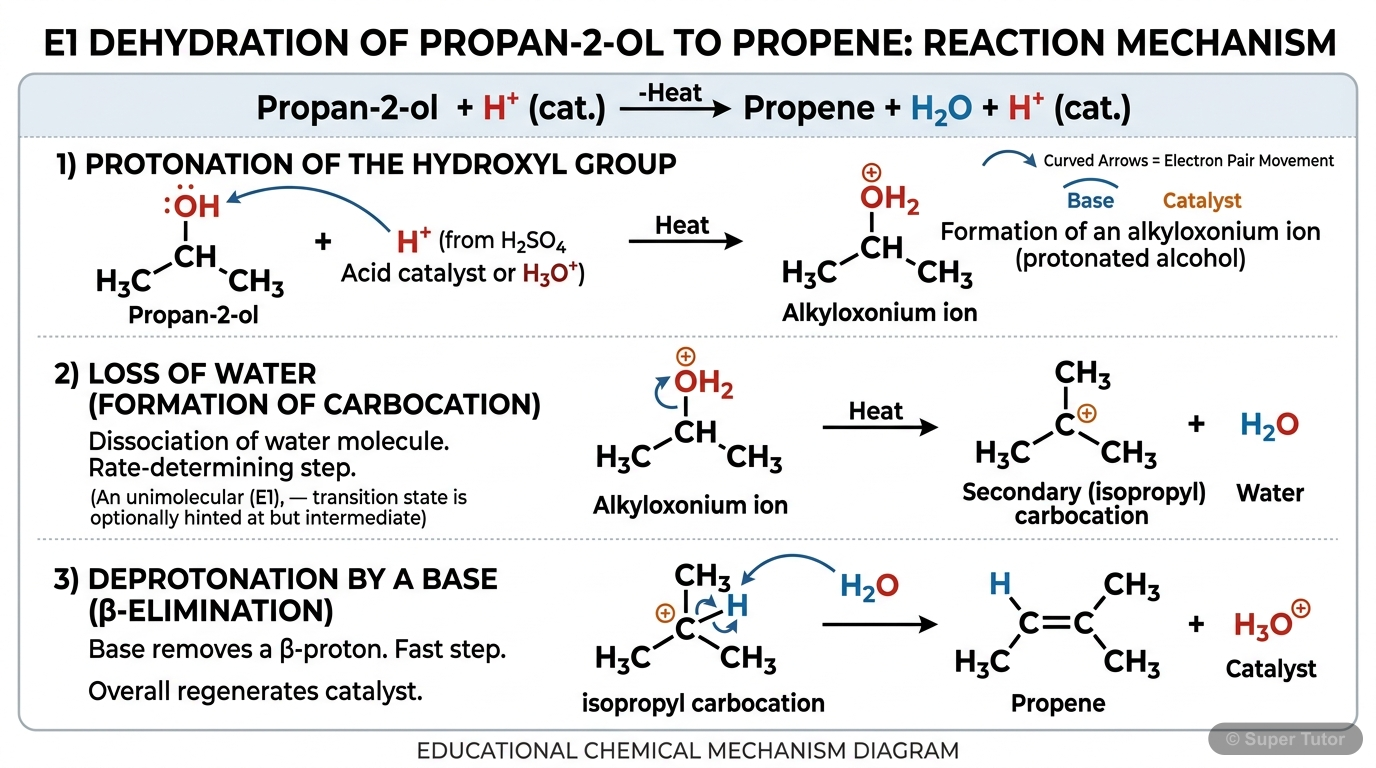
One of 2 illustrations for Hydroxy Compounds and Ethers in Super Tutor — alongside flashcards, concept maps and practice questions.
Overview
Hydroxy compounds and ethers are fundamental organic compounds containing oxygen. Hydroxy compounds include alcohols and phenols, characterized by the hydroxyl (-OH) functional group attached to carbon. Ethers contain an oxygen atom bonded to two alkyl or aryl groups (R-O-R'). These compounds play c
Key Concepts
Alcohols are classified as primary (1°)
Alcohols are classified as primary (1°), secondary (2°), or tertiary (3°) based on the carbon to which the -OH group is attached. Primary alcohols hav
IUPAC naming follows
IUPAC naming follows: Prefix (substituents) + Root word (longest carbon chain) + Primary suffix (saturation) + Secondary suffix (-ol). The carbon chai
The
The -OH group in alcohols is attached to an sp³ hybridized carbon. The oxygen is also sp³ hybridized, with one C-O σ bond, one O-H σ bond, and two lon
Five major methods exist
Five major methods exist: (1) Nucleophilic substitution of alkyl halides with dilute aqueous NaOH - primary halides undergo SN2, tertiary undergo SN1;
Alcohols are weak nucleophiles because OH⁻
Alcohols are weak nucleophiles because OH⁻ is a strong base (poor leaving group). Protonation converts -OH to -OH₂⁺ (good leaving group). For primary
Learning Objectives
- Describe important methods of preparation and reactions of alcohols
- Explain the mechanism of nucleophilic substitution reactions of alcohols and ethers
- Explain the elimination reactions of alcohols
- Describe the preparation and properties of phenols
- Discuss the preparation of ethers and explain their chemical reactions
Frequently Asked Questions
What are the important topics in Hydroxy Compounds and Ethers for Tamil Nadu Board Class 12 Chemistry?
How should I revise Hydroxy Compounds and Ethers for the Tamil Nadu Board Class 12 board exam?
Sources & Official References
Content is aligned to the official syllabus. Refer to the board website for the latest curriculum.
More resources for Hydroxy Compounds and Ethers
For serious students
Get the full Hydroxy Compounds and Ethers chapter — start free.
Quizzes, flashcards, an AI doubt solver and a study plan for Tamil Nadu Board Class 12 Chemistry. Free to start, no card needed.