Electronics and Communication — Flashcards
Tamil Nadu Board · Class 12 · Physics
30 flashcards for Electronics and Communication (Tamil Nadu Board Class 12 Physics) to test yourself on key terms and facts.
Interactive on Super Tutor
Studying Electronics and Communication? Get the full interactive chapter.
Quizzes, flashcards, AI doubt-solver and a step-by-step study plan — built for flashcards and more.
Free trial, no card needed.
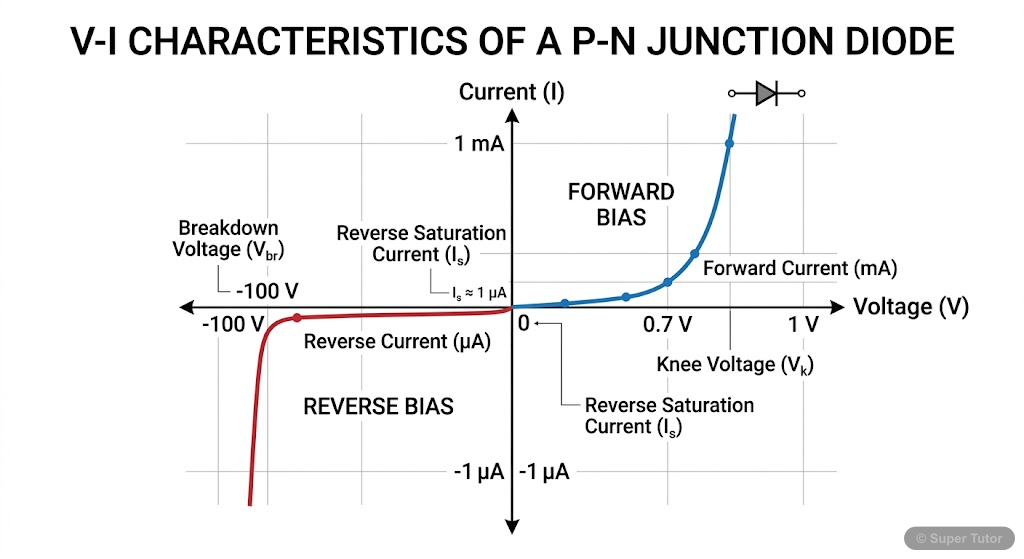
Learn better with visuals Super Tutor pairs illustrations like this with notes and quizzes for Electronics and Communication.
What is the forbidden energy gap (Eg) and how does it classify materials?
Answer
The forbidden energy gap (Eg) is the energy difference between the valence band and conduction band. Classification: - Insulators: Eg > 5 eV (electrons cannot move) - Conductors: Eg = 0 eV (bands over…
Calculate the energy required to promote an electron from valence band to conduction band in germanium at 25°C.
Answer
Given: Germanium has forbidden energy gap Eg = 0.7 eV at 25°C Solution: Energy required = Eg = 0.7 eV Conversion to Joules: E = 0.7 eV × 1.6 × 10⁻¹⁹ J/eV E = 1.12 × 10⁻¹⁹ J Alternatively, at room t…
What is an intrinsic semiconductor and how are charge carriers generated in it?
Answer
An intrinsic semiconductor is a pure semiconductor material without any impurity atoms (Si or Ge in their purest form). Charge carrier generation: 1. At 0 K: Acts like an insulator (no free charge ca…
In an n-type semiconductor doped with phosphorus, what are majority and minority carriers? Why?
Answer
N-type (Negative) Semiconductor: - Dopant: Phosphorus (pentavalent, 5 valence electrons) - Majority carriers: Electrons - Minority carriers: Holes Reason: 1. Phosphorus has 5 valence electrons, silic…
A p-n junction has a barrier potential of 0.7 V for silicon. If the junction is forward biased with 0.5 V applied, will it conduct? Explain.
Answer
Given: Vb (barrier potential) = 0.7 V, Applied voltage = 0.5 V Analysis: For conduction to occur, applied voltage must exceed the barrier potential (threshold/knee voltage): Applied voltage = 0.5 V <…
What happens to the depletion region when a p-n junction diode is reverse biased?
Answer
When reverse biased (positive terminal to n-side, negative to p-side): Depletion Region Changes: 1. Width: INCREASES significantly 2. Barrier potential: INCREASES 3. Immobile ion concentration: INCRE…
A silicon diode is connected in series with a 1 kΩ resistor across a 10 V supply. Calculate the current flowing through the circuit (neglect diode resistance when conducting).
Answer
Given: - Supply voltage: V = 10 V - Series resistance: R = 1 kΩ = 1000 Ω - Silicon diode (forward biased) - Diode forward voltage drop: VF = 0.7 V (for silicon) Step 1: Find voltage across resistor V…
What is rectification? How does a half-wave rectifier differ from a full-wave rectifier?
Answer
Rectification: Process of converting AC (alternating current) into DC (direct current). Half-Wave Rectifier: - Uses 1 diode - Conducts during positive half cycle only - Blocks negative half cycle - O…
+22 more flashcards
Practise AllFrequently Asked Questions
What are the important topics in Electronics and Communication for Tamil Nadu Board Class 12 Physics?
How many flashcards are available for Electronics and Communication?
How should I revise Electronics and Communication for the Tamil Nadu Board Class 12 board exam?
Sources & Official References
Content is aligned to the official syllabus. Refer to the board website for the latest curriculum.
More resources for Electronics and Communication
For serious students
Get the full Electronics and Communication chapter — start free.
Quizzes, flashcards, an AI doubt solver and a study plan for Tamil Nadu Board Class 12 Physics. Free to start, no card needed.