Sound — Chapter Summary
Tamil Nadu Board · Class 9 · Science
Summary of Sound for Tamil Nadu Board Class 9 Science. Key concepts: Sound is created when, Sound cannot travel through and Sound waves are longitudinal.
Interactive on Super Tutor
Studying Sound? Get the full interactive chapter.
Quizzes, flashcards, AI doubt-solver and a step-by-step study plan — built for chapter summary and more.
Free trial, no card needed.
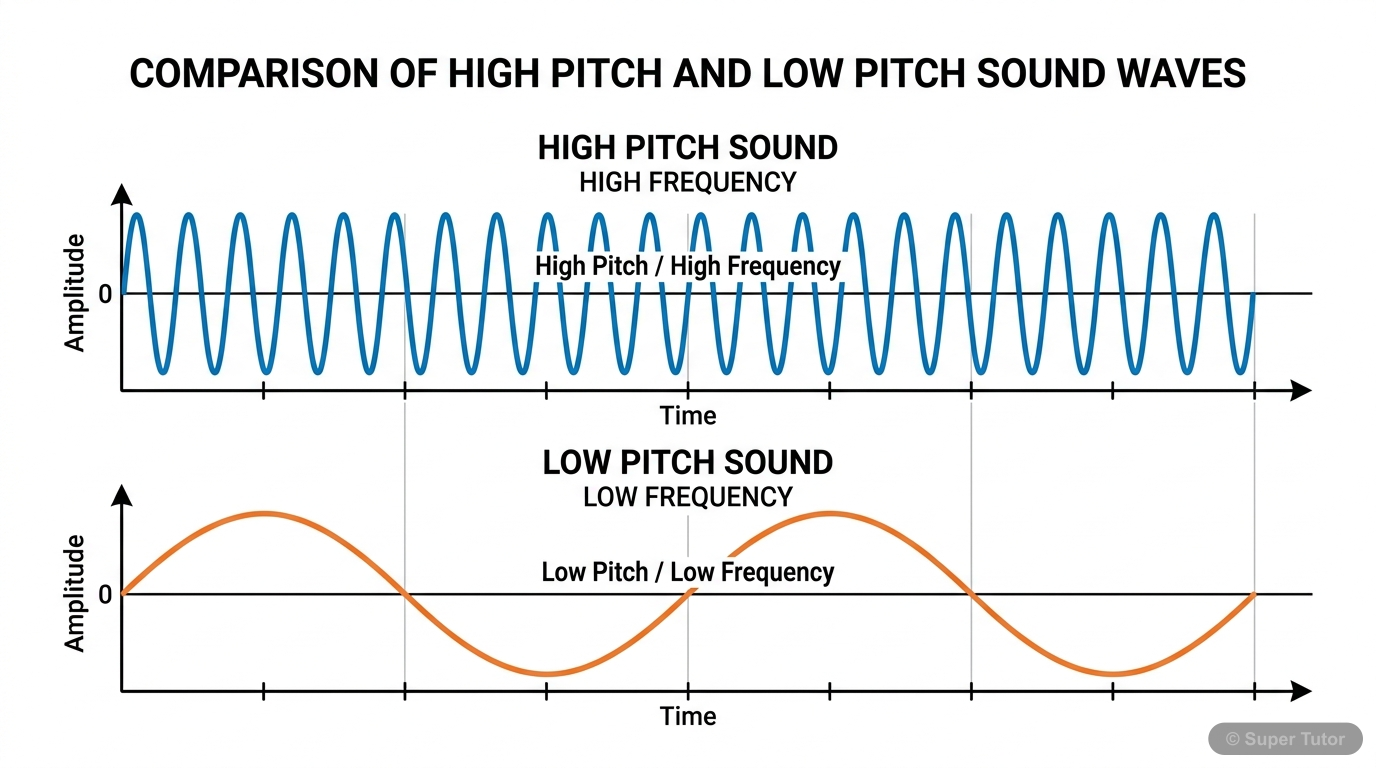
One of 3 illustrations for Sound in Super Tutor — alongside flashcards, concept maps and practice questions.
Overview
Sound is a form of energy that creates the sensation of hearing in our ears. It is produced by the vibrations of objects and travels through a medium as disturbances that reach our ears. Unlike light, sound cannot travel through empty space (vacuum) and requires a material medium such as air, water,
Key Concepts
Sound is created when an object
Sound is created when an object vibrates. These vibrations cause nearby particles to vibrate, producing sound waves. For example, when you strike a tu
Sound cannot travel through a vacuum
Sound cannot travel through a vacuum because it requires particles to vibrate and transfer energy. The Bell-Jar experiment demonstrates this: when air
Sound waves are longitudinal waves
Sound waves are longitudinal waves, meaning particles vibrate parallel to the direction of wave propagation. Sound travels as alternating regions of c
Amplitude is the maximum displacement
Amplitude is the maximum displacement of particles from their original position when a wave passes through. Measured in meters (m), it determines how
Frequency is the number of complete
Frequency is the number of complete vibrations or waves produced in one second, measured in hertz (Hz). The human ear can hear frequencies between 20
Learning Objectives
- Understand that sound is produced by vibrations of objects and cannot travel through vacuum
- Recognize that sound requires a material medium for propagation
- Explain that sound waves are longitudinal in nature with compressions and rarefactions
- Identify and describe the five main characteristics of sound: amplitude, frequency, time period, wavelength, and velocity
- Distinguish between different sounds using loudness, pitch, and timbre (quality)
Frequently Asked Questions
What are the important topics in Sound for Tamil Nadu Board Class 9 Science?
How should I revise Sound for Class 9 exams?
Sources & Official References
Content is aligned to the official syllabus. Refer to the board website for the latest curriculum.
More resources for Sound
For serious students
Get the full Sound chapter — start free.
Quizzes, flashcards, an AI doubt solver and a study plan for Tamil Nadu Board Class 9 Science. Free to start, no card needed.