Light — Chapter Summary
Tamil Nadu Board · Class 9 · Science
Summary of Light for Tamil Nadu Board Class 9 Science. Part of the Tamil Nadu Board Class 9 Science syllabus. Light is a form of electromagnetic energy.
Interactive on Super Tutor
Studying Light? Get the full interactive chapter.
Quizzes, flashcards, AI doubt-solver and a step-by-step study plan — built for chapter summary and more.
Free trial, no card needed.
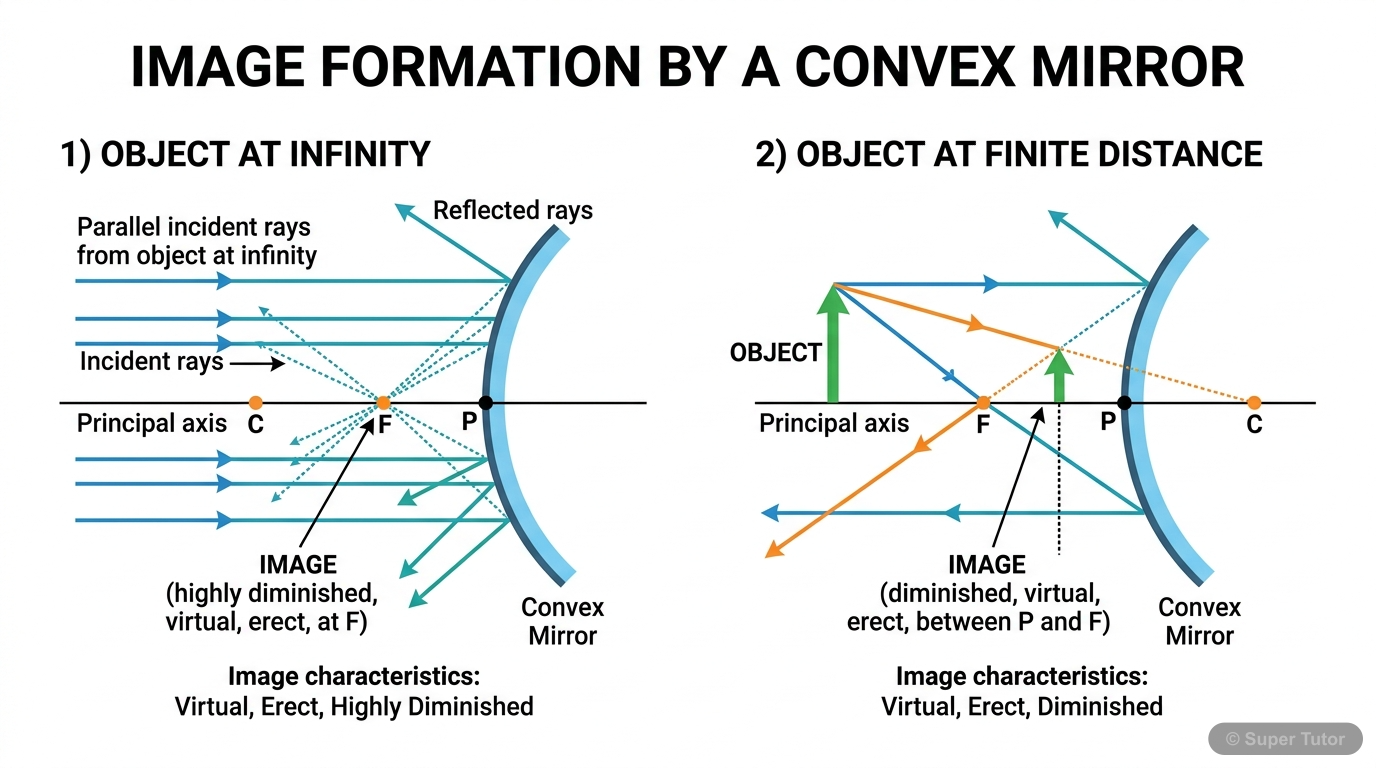
One of 13 illustrations for Light in Super Tutor — alongside flashcards, concept maps and practice questions.
Overview
Light is a form of electromagnetic energy that enables us to see the world around us. This chapter explores the fundamental properties of light, including reflection and refraction, and how these principles apply to mirrors and optical instruments. Understanding light helps us comprehend everyday ph
Key Concepts
Light follows two fundamental laws when
Light follows two fundamental laws when reflecting from any surface: (1) The angle of incidence equals the angle of reflection (∠i = ∠r), and (2) The
A plane mirror is a flat
A plane mirror is a flat reflecting surface. When you look at yourself in a plane mirror, you see an image that appears to be behind the mirror at the
Real images form when light rays
Real images form when light rays actually converge (meet) after reflection or refraction. They are always inverted and can be projected on a screen. V
A concave mirror has a reflecting
A concave mirror has a reflecting surface that curves inward (like the inside of a spoon). It has a center of curvature (C), a pole (P), and a princip
A convex mirror has a reflecting
A convex mirror has a reflecting surface that curves outward (like the back of a spoon). Unlike concave mirrors, convex mirrors always form virtual im
Learning Objectives
- Apply the laws of reflection for plane mirrors and spherical mirrors
- Draw ray diagrams to find position and size of images in spherical mirrors
- Distinguish between real and virtual images and their characteristics
- Apply the mirror equation to calculate position, size, and nature of images
- Identify the direction of light bending when passing between different media
Frequently Asked Questions
What are the important topics in Light for Tamil Nadu Board Class 9 Science?
How should I revise Light for Class 9 exams?
Sources & Official References
Content is aligned to the official syllabus. Refer to the board website for the latest curriculum.
More resources for Light
For serious students
Get the full Light chapter — start free.
Quizzes, flashcards, an AI doubt solver and a study plan for Tamil Nadu Board Class 9 Science. Free to start, no card needed.