Sexual Reproduction in Flowering Plants
CBSE · Class 12 · Biology
NCERT Solutions for Sexual Reproduction in Flowering Plants — CBSE Class 12 Biology.
Interactive on Super Tutor
Studying Sexual Reproduction in Flowering Plants? Get the full interactive chapter.
Quizzes, flashcards, AI doubt-solver and a step-by-step study plan — built for ncert solutions and more.
1,000+ Class 12 students started this chapter today
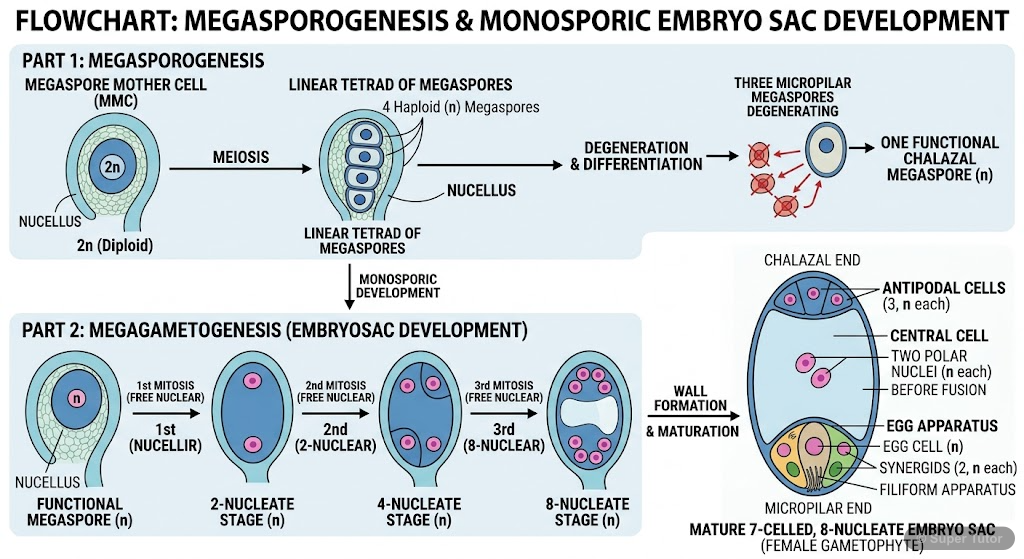
Super Tutor has 16+ illustrations like this for Sexual Reproduction in Flowering Plants alone — flashcards, concept maps, and step-by-step visuals.
See them all9 worked solutions below. Unlock all 18 free in Super Tutor
EXERCISES
1Name the parts of an angiosperm flower in which development of male and female gametophyte take place.Show solution
Not sure why a step works? check your working in Super Tutor
2Differentiate between microsporogenesis and megasporogenesis. Which type of cell division occurs during these events? Name the structures formed at the end of these two events.Show solution
In both cases, the cell division is meiosis.
At the end of microsporogenesis, a microspore tetrad is formed, and each microspore later develops into a pollen grain.
At the end of megasporogenesis, four megaspores are formed, out of which usually one functional megaspore develops into the embryo sac (female gametophyte).
Not sure why a step works? check your working in Super Tutor
3Arrange the following terms in the correct developmental sequence:Show solution
1. Sporogenous tissue
2. Pollen mother cell (PMC)
3. Microspore tetrad
4. Pollen grain
5. Male gametes
So the correct order is sporogenous tissue → pollen mother cell → microspore tetrad → pollen grain → male gametes.
Not sure why a step works? check your working in Super Tutor
4With a neat, labelled diagram, describe the parts of a typical angiosperm ovule.Show solution
Not sure why a step works? check your working in Super Tutor
5What is meant by monosporic development of female gametophyte?Show solution
Not sure why a step works? check your working in Super Tutor
6With a neat diagram explain the 7-celled, 8-nucleate nature of the female gametophyte.Show solution
Not sure why a step works? check your working in Super Tutor
7What are chasmogamous flowers? Can cross-pollination occur in cleistogamous flowers? Give reasons for your answer.Show solution
Cross-pollination cannot occur in cleistogamous flowers because these flowers do not open at all. Their anthers and stigma lie very close to each other, and pollen released inside the closed flower lands on the stigma of the same flower. So cleistogamous flowers are invariably autogamous and there is no chance for pollen from another flower to reach the stigma.
Not sure why a step works? check your working in Super Tutor
8Mention two strategies evolved to prevent self-pollination in flowers.Show solution
- Self-incompatibility
- Production of unisexual flowers
These help discourage self-pollination and promote cross-pollination.
Not sure why a step works? check your working in Super Tutor
9What is self-incompatibility? Why does self-pollination not lead to seed formation in self-incompatible species?Show solution
Self-pollination does not lead to seed formation in self-incompatible species because the pistil rejects its own pollen. Since the pollen tube cannot grow and reach the ovule, fertilisation does not occur, and therefore seeds are not formed.
Not sure why a step works? check your working in Super Tutor
9 more solved questions in Sexual Reproduction in Flowering Plants
Every remaining exercise is solved step by step in Super Tutor, plus practice quizzes and flashcards for this chapter. Free to start.
Stuck on a step?
Ask Super Tutor AI to explain any solution on this page in a simpler way — free, 24x7.
Ask a Doubt FreeFrequently Asked Questions
What are the important topics in Sexual Reproduction in Flowering Plants for CBSE Class 12 Biology?
How to score full marks in Sexual Reproduction in Flowering Plants — CBSE Class 12 Biology?
Where can I get free NCERT Solutions for Sexual Reproduction in Flowering Plants Class 12 Biology?
Sources & Official References
- NCERT Official — ncert.nic.in
- CBSE Academic — cbseacademic.nic.in
- CBSE Official — cbse.gov.in
- National Education Policy 2020 — education.gov.in
Content is aligned to the official syllabus. Refer to the board website for the latest curriculum.
More resources for Sexual Reproduction in Flowering Plants
Practice Quiz
Test yourself with a quick quiz
Important Questions
Practice with board exam-style questions
Revision Notes
Key points for last-minute revision
Formula Sheet
All formulas in one place
Chapter Summary
Understand the chapter at a glance
Concept Maps
See how topics connect visually
Study Plan
Step-by-step plan to ace this chapter
Flashcards
Quick-fire cards for active recall
Syllabus
What topics to cover
For serious students
Get the full Sexual Reproduction in Flowering Plants chapter — for free.
Quizzes, flashcards, AI doubt-solver and a step-by-step study plan for CBSE Class 12 Biology.