An Overview of Recombinant DNA Technology — Study Plan
CBSE · Class 12 · Biotechnology
A step-by-step study plan for An Overview of Recombinant DNA Technology, CBSE Class 12 Biotechnology: what to learn first, what to practise and when.
Interactive on Super Tutor
Studying An Overview of Recombinant DNA Technology? Get the full interactive chapter.
Quizzes, flashcards, AI doubt-solver and a step-by-step study plan — built for study plan and more.
Free trial, no card needed.
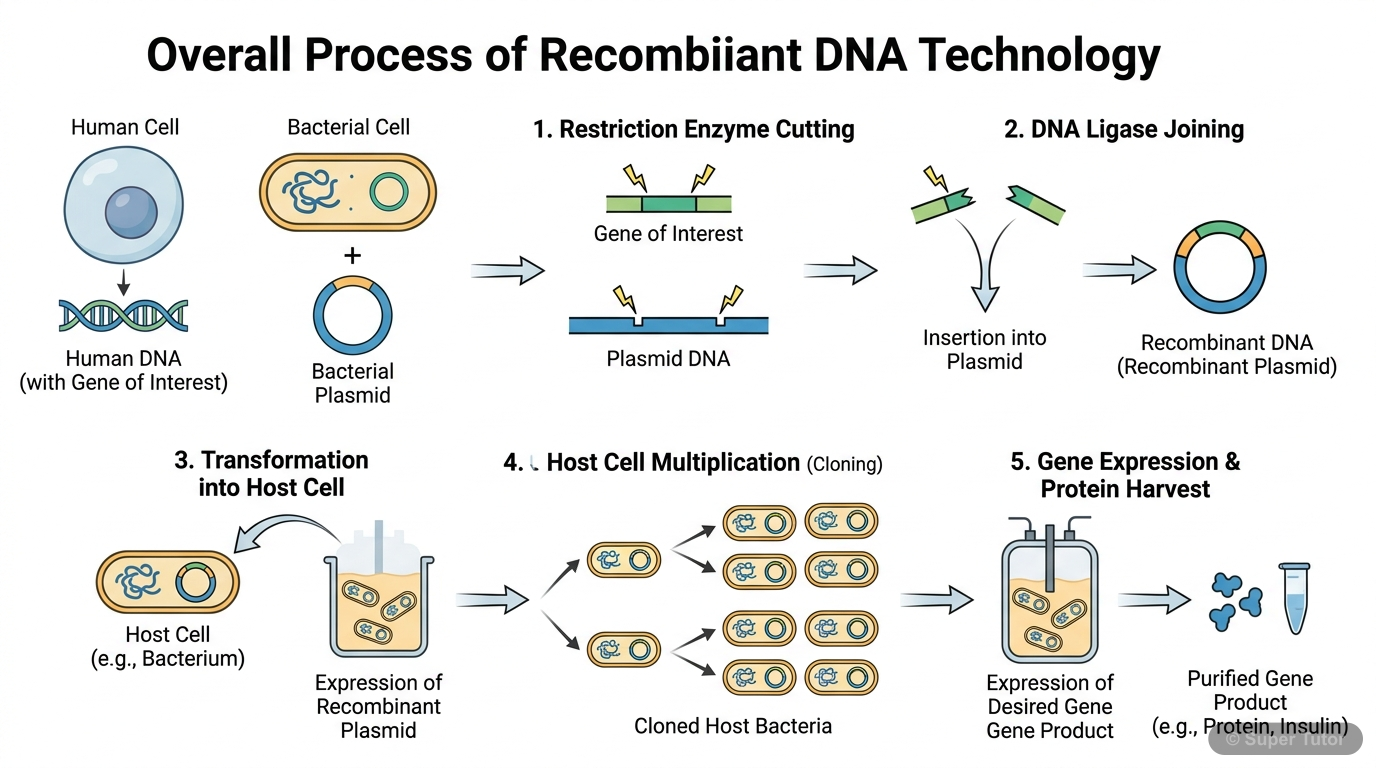
One of 6 illustrations for An Overview of Recombinant DNA Technology in Super Tutor — alongside flashcards, concept maps and practice questions.
See them allStudy Plan
Learn the Theory
Read the textbook chapter carefully. Note down definitions, formulas and key ideas. Focus on: Meaning and Scope of Recombinant DNA Technology, Scientific Foundations Behind rDNA Technology, Enzymes That Made DNA Manipulation Possible.
Practise
Solve the textbook exercises and extra practice questions. There are 64 questions available for this chapter.
Revise & Test
Revise key points without looking at your notes. Take a practice quiz and mark weak areas for another pass.
Spaced Revision
Come back to An Overview of Recombinant DNA Technology after a week. Use flashcards for quick recall and try past exam questions on this chapter.
What to Focus On
- Recombinant DNA technology is another name for genetic engineering.
- It involves direct manipulation of DNA or genome.
- Gene cloning means isolation and propagation of a desired gene to obtain its product in large quantity.
- Biotechnology was first named in 1917.
- DNA was established as genetic material in 1944.
- Plasmids were discovered in 1952.
- Restriction enzymes cut DNA at specific sites.
- Ligase joins DNA fragments.
- Type I and Type II restriction enzymes are different.
Common Mistakes to Avoid
Restriction enzymes and ligase do the same job in recombinant DNA technology.
Stanley Cohen and Herbert Boyer had the same expertise before developing recombinant DNA technology.
Type I and Type II restriction enzymes are the same discovery and can be used as one category.
Memory Tips
Definition of recombinant DNA technology
Gene cloning
Restriction enzymes
Ligase
Want a personalised study plan?
Super Tutor builds a day-by-day plan for CBSE Class 12 Biotechnology that fits your exam date and pace.
Create My Study PlanFrequently Asked Questions
What are the important topics in An Overview of Recombinant DNA Technology for CBSE Class 12 Biotechnology?
How should I revise An Overview of Recombinant DNA Technology for the CBSE Class 12 board exam?
Sources & Official References
- NCERT Official — ncert.nic.in
- CBSE Academic — cbseacademic.nic.in
- CBSE Official — cbse.gov.in
- National Education Policy 2020 — education.gov.in
Content is aligned to the official syllabus. Refer to the board website for the latest curriculum.
More resources for An Overview of Recombinant DNA Technology
Practice Quiz
Test yourself with a quick quiz
Important Questions
Exam-style questions with answers
Revision Notes
Key points for last-minute revision
Chapter Summary
Understand the chapter at a glance
Concept Maps
See how topics connect
Flashcards
Quick-fire cards for active recall
Syllabus
What topics to cover
NCERT Solutions
Every textbook question solved step by step
For serious students
Get the full An Overview of Recombinant DNA Technology chapter — start free.
Quizzes, flashcards, an AI doubt solver and a study plan for CBSE Class 12 Biotechnology. Free to start, no card needed.