Microbial Culture — Study Plan
CBSE · Class 12 · Biotechnology
A step-by-step study plan for Microbial Culture, CBSE Class 12 Biotechnology: what to learn first, what to practise and when to revise.
Interactive on Super Tutor
Studying Microbial Culture? Get the full interactive chapter.
Quizzes, flashcards, AI doubt-solver and a step-by-step study plan — built for study plan and more.
Free trial, no card needed.
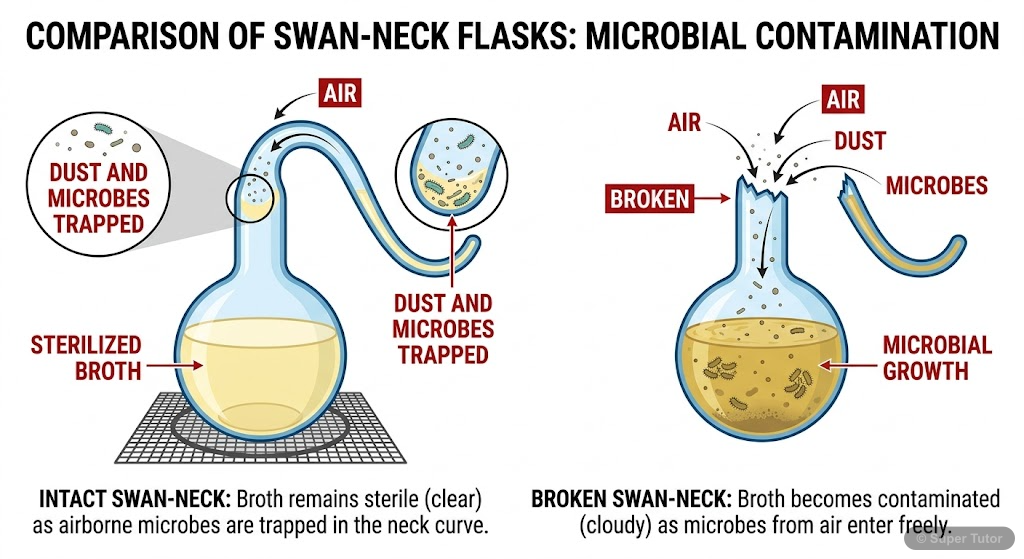
One of 14 illustrations for Microbial Culture in Super Tutor — alongside flashcards, concept maps and practice questions.
See them allStudy Plan
Learn the Theory
Read the textbook chapter carefully. Note down definitions, formulas and key ideas. Focus on: Historical Perspective, Nutritional Requirements and Types of Media, Sterilisation Methods.
Practise
Solve the textbook exercises and extra practice questions. There are 63 questions available for this chapter.
Revise & Test
Revise key points without looking at your notes. Take a practice quiz and mark weak areas for another pass.
Spaced Revision
Come back to Microbial Culture after a week. Use flashcards for quick recall and try past exam questions on this chapter.
What to Focus On
- Leeuwenhoek developed the microscope in the 1670s to 1680s and coined 'animalcules'.
- Spallanzani found no microscopic life in boiled broth.
- Pasteur disproved spontaneous generation and postulated germ theory.
- Macronutrients are required in large amounts.
- Carbon, oxygen, hydrogen, nitrogen, sulfur, phosphorus, potassium, calcium, magnesium and iron are macronutrients.
- Heterotrophs use organic carbon.
- Defined media have all components known.
- Complex media contain some unknown components.
- Liquid media are broth media without agar.
Common Mistakes to Avoid
Agar is a nutrient that feeds bacteria in solid media.
Pasteurisation fully sterilises milk.
Autoclaving is the same as boiling water at 100°C.
Memory Tips
Historical development of microbiology from Leeuwenhoek to Petri
Leeuwenhoek and animalcules
Spallanzani and boiled broth
Pasteur’s swan-neck flask and germ theory
Want a personalised study plan?
Super Tutor builds a day-by-day plan for CBSE Class 12 Biotechnology that fits your exam date and pace.
Create My Study PlanFrequently Asked Questions
What are the important topics in Microbial Culture for CBSE Class 12 Biotechnology?
How should I revise Microbial Culture for the CBSE Class 12 board exam?
Sources & Official References
- NCERT Official — ncert.nic.in
- CBSE Academic — cbseacademic.nic.in
- CBSE Official — cbse.gov.in
- National Education Policy 2020 — education.gov.in
Content is aligned to the official syllabus. Refer to the board website for the latest curriculum.
More resources for Microbial Culture
Practice Quiz
Test yourself with a quick quiz
Important Questions
Exam-style questions with answers
Revision Notes
Key points for last-minute revision
Chapter Summary
Understand the chapter at a glance
Concept Maps
See how topics connect
Flashcards
Quick-fire cards for active recall
Syllabus
What topics to cover
NCERT Solutions
Every textbook question solved step by step
For serious students
Get the full Microbial Culture chapter — start free.
Quizzes, flashcards, an AI doubt solver and a study plan for CBSE Class 12 Biotechnology. Free to start, no card needed.