An Overview of Recombinant DNA Technology — NCERT Solutions
CBSE · Class 12 · Biotechnology
NCERT Solutions for An Overview of Recombinant DNA Technology, CBSE Class 12 Biotechnology: 6 textbook questions solved step by step. Covers Exercises.
Interactive on Super Tutor
Studying An Overview of Recombinant DNA Technology? Get the full interactive chapter.
Quizzes, flashcards, AI doubt-solver and a step-by-step study plan — built for NCERT solutions and more.
Free trial, no card needed.
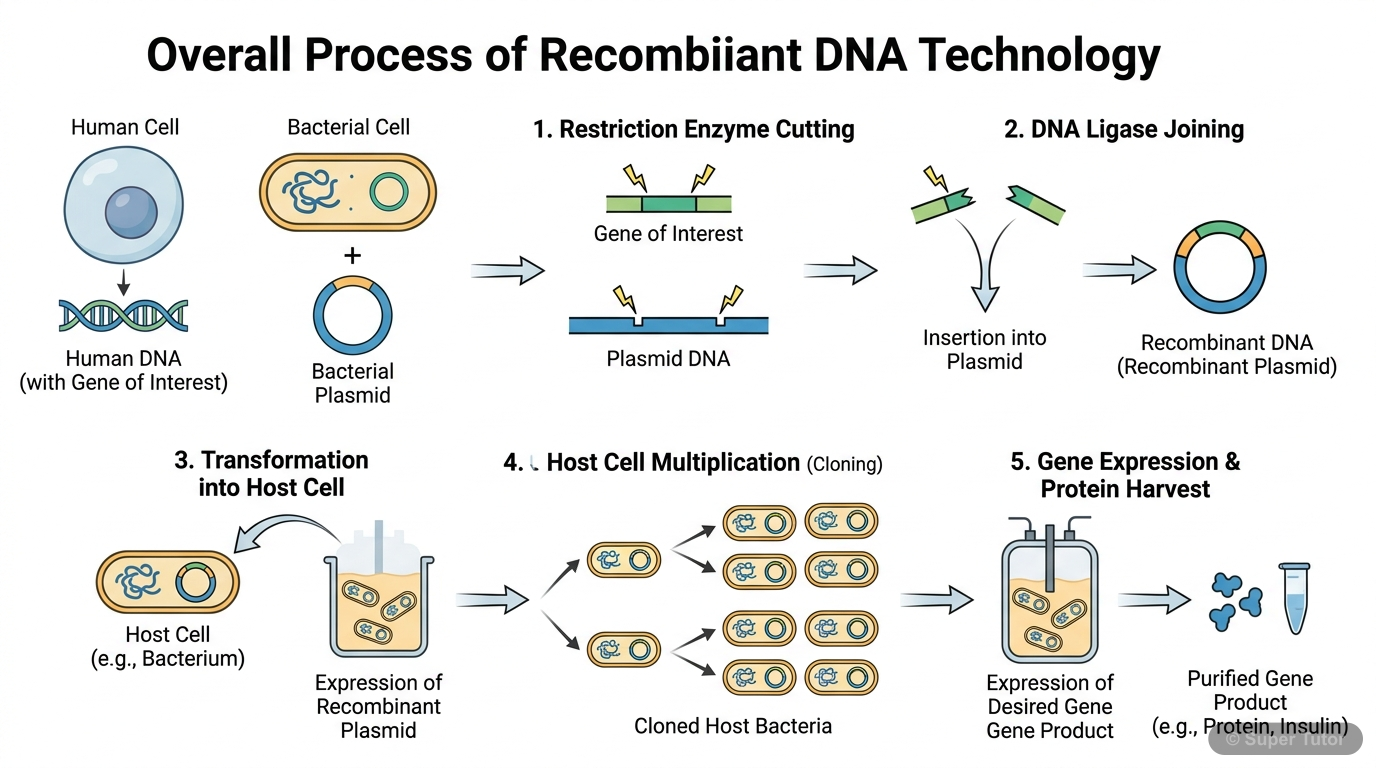
One of 6 illustrations for An Overview of Recombinant DNA Technology in Super Tutor — alongside flashcards, concept maps and practice questions.
See them allThe first 3 solutions are open to read. The other 3 are free with a Super Tutor account. Unlock all 6 free in Super Tutor
Exercises
1Discuss in brief how recombinant DNA technology was initially developed?Show solution
Recombinant DNA technology was developed when scientists understood that DNA is the genetic material and learned how to isolate, cut, and join DNA molecules. The important steps were:
- discovery of the double-helical structure of DNA;
- understanding of replication, transcription, and translation;
- development of methods to isolate and purify DNA;
- discovery of enzymes such as restriction enzymes that cut DNA and ligase that joins DNA fragments.
At the same time, scientists found that foreign DNA fragments can enter bacteria and get integrated into their genome. Stanley Cohen had the skill to introduce plasmid DNA into E. coli and clone it, while Herbert Boyer could cut DNA using restriction enzymes. By combining these discoveries, they created the first recombinant DNA and started rDNA technology.
Not sure why a step works? check your working in Super Tutor
2Briefly discuss the application of rDNA technology in crop improvement and therapeutics.Show solution
In crop improvement, rDNA technology is used to produce genetically modified crops with useful traits such as:
- disease resistance,
- drought resistance,
- salinity tolerance,
- improved quality of production and value of products.
These help farmers by reducing crop loss and allowing cultivation in adverse conditions.
In therapeutics, rDNA technology is used to produce important human proteins and medicines in bacteria or other systems, such as:
- human insulin for diabetes,
- growth hormone for dwarfism,
- interferon for cancer treatment,
- plasminogen activator and urokinase to dissolve blood clots.
These products are cheaper, available in larger quantity, and avoid some problems of animal-derived products.
Not sure why a step works? check your working in Super Tutor
3Who discovered the Plasmid?- (a) Paul Berg
- (b) Sir Alec Jeffreys
- (c) Joshua Lederberg
- (d) Kary Mullis
Show solution
- (a) Paul Berg
- (b) Sir Alec Jeffreys
- (c) Joshua Lederberg
- (d) Kary Mullis
The chapter states that Joshua Lederberg discovered plasmids in 1952. So the correct answer is Joshua Lederberg.
Not sure why a step works? check your working in Super Tutor
(a) Antiviral agent
(b) Blood clot dissolving drug
(c) Sugar lowering agent
(d) Cholesterol lowering agent
- (a) Antiviral agent
- (b) Blood clot dissolving drug
- (c) Sugar lowering agent
- (d) Cholesterol lowering agent
Free with a Super Tutor account
Reason: Restriction endonuclease is a type of nuclease.
(a) Both assertion and reason are true and the reason is the correct explanation of the assertion.
(b) Both assertion and reason are true but the reason is not the correct explanation of the assertion.
(c) Assertion is true but reason is false.
(d) Both assertion and reason are false.
- (a) Both assertion and reason are true and the reason is the correct explanation of the assertion.
- (b) Both assertion and reason are true but the reason is not the correct explanation of the assertion.
- (c) Assertion is true but reason is false.
- (d) Both assertion and reason are false.
Free with a Super Tutor account
Reason: E. coli follows multifork replication mechanism.
(a) Both assertion and reason are true and the reason is the correct explanation of the assertion.
(b) Both assertion and reason are true but the reason is not the correct explanation of the assertion.
(c) Assertion is true but reason is false.
(d) Both assertion and reason are false.
- (a) Both assertion and reason are true and the reason is the correct explanation of the assertion.
- (b) Both assertion and reason are true but the reason is not the correct explanation of the assertion.
- (c) Assertion is true but reason is false.
- (d) Both assertion and reason are false.
Free with a Super Tutor account
3 more solved questions in An Overview of Recombinant DNA Technology
They are free with a Super Tutor account, along with practice quizzes and flashcards for this chapter. Free to start, no card needed.
Frequently Asked Questions
What are the important topics in An Overview of Recombinant DNA Technology for CBSE Class 12 Biotechnology?
Are these NCERT Solutions for An Overview of Recombinant DNA Technology free?
How should I revise An Overview of Recombinant DNA Technology for the CBSE Class 12 board exam?
Sources & Official References
- NCERT Official — ncert.nic.in
- CBSE Academic — cbseacademic.nic.in
- CBSE Official — cbse.gov.in
- National Education Policy 2020 — education.gov.in
Content is aligned to the official syllabus. Refer to the board website for the latest curriculum.
More resources for An Overview of Recombinant DNA Technology
Practice Quiz
Test yourself with a quick quiz
Important Questions
Exam-style questions with answers
Revision Notes
Key points for last-minute revision
Chapter Summary
Understand the chapter at a glance
Concept Maps
See how topics connect
Study Plan
Step-by-step plan for this chapter
Flashcards
Quick-fire cards for active recall
Syllabus
What topics to cover
For serious students
Get the full An Overview of Recombinant DNA Technology chapter — start free.
Quizzes, flashcards, an AI doubt solver and a study plan for CBSE Class 12 Biotechnology. Free to start, no card needed.