Exploration : Entering the World of Secondary Science — Chapter Summary
CBSE · Class 9 · Science
Summary of Exploration : Entering the World of Secondary Science for CBSE Class 9 Science. Part of the CBSE Class 9 Science syllabus.
Interactive on Super Tutor
Studying Exploration : Entering the World of Secondary Science? Get the full interactive chapter.
Quizzes, flashcards, AI doubt-solver and a step-by-step study plan — built for chapter summary and more.
Free trial, no card needed.
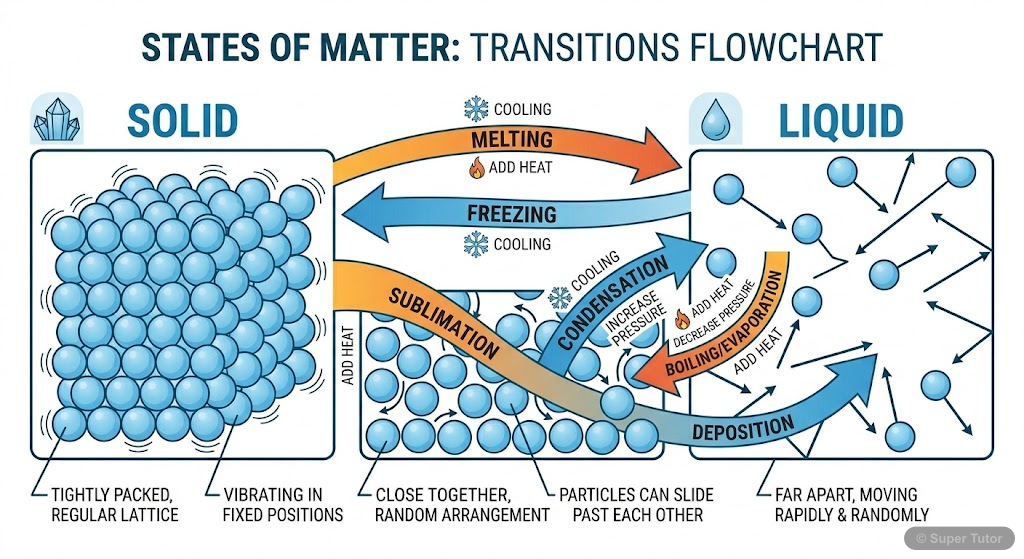
Learn better with visuals Super Tutor pairs illustrations like this with notes and quizzes for Exploration : Entering the World of Secondary Science.
Overview
Science at the secondary stage becomes a deeper search for meaning, not just a collection of facts. It depends on careful observation, measurement, models, symbols, equations, testing, and revision. Scientific thinking also uses estimation and reasoning, because exact calculation is not always the f
Key Concepts
Models are simplified ways of representing
Models are simplified ways of representing real systems. A moving car may be shown as a single point, atoms and molecules as spheres and bonds, cells
Meghnad Saha studied light from stars
Meghnad Saha studied light from stars by treating stellar matter as hot gas and focusing on temperature, pressure, and ion formation. This simplificat
Scientific quantities such as mass
Scientific quantities such as mass, velocity, force, and electric current are represented by defined symbols. This gives science a shared and precise
The speed of light is denoted
The speed of light is denoted by c, from the Latin word celeritas meaning speed, and it is defined to be exactly 299792458 m/s.
A law describes a regular pattern
A law describes a regular pattern observed in nature, a theory explains why patterns occur, and a principle is a broad idea applied in many situations
Learning Objectives
- Understand how science uses observation, measurement, models, symbols, and equations to study the world
- Recognise the purpose of scientific models and why some details are deliberately ignored
- Distinguish between a law, a theory, and a principle in science
- Understand how predictions are tested using measurable evidence
- Learn why estimation is an important scientific skill
Frequently Asked Questions
What are the important topics in Exploration : Entering the World of Secondary Science for CBSE Class 9 Science?
How should I revise Exploration : Entering the World of Secondary Science for Class 9 exams?
Sources & Official References
- NCERT Official — ncert.nic.in
- CBSE Academic — cbseacademic.nic.in
- CBSE Official — cbse.gov.in
- National Education Policy 2020 — education.gov.in
Content is aligned to the official syllabus. Refer to the board website for the latest curriculum.
More resources for Exploration : Entering the World of Secondary Science
Practice Quiz
Test yourself with a quick quiz
Important Questions
Exam-style questions with answers
Revision Notes
Key points for last-minute revision
Concept Maps
See how topics connect
Study Plan
Step-by-step plan for this chapter
Flashcards
Quick-fire cards for active recall
Syllabus
What topics to cover
NCERT Solutions
Every textbook question solved step by step
For serious students
Get the full Exploration : Entering the World of Secondary Science chapter — start free.
Quizzes, flashcards, an AI doubt solver and a study plan for CBSE Class 9 Science. Free to start, no card needed.