Cell :The Building Block of Life — Chapter Summary
CBSE · Class 9 · Science
Summary of Cell :The Building Block of Life for CBSE Class 9 Science. Part of the CBSE Class 9 Science syllabus.
Interactive on Super Tutor
Studying Cell :The Building Block of Life? Get the full interactive chapter.
Quizzes, flashcards, AI doubt-solver and a step-by-step study plan — built for chapter summary and more.
Free trial, no card needed.
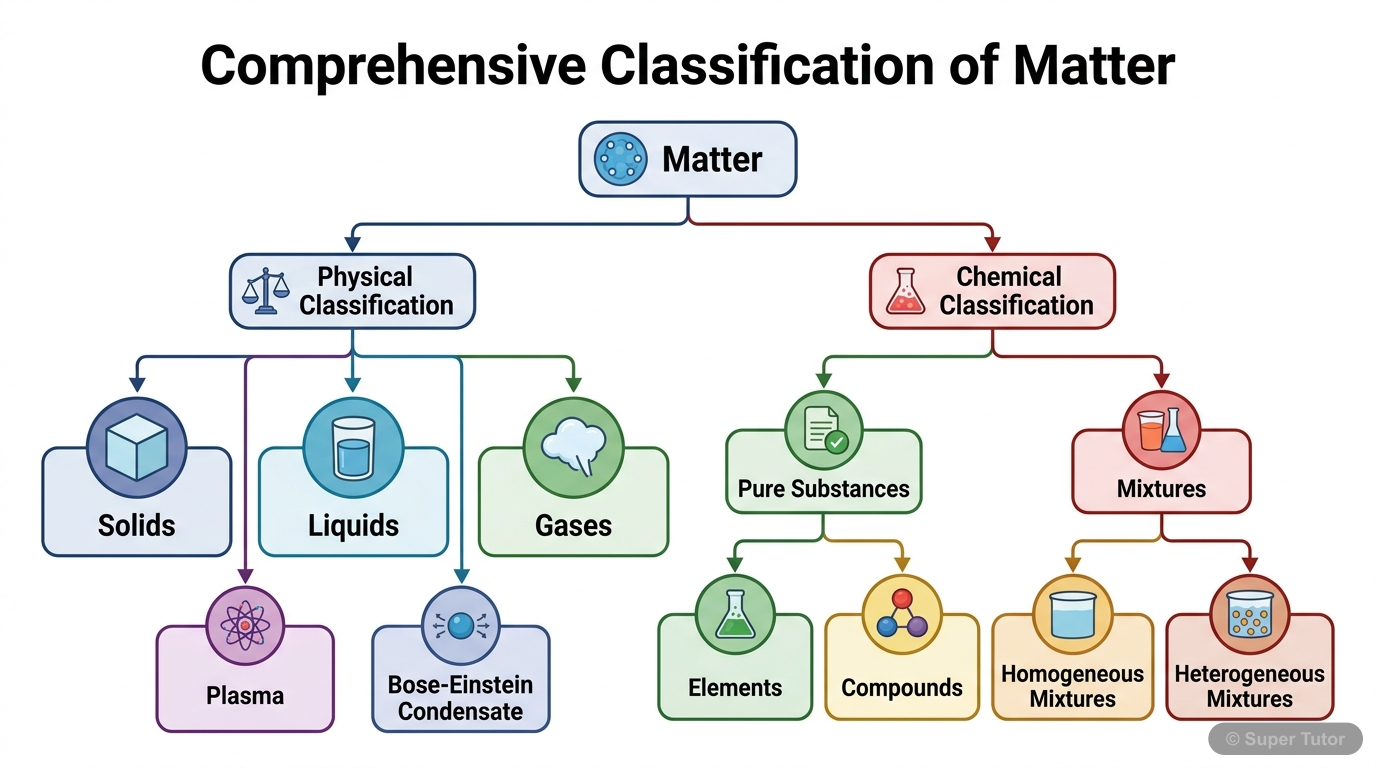
Learn better with visuals Super Tutor pairs illustrations like this with notes and quizzes for Cell :The Building Block of Life.
Overview
Cells are the basic structural and functional units of life. Some organisms are made of one cell, while others are made of many cells working together in tissues, organs, and organ systems. Cell study became possible with microscopes because many cells are smaller than the limit of resolution of the
Key Concepts
Robert Hooke observed cork cells
Robert Hooke observed cork cells in 1665 using a self-designed microscope of about 200 to 300X magnification and named the small box-like compartments
The human eye cannot clearly separate
The human eye cannot clearly separate objects closer than 0.1 mm at 25 cm. Microscopes increase magnification and resolution so tiny structures can be
The cell membrane is a thin
The cell membrane is a thin, selectively permeable boundary about 7 to 10 nanometres thick. Its structure is explained by the fluid-mosaic model, with
Diffusion is the net movement
Diffusion is the net movement of particles from higher to lower concentration. Osmosis is the diffusion of water across a selectively permeable membra
Plant
Plant, fungi, and bacterial cells have a rigid but permeable cell wall outside the membrane. In plants it is mainly made of cellulose, which helps sup
Learning Objectives
- Understand why the cell is called the basic unit of life
- Recognise the discovery and study of cells through microscopes
- Differentiate between prokaryotic and eukaryotic cells
- Describe the structure and function of the cell membrane and cell wall
- Explain the role of nucleus, cytoplasm, and major cell organelles
Frequently Asked Questions
What are the important topics in Cell :The Building Block of Life for CBSE Class 9 Science?
How should I revise Cell :The Building Block of Life for Class 9 exams?
Sources & Official References
- NCERT Official — ncert.nic.in
- CBSE Academic — cbseacademic.nic.in
- CBSE Official — cbse.gov.in
- National Education Policy 2020 — education.gov.in
Content is aligned to the official syllabus. Refer to the board website for the latest curriculum.
More resources for Cell :The Building Block of Life
Practice Quiz
Test yourself with a quick quiz
Important Questions
Exam-style questions with answers
Revision Notes
Key points for last-minute revision
Formula Sheet
The chapter's formulas in one place
Concept Maps
See how topics connect
Study Plan
Step-by-step plan for this chapter
Flashcards
Quick-fire cards for active recall
Syllabus
What topics to cover
NCERT Solutions
Every textbook question solved step by step
For serious students
Get the full Cell :The Building Block of Life chapter — start free.
Quizzes, flashcards, an AI doubt solver and a study plan for CBSE Class 9 Science. Free to start, no card needed.