Study of Acids, Bases and Salts — Flashcards
ICSE · Class 10 · Chemistry
40 flashcards for Study of Acids, Bases and Salts (ICSE Class 10 Chemistry) to test yourself on key terms and facts. Sample: "What is a mineral acid?"
Interactive on Super Tutor
Studying Study of Acids, Bases and Salts? Get the full interactive chapter.
Quizzes, flashcards, AI doubt-solver and a step-by-step study plan — built for flashcards and more.
Free trial, no card needed.
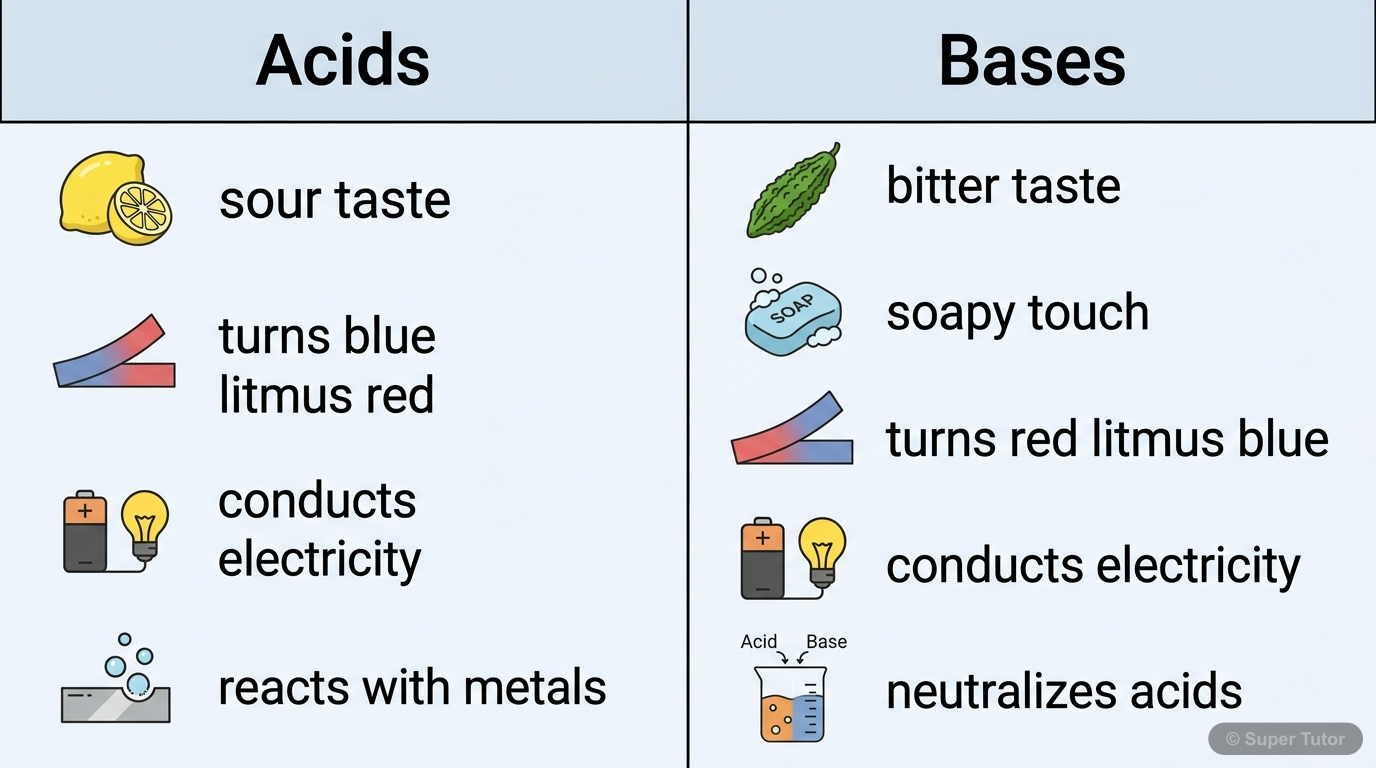
One of 15 illustrations for Study of Acids, Bases and Salts in Super Tutor — alongside flashcards, concept maps and practice questions.
See them allWhat is a mineral acid?
Answer
A mineral acid is an acid derived from minerals. It is usually a strong, corrosive acid and is completely ionised in water. Examples: HCl, HNO3, H2SO4. Balanced ionisation examples: HCl(aq) + H2O(l) →…
How are organic acids different from mineral acids?
Answer
Organic acids are derived from living organisms and contain carbon. They are weak, less corrosive, and partially ionised in water. Examples: formic acid, acetic acid, oxalic acid. Example ionisation: …
Why does an acid show acidic properties in water?
Answer
An acid gives H3O+ ions in water. These hydronium ions are responsible for acidity. General idea: acid + water → hydronium ion + anion. Example: HCl(aq) + H2O(l) → H3O+(aq) + Cl-(aq).
What is the basicity of an acid?
Answer
Basicity of an acid is the number of hydronium ions or hydrogen ions furnished by one molecule of the acid in aqueous solution. It depends on ionisable hydrogen atoms, not total hydrogen atoms. Exampl…
Why is acetic acid monobasic even though it has four hydrogen atoms?
Answer
Only one hydrogen atom in CH3COOH is ionisable in water. So its basicity is 1. Ionisation: CH3COOH(aq) + H2O(l) ⇌ CH3COO-(aq) + H3O+(aq).
Why are H3PO3 and H3PO2 exception acids?
Answer
H3PO3 is dibasic because it furnishes only two protons in water. H3PO2 is monobasic because it furnishes only one proton in water. In oxoacids, only hydrogen atoms attached directly to oxygen are repl…
What happens when phosphoric acid ionises in water?
Answer
Phosphoric acid is tribasic and ionises in three steps: H3PO4(aq) + H2O(l) ⇌ H3O+(aq) + H2PO4-(aq); H2PO4-(aq) + H2O(l) ⇌ H3O+(aq) + HPO4^2-(aq); HPO4^2-(aq) + H2O(l) ⇌ H3O+(aq) + PO4^3-(aq).
What is an alkali?
Answer
An alkali is a water-soluble base that furnishes hydroxyl ions as the only negative ions in aqueous solution. Examples: KOH, NaOH, Ca(OH)2, Ba(OH)2, NH4OH. Example dissociation: NaOH(aq) → Na+(aq) + O…
+32 more flashcards
Practise AllFrequently Asked Questions
What are the important topics in Study of Acids, Bases and Salts for ICSE Class 10 Chemistry?
How many flashcards are available for Study of Acids, Bases and Salts?
How should I revise Study of Acids, Bases and Salts for the ICSE Class 10 board exam?
Sources & Official References
Content is aligned to the official syllabus. Refer to the board website for the latest curriculum.
More resources for Study of Acids, Bases and Salts
Practice Quiz
Test yourself with a quick quiz
Important Questions
Exam-style questions with answers
Revision Notes
Key points for last-minute revision
Formula Sheet
The chapter's formulas in one place
Chapter Summary
Understand the chapter at a glance
Concept Maps
See how topics connect
Study Plan
Step-by-step plan for this chapter
Syllabus
What topics to cover
For serious students
Get the full Study of Acids, Bases and Salts chapter — start free.
Quizzes, flashcards, an AI doubt solver and a study plan for ICSE Class 10 Chemistry. Free to start, no card needed.