Study of Acids, Bases and Salts — Chapter Summary
ICSE · Class 10 · Chemistry
Summary of Study of Acids, Bases and Salts for ICSE Class 10 Chemistry. Part of the ICSE Class 10 Chemistry syllabus.
Interactive on Super Tutor
Studying Study of Acids, Bases and Salts? Get the full interactive chapter.
Quizzes, flashcards, AI doubt-solver and a step-by-step study plan — built for chapter summary and more.
Free trial, no card needed.
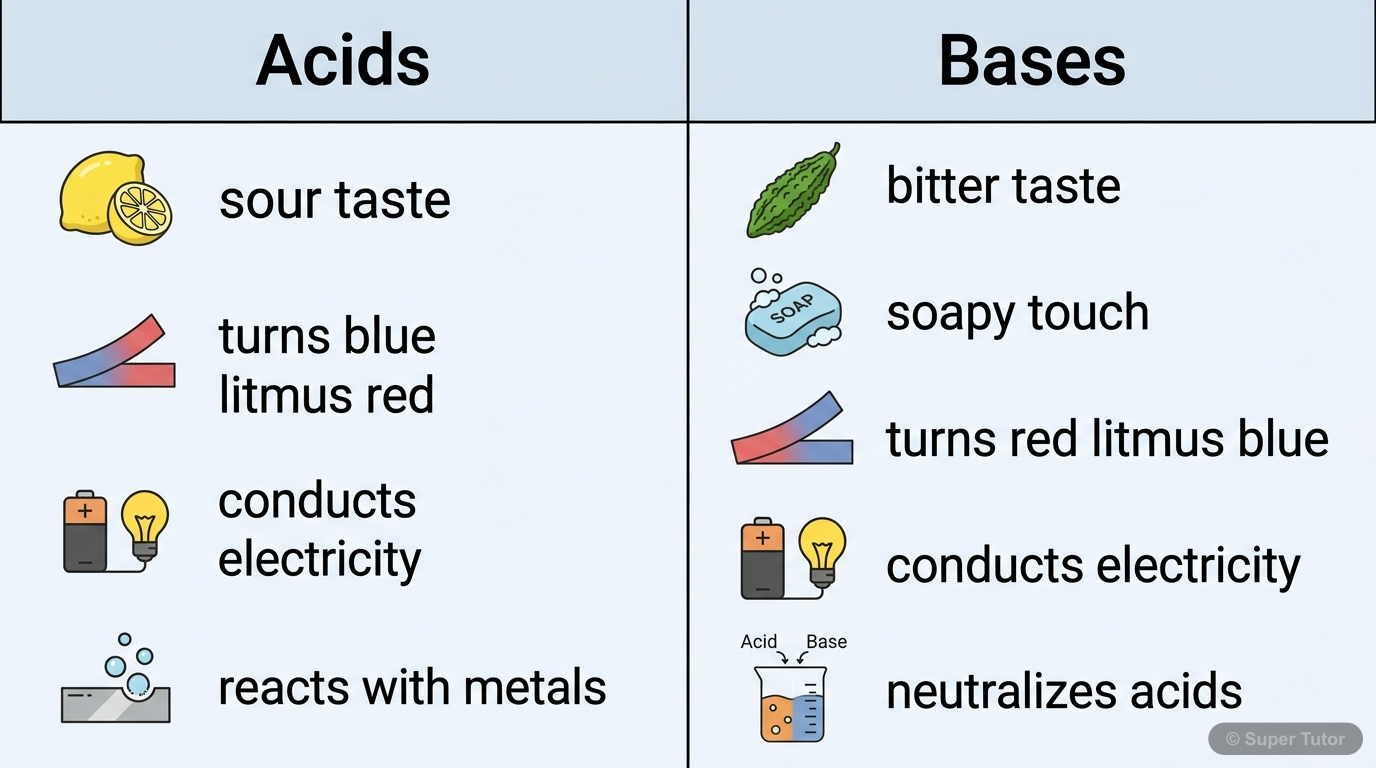
One of 15 illustrations for Study of Acids, Bases and Salts in Super Tutor — alongside flashcards, concept maps and practice questions.
See them allOverview
Acids, bases and salts are common chemical substances found in daily life, industry and laboratories. Acids produce hydronium ions in water and are generally sour, bases produce hydroxyl ions and are generally bitter and soapy, and salts are formed when the hydrogen of an acid is partly or fully rep
Key Concepts
Acids are substances that furnish hydronium
Acids are substances that furnish hydronium ions in aqueous solution. Mineral acids such as HCl, HNO3 and H2SO4 are strong, corrosive and completely i
Basicity is the number of hydronium
Basicity is the number of hydronium ions or hydrogen ions furnished by one molecule of an acid in water. HCl is monobasic, H2SO4 is dibasic and H3PO4
A base reacts with hydronium ions
A base reacts with hydronium ions to form salt and water. Alkalis are a special class of bases that are water soluble and furnish hydroxyl ions as the
Acidity of a base is
Acidity of a base is the number of hydroxyl ions furnished by one molecule of the base. NaOH is monoacidic, Ca(OH)2 is diacidic and Al(OH)3 is triacid
The pH of a solution
The pH of a solution is the negative logarithm of the hydronium ion concentration. Pure water has equal concentrations of H3O+ and OH-, each 1 x 10^-7
Learning Objectives
- Understand the meaning, types and properties of acids, bases and salts
- Explain ionisation of acids and bases in water using equations
- Distinguish mineral acids from organic acids
- Classify acids by basicity and bases by acidity
- Identify alkalis as water-soluble bases
Frequently Asked Questions
What are the important topics in Study of Acids, Bases and Salts for ICSE Class 10 Chemistry?
How should I revise Study of Acids, Bases and Salts for the ICSE Class 10 board exam?
Sources & Official References
Content is aligned to the official syllabus. Refer to the board website for the latest curriculum.
More resources for Study of Acids, Bases and Salts
Practice Quiz
Test yourself with a quick quiz
Important Questions
Exam-style questions with answers
Revision Notes
Key points for last-minute revision
Formula Sheet
The chapter's formulas in one place
Concept Maps
See how topics connect
Study Plan
Step-by-step plan for this chapter
Flashcards
Quick-fire cards for active recall
Syllabus
What topics to cover
For serious students
Get the full Study of Acids, Bases and Salts chapter — start free.
Quizzes, flashcards, an AI doubt solver and a study plan for ICSE Class 10 Chemistry. Free to start, no card needed.