Study of Acids, Bases and Salts — Study Plan
ICSE · Class 10 · Chemistry
A step-by-step study plan for Study of Acids, Bases and Salts, ICSE Class 10 Chemistry: what to learn first, what to practise and when to revise.
Interactive on Super Tutor
Studying Study of Acids, Bases and Salts? Get the full interactive chapter.
Quizzes, flashcards, AI doubt-solver and a step-by-step study plan — built for study plan and more.
Free trial, no card needed.
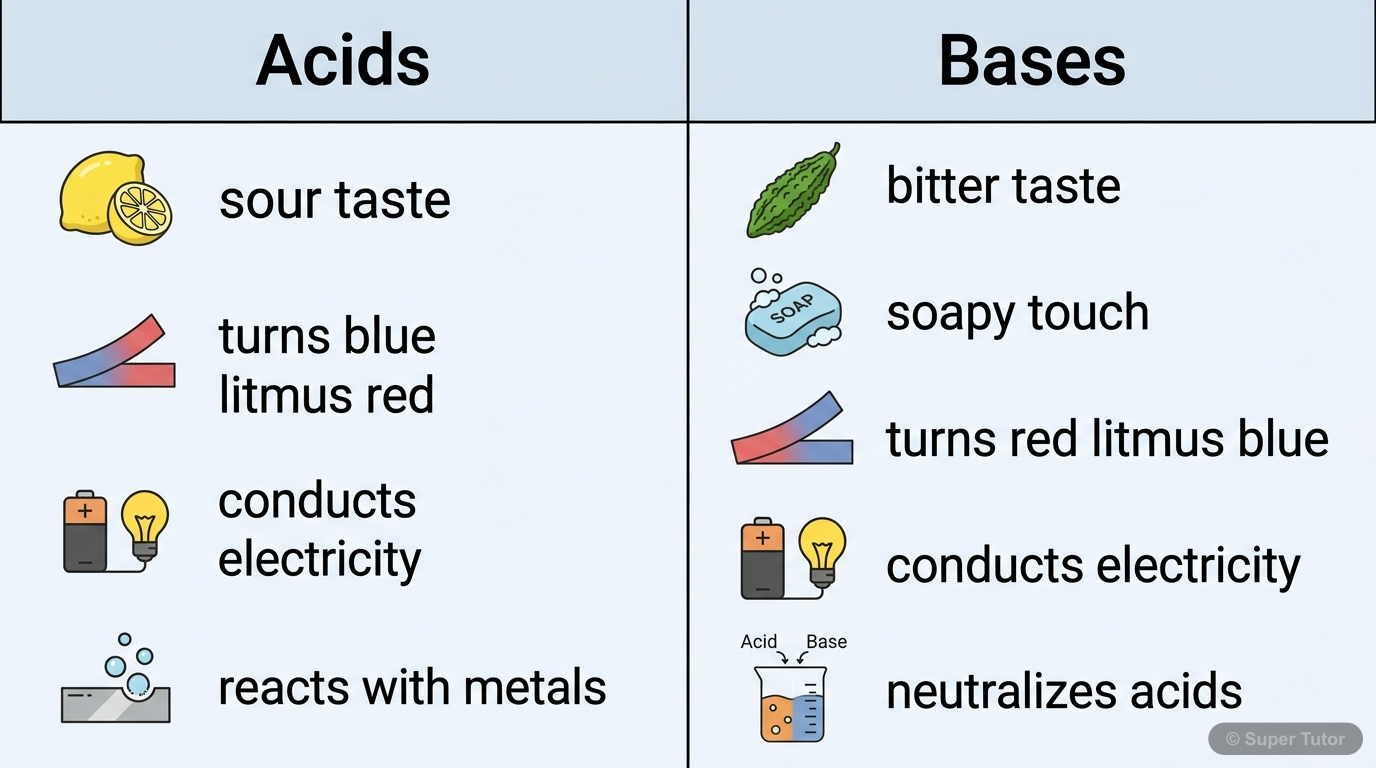
One of 15 illustrations for Study of Acids, Bases and Salts in Super Tutor — alongside flashcards, concept maps and practice questions.
See them allStudy Plan
Learn the Theory
Read the textbook chapter carefully. Note down definitions, formulas and key ideas. Focus on: Acids: Nature, Types and Basicity, Bases and Alkalis, Salts and Their Types.
Practise
Solve the textbook exercises and extra practice questions. There are 44 questions available for this chapter.
Revise & Test
Revise key points without looking at your notes. Take a practice quiz and mark weak areas for another pass.
Spaced Revision
Come back to Study of Acids, Bases and Salts after a week. Use flashcards for quick recall and try past exam questions on this chapter.
What to Focus On
- Mineral acids are strong, corrosive and completely ionised in water.
- Organic acids are weak, less corrosive and partially ionised.
- Basicity means number of ionisable hydrogen ions furnished by one molecule.
- A base reacts with hydronium ions to form salt and water.
- An alkali is a water-soluble base.
- All alkalis are bases, but all bases are not alkalis.
- Indicators show colour change in a definite pH range.
- Litmus changes red-blue over pH 5.0 to 8.0.
- Universal indicator shows a range of colours.
Common Mistakes to Avoid
All acids contain hydrogen ions already present inside them, so an acid solution directly contains free hydronium ions before dissolving in water.
Basicity of an acid depends on the total number of hydrogen atoms in the molecule.
All alkalis are bases, and all bases are alkalis, so every base should dissolve in water.
Memory Tips
Mineral acids
Organic acids
Basicity of acids
H3PO4, H3PO3, H3PO2 basicity
Want a personalised study plan?
Super Tutor builds a day-by-day plan for ICSE Class 10 Chemistry that fits your exam date and pace.
Create My Study PlanFrequently Asked Questions
What are the important topics in Study of Acids, Bases and Salts for ICSE Class 10 Chemistry?
How should I revise Study of Acids, Bases and Salts for the ICSE Class 10 board exam?
Sources & Official References
Content is aligned to the official syllabus. Refer to the board website for the latest curriculum.
More resources for Study of Acids, Bases and Salts
Practice Quiz
Test yourself with a quick quiz
Important Questions
Exam-style questions with answers
Revision Notes
Key points for last-minute revision
Formula Sheet
The chapter's formulas in one place
Chapter Summary
Understand the chapter at a glance
Concept Maps
See how topics connect
Flashcards
Quick-fire cards for active recall
Syllabus
What topics to cover
For serious students
Get the full Study of Acids, Bases and Salts chapter — start free.
Quizzes, flashcards, an AI doubt solver and a study plan for ICSE Class 10 Chemistry. Free to start, no card needed.