Mole Concept and Stoichiometry
ICSE · Class 10 · Chemistry
Summary of Mole Concept and Stoichiometry for ICSE Class 10 Chemistry. Key concepts, important points, and chapter overview.
Interactive on Super Tutor
Studying Mole Concept and Stoichiometry? Get the full interactive chapter.
Quizzes, flashcards, AI doubt-solver and a step-by-step study plan — built for chapter summary and more.
1,000+ Class 10 students started this chapter today
Learn better with visuals Super Tutor has hundreds of illustrations like this across every chapter — all free to try.
Get startedOverview
The mole concept gives a practical way to count extremely small particles such as atoms, molecules and ions. Just as a dozen means 12 objects, one mole means 6.023 × 10^23 particles. This idea connects atomic mass, molecular mass, volume of gases, and chemical equations, making it possible to calcul
Key Concepts
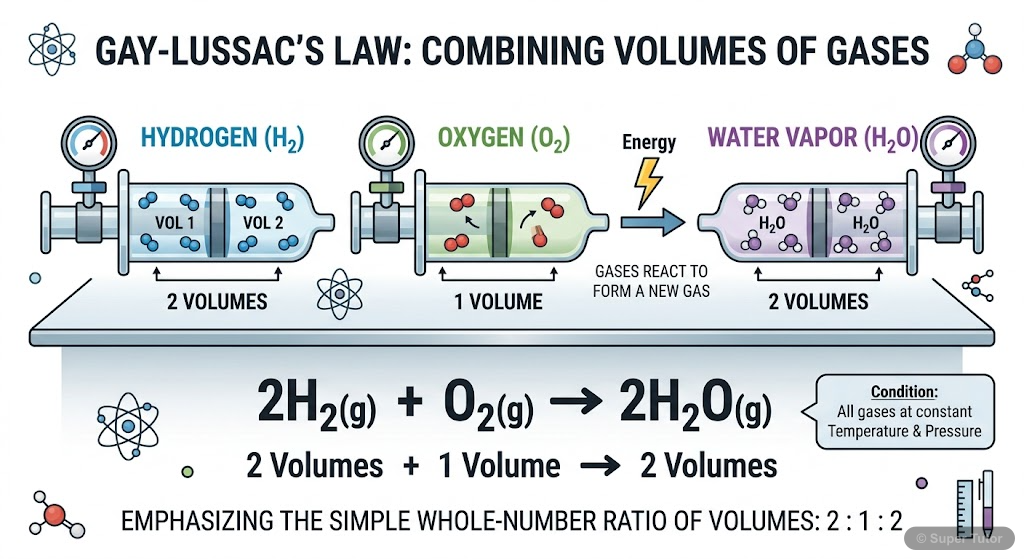
When two or more gases react
When two or more gases react together, their volumes bear simple whole number ratio with one another and to the volume of products, if they are also g
Under identical conditions of temperature
Under identical conditions of temperature and pressure, equal volumes of all gases contain equal number of molecules. This explains why gas volume dep
A mole is the amount
A mole is the amount of any substance which contains as many elementary entities as there are atoms in 12 g of C12. Avogadro's number is 6.023 × 10^23
At STP
At STP, the volume of 1 mole of gas is 22.4 litre. SATP refers to 1 bar pressure and 25°C or 298 K, where 1 mole of gas occupies 24.78 litre.
The molar volume of a gas
The molar volume of a gas is the volume occupied by one mole of the gas at STP. It is 22.4 litres at STP.
Learning Objectives
- Understand the meaning of mole and Avogadro's number
- Use Avogadro's law and Gay Lussac's law for gases
- Relate molar mass, gram atomic mass and gram molecular mass
- Calculate molecular mass and relative atomic mass on the C12 scale
- Distinguish empirical formula from molecular formula
Frequently Asked Questions
What are the important topics in Mole Concept and Stoichiometry for ICSE Class 10 Chemistry?
How to score full marks in Mole Concept and Stoichiometry — ICSE Class 10 Chemistry?
Sources & Official References
Content is aligned to the official syllabus. Refer to the board website for the latest curriculum.
More resources for Mole Concept and Stoichiometry
Practice Quiz
Test yourself with a quick quiz
Important Questions
Practice with board exam-style questions
Revision Notes
Key points for last-minute revision
Formula Sheet
All formulas in one place
Concept Maps
See how topics connect visually
Study Plan
Step-by-step plan to ace this chapter
Flashcards
Quick-fire cards for active recall
Syllabus
What topics to cover
NCERT Solutions
Every textbook question solved step by step
For serious students
Get the full Mole Concept and Stoichiometry chapter — for free.
Quizzes, flashcards, AI doubt-solver and a step-by-step study plan for ICSE Class 10 Chemistry.