Mole Concept and Stoichiometry — Flashcards
ICSE · Class 10 · Chemistry
36 flashcards for Mole Concept and Stoichiometry (ICSE Class 10 Chemistry) to test yourself on key terms and facts. Sample: "What is a mole in chemistry?"
Interactive on Super Tutor
Studying Mole Concept and Stoichiometry? Get the full interactive chapter.
Quizzes, flashcards, AI doubt-solver and a step-by-step study plan — built for flashcards and more.
Free trial, no card needed.
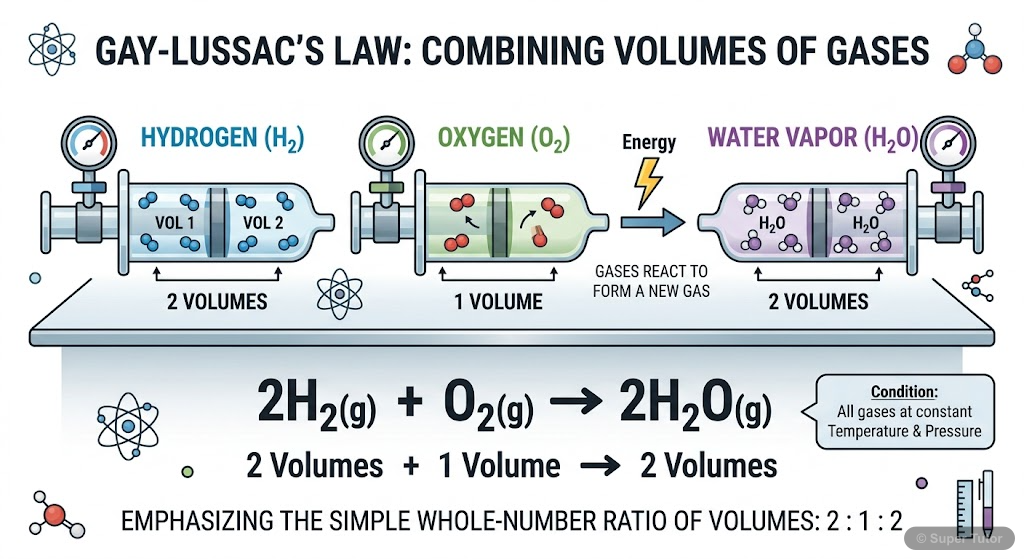
One of 9 illustrations for Mole Concept and Stoichiometry in Super Tutor — alongside flashcards, concept maps and practice questions.
See them allWhat is a mole in chemistry?
Answer
A mole is the amount of any substance which contains as many elementary entities as there are atoms in 12 g of C12. One mole contains 6.023 × 10^23 particles.
What is Avogadro's number?
Answer
Avogadro's number or Avogadro's constant is the number of atoms present in 12 g of C12 isotope of carbon. Value = 6.023 × 10^23. It represents atoms in 1 gram atom, molecules in 1 gram molecule, and i…
State Avogadro's law.
Answer
Under identical conditions of temperature and pressure, equal volumes of all gases contain equal number of molecules. This explains why gas volumes can be compared using mole ratios.
Why is a mole compared to a dozen?
Answer
A dozen means 12 objects. A mole means 6.023 × 10^23 particles. Both are counting units; only the size of the count is different.
What is Gay Lussac's law of combining volumes?
Answer
When two or more gases react together, their volumes bear simple whole number ratio with one another and to the volume of products, if they are also gaseous, provided all volumes are measured under id…
Write the volume ratio for hydrogen and chlorine reacting to form hydrogen chloride.
Answer
Balanced equation: H2(g) + Cl2(g) → 2HCl(g). Volume ratio = 1 : 1 : 2. One volume of hydrogen reacts with one volume of chlorine to give two volumes of hydrogen chloride.
Write the volume ratio for nitrogen and hydrogen reacting to form ammonia.
Answer
Balanced equation: N2(g) + 3H2(g) → 2NH3(g). Volume ratio = 1 : 3 : 2.
What is the atomicity of H2, O2, N2 and Cl2?
Answer
H2, O2, N2 and Cl2 are diatomic molecules. Each molecule contains two atoms.
+28 more flashcards
Practise AllFrequently Asked Questions
What are the important topics in Mole Concept and Stoichiometry for ICSE Class 10 Chemistry?
How many flashcards are available for Mole Concept and Stoichiometry?
How should I revise Mole Concept and Stoichiometry for the ICSE Class 10 board exam?
Sources & Official References
Content is aligned to the official syllabus. Refer to the board website for the latest curriculum.
More resources for Mole Concept and Stoichiometry
Practice Quiz
Test yourself with a quick quiz
Important Questions
Exam-style questions with answers
Revision Notes
Key points for last-minute revision
Formula Sheet
The chapter's formulas in one place
Chapter Summary
Understand the chapter at a glance
Concept Maps
See how topics connect
Study Plan
Step-by-step plan for this chapter
Syllabus
What topics to cover
For serious students
Get the full Mole Concept and Stoichiometry chapter — start free.
Quizzes, flashcards, an AI doubt solver and a study plan for ICSE Class 10 Chemistry. Free to start, no card needed.