Natural Vegetation — Concept Maps
ICSE · Class 10 · Geography
4 concept maps of Natural Vegetation for ICSE Class 10 Geography, each also written out as a text outline. Part of the ICSE Class 10 Geography syllabus.
Interactive on Super Tutor
Studying Natural Vegetation? Get the full interactive chapter.
Quizzes, flashcards, AI doubt-solver and a step-by-step study plan — built for concept maps and more.
Free trial, no card needed.
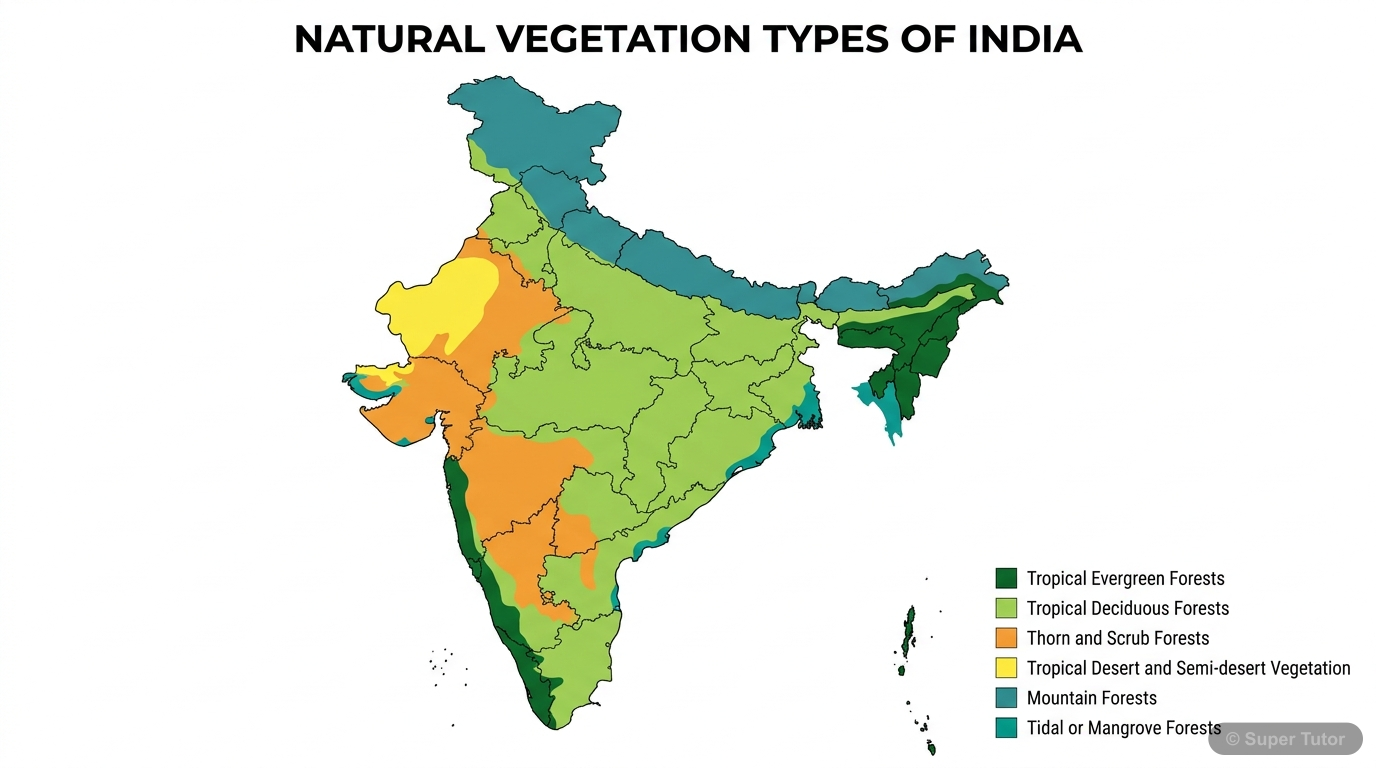
Learn better with visuals Super Tutor pairs illustrations like this with notes and quizzes for Natural Vegetation.
Get startedCorrect vs Incorrect Understanding: Why Are Evergreen Forests Always Green?
The map in words
- Tropical Evergreen Forest
- Why Always Green?
- WRONG Belief: No Tree Ever Sheds Leaves
- Loses Full Marks in Exam
- CORRECT Reason: Different Trees Shed at Different Times
- Forest Appears Green Throughout Year
- No Single Species Sheds Simultaneously
- KEY POINT: Asynchronous Leaf Shedding
- No Single Species Sheds Simultaneously
- Forest Appears Green Throughout Year
- WRONG Belief: No Tree Ever Sheds Leaves
- Why Always Green?
Types of Natural Vegetation in India — Overview
The map in words
- Natural Vegetation of India
- Based on Rainfall
- Tropical Evergreen
- Rainfall over 200cm
- Western Ghats and NE India
- Rosewood and Ebony
- Tropical Deciduous
- Rainfall 150 to 200cm
- Most Commercially Valuable
- Teak and Sal
- Desert Vegetation
- Rainfall below 25cm
- Rajasthan and Kutch
- Babul and Khair
- Thorn and Scrub
- Rainfall below 100cm
- NW India
- Xerophytes
- Tropical Evergreen
- Based on Relief
- Mountain Forests
- Altitude 1500m to 3300m
- Coniferous and Mixed
- Deodar and Pine
- Tidal Mangrove Forests
- Delta and Coastal Regions
- Breathing Roots
- Sundari Tree
- Mountain Forests
- Based on Rainfall
Natural Vegetation of India - Complete Chapter Overview
The map in words
- root((Natural Vegetation
- of India))
- Types of Forests
- Tropical Evergreen
- Rainfall above 200 cm
- Temperature 25 to 27 C
- Western Ghats NE India
- Trees Rosewood Gurjan Shisham
- Tropical Deciduous
- Rainfall 150 to 200 cm
- Temperature 24 to 27 C
- Bihar UP Odisha MP
- Trees Teak Sal Sandalwood
- Desert Vegetation
- Rainfall below 25 cm
- Temperature 25 to 27 C
- Rajasthan Kutch Punjab
- Trees Babul Khair Date Palm
- Thorn and Scrub
- Rainfall below 100 cm
- NW India Rajasthan
- Long roots thorny branches
- Mountain Forests
- Altitude 1500 to 3300 m
- Temperature below 20 C
- Himalayas Nilgiris
- Trees Deodar Chir Pine Fir
- Tidal Mangrove
- Rainfall above 200 cm
- Delta regions estuaries
- Sundarbans East Coast
- Trees Sundari Gorjan Hintal
- Tropical Evergreen
- Environmental Factors
- Rainfall
- Amount and distribution
- Determines vegetation type
- Relief
- Altitude variation
- Windward leeward sides
- Temperature
- Affects growth rate
- Controls leaf shedding
- Soil
- Nutrient content
- Water retention
- Rainfall
- Forest Products
- Timber and Wood
- Fuel and Energy
- Industrial Raw Material
- Gums Resins Lac
- Medicinal Herbs
- Wildlife Habitat
- Conservation Methods
- Afforestation
- Reafforestation
- Van Mahotsava 1950
- Social Forestry
- Agroforestry
- Silviculture
- Fire Line
- Chipko Movement 1974
- National Forest Policy
- Since 1894
- Target 33 percent cover
- Biodiversity conservation
- Community participation
- Sustainable management
- Types of Forests
Natural Vegetation of India
The map in words
- Natural Vegetation of India
- Importance of forests
- Factors affecting distribution
- Forests based on variation of rainfall
- Forests based on variation of relief
- Forest conservation
- National Forest Policy
- Forest products and uses
- Tropical Evergreen Forests
Explore these maps interactively
Explore DiagramsFrequently Asked Questions
What are the important topics in Natural Vegetation for ICSE Class 10 Geography?
What do the concept maps for Natural Vegetation show?
How should I revise Natural Vegetation for the ICSE Class 10 board exam?
Sources & Official References
Content is aligned to the official syllabus. Refer to the board website for the latest curriculum.
More resources for Natural Vegetation
Practice Quiz
Test yourself with a quick quiz
Important Questions
Exam-style questions with answers
Revision Notes
Key points for last-minute revision
Chapter Summary
Understand the chapter at a glance
Study Plan
Step-by-step plan for this chapter
Flashcards
Quick-fire cards for active recall
Syllabus
What topics to cover
For serious students
Get the full Natural Vegetation chapter — start free.
Quizzes, flashcards, an AI doubt solver and a study plan for ICSE Class 10 Geography. Free to start, no card needed.