Natural Vegetation
ICSE · Class 10 · Geography
Summary of Natural Vegetation for ICSE Class 10 Geography. Key concepts, important points, and chapter overview.
Interactive on Super Tutor
Studying Natural Vegetation? Get the full interactive chapter.
Quizzes, flashcards, AI doubt-solver and a step-by-step study plan — built for chapter summary and more.
1,000+ Class 10 students started this chapter today
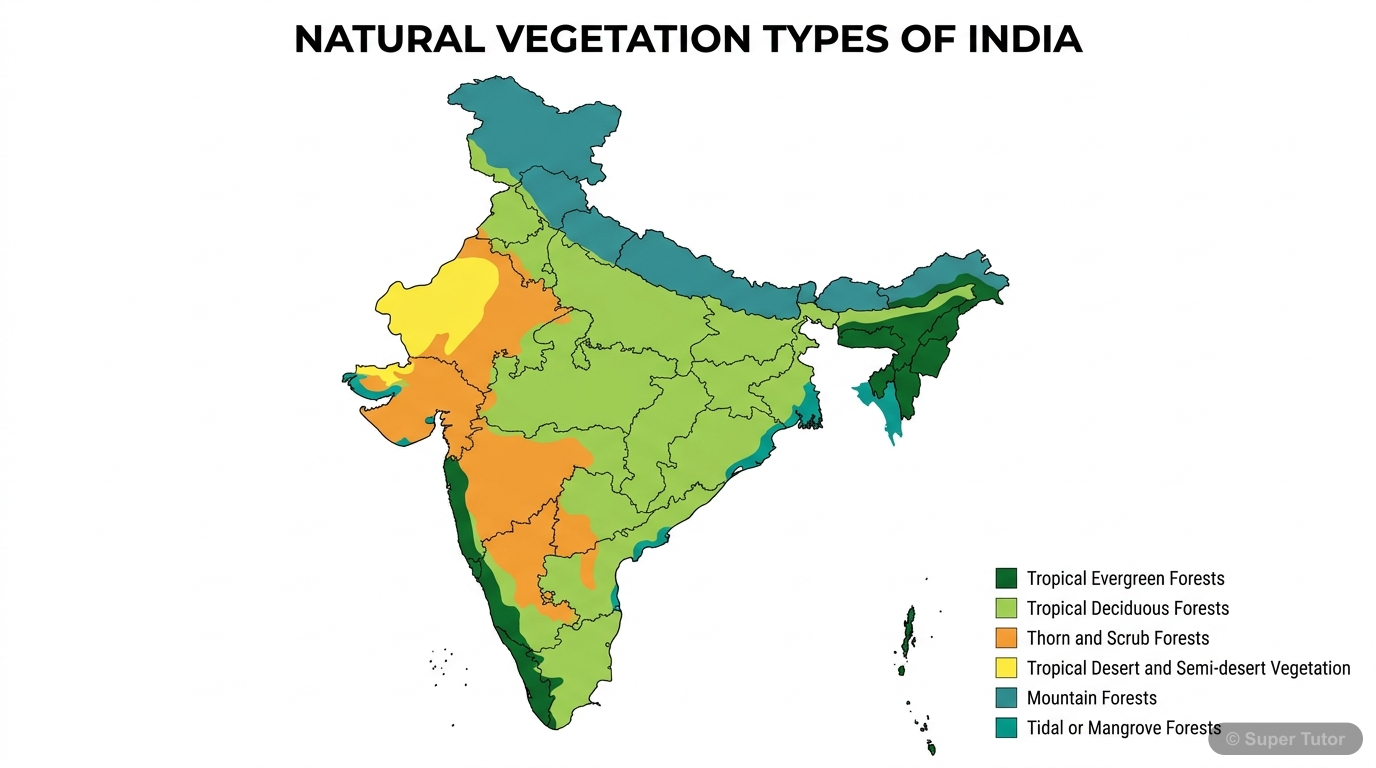
Learn better with visuals Super Tutor has hundreds of illustrations like this across every chapter — all free to try.
Get startedOverview
Natural vegetation grows naturally without human help and changes according to climate, relief, and rainfall. In India, forests are a major natural resource because they support wildlife, maintain ecological balance, reduce pollution, prevent soil erosion, and provide timber, fuel, fruits, fibres, a
Key Concepts
Natural vegetation refers to plants
Natural vegetation refers to plants that grow naturally in an area without being planted by humans. Their distribution depends mainly on climate, soil
Many forest types are grouped according
Many forest types are grouped according to rainfall conditions. Tropical evergreen forests, deciduous monsoon forests, desert and semi-desert vegetati
Mountain forests and tidal or mangrove
Mountain forests and tidal or mangrove forests are grouped under variation of relief. Their growth depends on altitude or coastal delta conditions.
These forests occur where rainfall
These forests occur where rainfall is more than 200 cm and temperature is 25°C to 27°C. They are also called rain forests because they grow in areas o
These forests grow in areas
These forests grow in areas with rainfall between 150 cm and 200 cm and temperature between 24°C and 27°C. Trees shed leaves for about 6-8 weeks in sp
Learning Objectives
- Understand the meaning and importance of natural vegetation
- Identify the main factors controlling the distribution of forests in India
- Classify the major forest types based on rainfall and relief
- Learn the climatic conditions, features, and uses of each forest type
- Recognize important tree species and their economic value
Frequently Asked Questions
What are the important topics in Natural Vegetation for ICSE Class 10 Geography?
How to score full marks in Natural Vegetation — ICSE Class 10 Geography?
Sources & Official References
Content is aligned to the official syllabus. Refer to the board website for the latest curriculum.
More resources for Natural Vegetation
Practice Quiz
Test yourself with a quick quiz
Important Questions
Practice with board exam-style questions
Revision Notes
Key points for last-minute revision
Formula Sheet
All formulas in one place
Concept Maps
See how topics connect visually
Study Plan
Step-by-step plan to ace this chapter
Flashcards
Quick-fire cards for active recall
Syllabus
What topics to cover
NCERT Solutions
Every textbook question solved step by step
For serious students
Get the full Natural Vegetation chapter — for free.
Quizzes, flashcards, AI doubt-solver and a step-by-step study plan for ICSE Class 10 Geography.