Work, Energy and power — Important Questions
ICSE · Class 10 · Physics
43 important questions from Work, Energy and power for ICSE Class 10 Physics, with answers. Written for the board exams 2027.
Interactive on Super Tutor
Studying Work, Energy and power? Get the full interactive chapter.
Quizzes, flashcards, AI doubt-solver and a step-by-step study plan — built for important questions and more.
Free trial, no card needed.
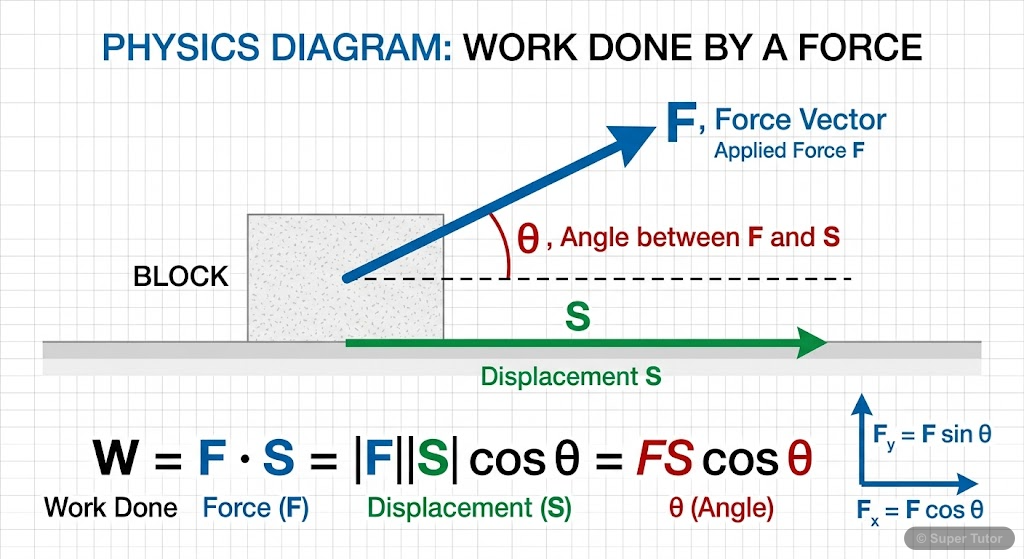
One of 16 illustrations for Work, Energy and power in Super Tutor — alongside flashcards, concept maps and practice questions.
See them allImportant Questions from Work, Energy and power
Which of the following are examples of kinetic energy?
Show answer
A moving car, A bullet fired from a gun, A rolling ball
Kinetic energy is possessed by objects in motion. A moving car, bullet fired from gun, and rolling ball all have kinetic energy. A book on shelf has potential energy due to height, and stretched rubber band has elastic potential energy.
The formula for kinetic energy is KE = ½mv².
Show answer
True
Kinetic energy is the energy possessed by a body due to its motion, and its expression is derived from the work done by a retarding force in bringing a moving body to rest. This derivation gives K = ½mv², where m is mass and v is velocity, confirming the statement as true.
Which forms of energy are types of mechanical energy?
Show answer
Kinetic energy, Potential energy
Mechanical energy consists of only two types: kinetic energy (due to motion) and potential energy (due to position or configuration). Heat, light, and chemical energy are other forms of energy.
When does work done become negative?
Show answer
When force opposes displacement
Work done is negative when force opposes displacement (θ = 180°). Examples include friction force and gravitational force on upward motion. When θ = 90°, work is zero, and when displacement is zero, work is also zero.
+39 more questions on Work, Energy and power (ICSE Class 10 Physics)
Practise AllFrequently Asked Questions
What are the important topics in Work, Energy and power for ICSE Class 10 Physics?
How many important questions are there in Work, Energy and power?
Sources & Official References
Content is aligned to the official syllabus. Refer to the board website for the latest curriculum.
More resources for Work, Energy and power
Practice Quiz
Test yourself with a quick quiz
Revision Notes
Key points for last-minute revision
Formula Sheet
The chapter's formulas in one place
Chapter Summary
Understand the chapter at a glance
Concept Maps
See how topics connect
Study Plan
Step-by-step plan for this chapter
Flashcards
Quick-fire cards for active recall
Syllabus
What topics to cover
For serious students
Get the full Work, Energy and power chapter — start free.
Quizzes, flashcards, an AI doubt solver and a study plan for ICSE Class 10 Physics. Free to start, no card needed.